Pi Network vs Traditional Crypto Mining: Comparing Two Models

Pi Network vs Traditional Crypto Mining: What Beginners Should Know
Crypto mining once meant a computer humming in a corner. Today it can also mean tapping a button on a phone. Both are called "mining", yet they work in very different ways.
This guide explains Pi Network vs traditional crypto mining step by step, using official sources. It suits anyone starting with crypto mining for beginners and wondering which model is real, cheap or safe.
Key Takeaways
Pi mining runs on a phone app. It rewards participation, not puzzle-solving.
Traditional mining is proof of work. Bitcoin, Litecoin and Monero all pay miners for computing effort.
The words overlap, the methods do not. Pi's own whitepaper says it defines mining more broadly than proof of work.
What Is Pi Network Mining?
Pi Network mining is the process of earning Pi through a free mobile app. According to the official homepage, joining needs an invitation from an existing trusted member. The site also calls the app energy-light and says it does not drain the battery.
That answers a common question: does Pi Network mining drain battery? Pi says no. Independent testing is still a good idea for anyone who is unsure.
Source: official Pi website
How Pi Network Mining Works
Pi mining works through a daily check-in. Users confirm they are real people, and the network issues new Pi to active participants. No mining rig is involved, so it is mining without hardware in the usual sense.
The whitepaper lists four roles. One person can hold several.
Role | What it does |
Pioneer | Confirms daily that they are not a robot |
Contributor | Lists trusted people to build a trust graph |
Ambassador | Brings new users into the network |
Node | Runs the Pi node software on a computer |
Behind the app sits the Stellar Consensus Protocol. This consensus mechanism relies on nodes voting, not racing to solve puzzles. The whitepaper says it avoids energy waste, though it needs many network messages. Node operators act much like validators, because they help confirm transactions.
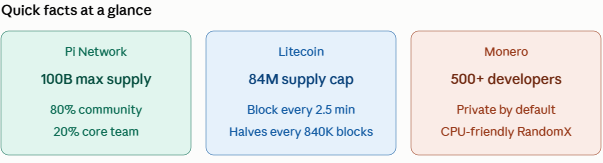
Mined Pi moves to the mainnet only after KYC verification. The roadmap says the Enclosed Mainnet began on December 28, 2021. The mainnet token model sets a maximum supply of 100 billion Pi, split 80% to the community and 20% to the core team.
Source: official whitepaper
What Is Traditional Crypto Mining?
Traditional crypto mining uses proof of work mining. Miners compete to solve a computing puzzle. The winner adds the next block and earns the block rewards.
Strength is measured in hash rate, which means guesses per second. More hash rate gives better odds, so serious miners need a mining rig. That is also why energy consumption is high. Pi's whitepaper calls the system very secure but says it effectively burns money to prove honesty.
Two coins show how different this world can be.
Litecoin Mining: The Lighter Cousin
Litecoin is built on Bitcoin's code, with three key changes. It uses the Scrypt algorithm instead of SHA-256. Blocks arrive about every 2.5 minutes, not 10. The supply cap is 84 million coins, four times Bitcoin's.
Scrypt is more memory-intensive. In the early years, that let ordinary graphics cards mine Litecoin, which lowered the barrier compared with ASIC-dominated Bitcoin. Rewards started at 50 LTC and halve every 840,000 blocks. Difficulty adjusts every 2,016 blocks, about every 3.5 days, to keep block timing steady.
Many people call it the silver to Bitcoin's gold. It keeps the same proof-of-work idea but aims for faster, cheaper payments.
Source: Litecoin website
Monero Mining: Proof of Work With Privacy
Monero also relies on proof of work. Its big difference is privacy. The official site notes that Bitcoin and Ethereum have transparent blockchains where transactions can be traced. Monero hides the sender, receiver and amount of every transaction using stealth addresses, ring signatures and RingCT.
Because all transactions are private, no coin can be flagged as tainted. The project calls this a true fungible currency. More than 500 developers have contributed since launch.
On the mining side, the official page links pool lists, CPU and GPU hashrate benchmarks and mining software. It warns that some miners charge developer fees. It also says the Monero Project does not endorse any pool, software or hardware. Its RandomX algorithm is designed to run on ordinary CPUs.
Source: official Monero documentation
Pi Network vs Traditional Crypto Mining: The Real Difference
The table below puts all three side by side.
Factor | Pi Network | Litecoin | Monero |
Method | Daily check-in | Proof of work (Scrypt) | Proof of work (RandomX) |
Hardware | Phone; optional node on a computer | GPUs at first, then Scrypt rigs | CPUs |
Energy use | Described as light | Proof-of-work level | Proof-of-work level |
Reward style | Shared daily among active users | One winner per block | One winner per block |
Entry cost | Free, invitation, KYC for mainnet | Hardware plus power | Hardware plus power |
Standout trait | Trust graph of Security Circles | 84 million supply cap | Private by default |
The Pi Network mining vs traditional mining difference is clearest on rewards. Pi calculates rewards once a day and shares them among active participants. In proof of work, one miner wins each block, which is why miners join pools. Pi says it needs no pools.
In short, proof of work vs Pi mining is computing power against contribution. For beginners, mobile crypto mining is the easier door. Hardware-based mining asks for money, space and power first.
Is Pi Network Mining Real? Is It Safe?
Is Pi Network mining real? The whitepaper defines mining as receiving newly minted currency for contributions. That is broader than proof of work. So the rewards are real in design, but the activity is not the same as Litecoin or Monero mining.
On safety, the official materials are clear. Pi says it has no ICO and runs no crowdfunding sale. It says mined Pi can only be claimed inside the Pi app through the mainnet dashboard, and any site asking otherwise is fake.
Is Pi Network mining safe? Sticking to official channels is the best protection. Note also that the roadmap page is marked as a legacy version and is no longer updated. The whitepaper itself says its original content may need updates, so readers should check the latest official communications.
Which Model Suits Whom?
Mobile crypto mining suits people who want a beginner-friendly crypto entry with no hardware spend. Bitcoin and Litecoin suit those who can fund rigs and power. Monero suits those who prefer CPU mining and privacy. Each carries its own risks.
Final Thoughts
Pi Network vs traditional crypto mining is a comparison of two ideas: a phone-based participation model and a hardware-based race. Neither is simply better. Readers should match the model to their budget, patience and risk limit, and verify every claim on official sites.
Disclaimer: This article is for information only and is not financial advice. Crypto is volatile, and losses are possible.









.webp)