Polygon News Today: Could Another POL Burn Change the Supply Story?


Polygon News Today: Is Another POL Burn Already Loading?
Polygon news today comes from co-founder Sandeep Nailwal, who says 22 million more POL is lined up for the next stage of burn. He puts that at about 0.20% of supply.
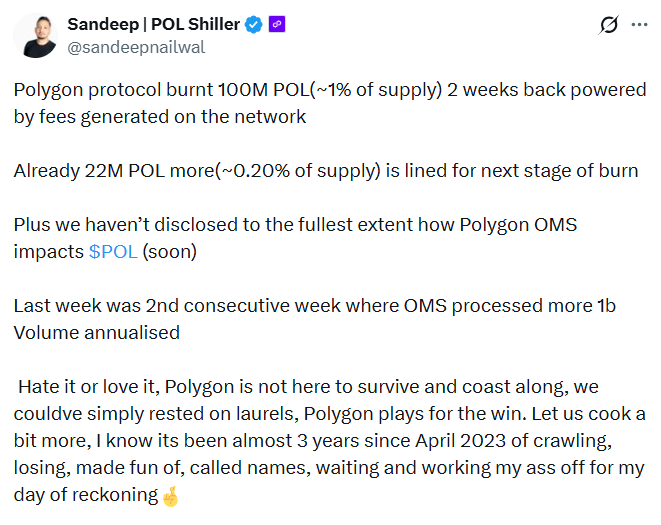
Source: Sandeep Nailwal Post on X
The post arrives weeks after Polygon removed 100 million $POL from circulation. Nailwal also hinted that the Open Money Stack will affect POL more than the market currently sees, with details promised soon.
How Big Was the First Polygon Token Burn?
Polygon confirmed the first supply reduction on September 23, 2026. The transaction removed 100 million $POL, roughly 1% of supply, and the PolygonScan transaction shows it as successful.
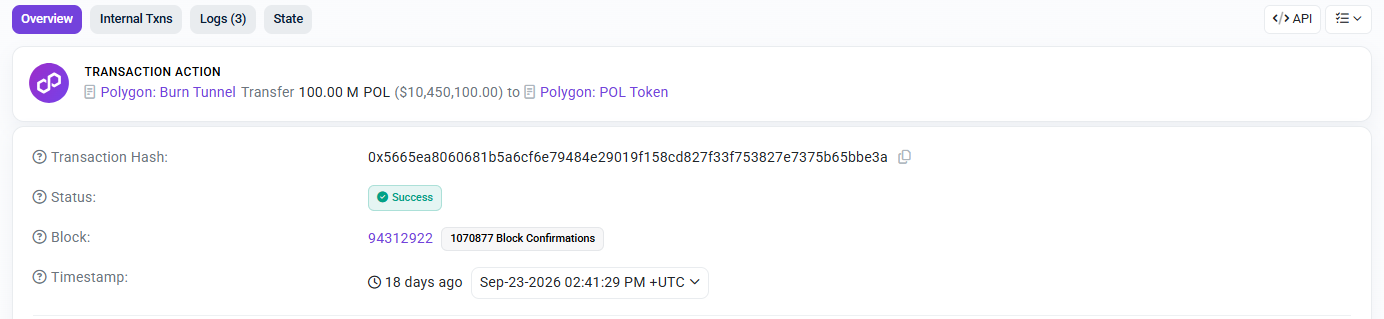
Nailwal says the burn was powered by fees generated on the network. Earlier, he put the fee collector balance near 121 million POL, which left about 21 million after the 100 million POL burn. These Polygon network fee figures come from his statements, not an independent audit.
The new post does not say where the 22 million $POL sits or when it will supply reduction. Quarterly, community-triggered burns were part of the earlier plan, but no date has been set.
Why Does 22M POL Matter for Supply Reduction?
At roughly $0.10 per $POL on market trackers on October 12, 22 million tokens equal about $2.2 million. That is a simple calculation, and the price moves daily. The size is small next to the first supply reduction.
The bigger signal is repetition. Base fees keep landing in the collector, and burns can follow. This is the core of the Polygon supply reduction story in Polygon crypto news this week.
Nailwal says POL has been deflationary since January 2026. POL still carries a 2% yearly emission, close to 200 million tokens on the original 10 billion supply. The first supply reduction alone covers about half of that yearly issuance. Net supply depends on several quarters of burns, and the post gives no net figure.
Can the Open Money Stack Feed the Next Burn?
The second claim in today's Polygon news concerns OMS. Nailwal says last week was the second straight week where OMS processed more than 1 billion in annualized volume. He gave no currency, dashboard, or breakdown. That makes it a project claim, not verified data.
The Polygon Open Money Stack is Polygon's stablecoin payments platform, announced in January 2026. It combines wallets, compliance tools, fiat access, and settlement on Polygon Chain.
The unveiling drew a visible POL price reaction at the time, though price moves since then depend on wider market conditions.
The rest of the post is sentiment. Nailwal says Polygon plays for the win and refers to years of criticism since April 2023. It adds no new numbers.
Expert Take: What to Watch Before the Next $POL Burn
The data suggests the supply reduction is turning into a recurring process rather than a one-time event. Three numbers matter next: the date of the next supply reduction, the collector balance, and the net supply after emissions.
The main uncertainty remains the OMS figure. Without a unit or a public source, it cannot be tied to fee revenue yet. A larger burn also does not guarantee a higher $POL price, since demand and broader crypto conditions still set the market.
Conclusion
Polygon news today points to a second burn stage, with 22 million $POL queued after the 100 million supply reduction. The OMS volume claim adds a payments angle that still lacks independent confirmation.
The next confirmations would be on-chain, through a burn transaction and updated supply data. This Polygon latest news also sits within a wider run of crypto news today around stablecoins and payments.
Disclaimer: This article is for information only and is not financial advice. Crypto assets are volatile and carry a risk of loss. Token burns do not guarantee price gains.









