Squid Router Listing Price Prediction: QUID TGE Across Exchanges Today


Squid Router just went from a quiet cross-chain tool to one of the most talked about tokens on crypto Twitter.
The Squid Router listing conversation is heating up fast because $QUID is not launching on one platform today; it is launching on four at once.
That kind of simultaneous rollout rarely happens for a fresh token generation event, and traders want to know what it means for price.
Squid Router listing price prediction points to a volatile TGE day as $QUID debuts on Binance Alpha, Bitget, Kraken, and PancakeSwap on August 4.
Analysts expect sharp early swings driven by claim unlocks and thin order books before price finds a base once trading volume normalizes.
Key Takeaways
QUID trading goes live August 4 across Binance Alpha, Bitget, Kraken and PancakeSwap on Base
Legion app users can claim $QUID tokens directly once the TGE goes live
Squid Router listing price prediction models point to high early volatility on thin liquidity
What Is Squid Router (QUID), and Why Is It Trending Today?
Squid Router is a cross-chain application that lets users swap, bridge, and send tokens across more than 100 networks in a single transaction, removing the need to manually bridge assets between chains.
The project's native token, QUID, powers this infrastructure, and today marks its Token Generation Event, commonly called TGE, the point where a project's tokens first become tradable or claimable by the public.
The timing matters. Multiple exchanges syncing a listing on the same day usually signals coordinated marketing and deep liquidity commitments, both of which tend to concentrate trading activity into a short window.
Where Is $QUID Listing Today Across Multiple Exchanges?
Here's a quick snapshot of where and when QUID goes live today:
Platform | Access Type | Timing (Aug 4) |
Airdrop claim via Alpha Points | Trading opens once claims open | |
Bitget | QUID/USDT spot pair | |
Kraken | Spot listing | Trading live 1PM UTC |
PancakeSwap (Base) | DEX swap and liquidity | Live same day |
Legion app | Direct token claim | Live same day |
Each platform is handling the same-day rollout differently: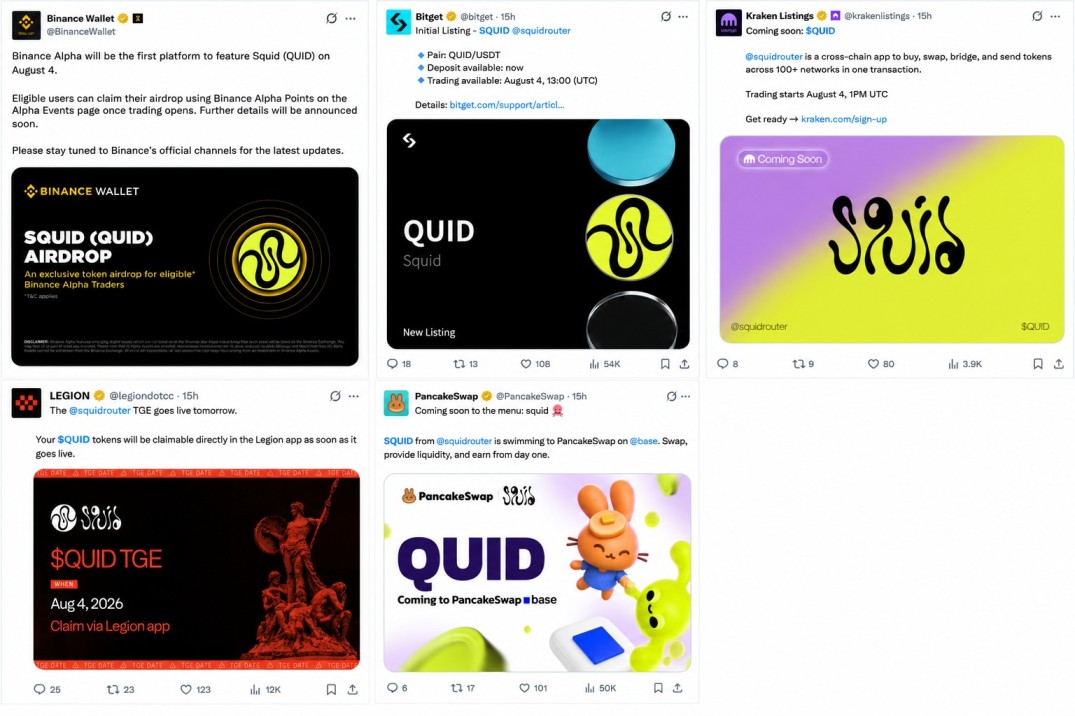
Binance Alpha: First to feature the airdrop, claimable via Alpha Points once claims open
Bitget: Deposits opened ahead of its 13:00 UTC trading window
Kraken: Teased a day earlier, confirmed trading from 1PM UTC
PancakeSwap: Bringing $QUID to Base for swaps and liquidity
Legion: Direct claims for its own users, no exchange routing needed
Squid Router Listing Price Prediction: What Could QUID Price Do Next?
No live trading price exists yet, so this QUID price prediction uses the $0.045 public sale price as its baseline rather than a settled market number.
Scenario | Price Range | Assumption |
Bear Case | $0.03 - $0.045 | Airdrop recipients across all four venues sell early |
Base Case | $0.06 - $0.10 | Volume spreads evenly, price stabilizes within days |
Bull Case | $0.12 - $0.20 | Cross-chain narrative and multi-exchange liquidity pull demand |
Methodology: ranges assume no exchange delays and no unexpected unlock changes.
Invalidation: The bear case fails if volume stays elevated for 48 hours without price falling toward $0.03-$0.045; the bull case fails if price can't clear $0.10 within 24 hours on two or more venues.
Why Are Analysts Making This Squid Router Price Prediction?
New listings that span multiple exchanges on day one tend to fragment liquidity rather than concentrate it, which is why the base case leans toward choppiness instead of a clean directional move.
Airdrop claimants, particularly those who received tokens through Binance Alpha Points, are historically quick to take profit, which supports the bear case risk.
On the other side, the project's existing cross-chain utility gives it a use case beyond pure speculation, which is the main argument behind the bull case.
Is This TGE a Bullish Catalyst for QUID Price?
A multi-exchange TGE is generally viewed as a positive signal because it reflects exchange due diligence and expected trading demand.
Bitget, Kraken, PancakeSwap, and Binance Alpha all listing QUID within the same 24-hour window suggests coordinated timing rather than opportunistic piggybacking.
That said, a busy listing day also means attention gets split, and price discovery across five separate venues, including Legion's claim portal, can take longer to settle than a single-exchange debut.
What Are the Risks to This Squid Router Listing Price Prediction?
Presale and TGE figures around claim eligibility and allocation size are project-self-reported and have not been independently verified by CoinGabbar. Traders should also note that thin early liquidity on any single venue can produce misleading price prints that do not reflect the token's broader market.
Expert Opinion: What Does the Squid Router Listing Mean for QUID?
According to a CoinGabbar analyst, the simultaneous multi-exchange approach gives QUID more organic price discovery than a single-listing launch typically allows, though it also raises the odds of a volatile first 48 hours as liquidity settles across venues.
The analyst notes that QUID's medium-term trajectory will likely depend more on actual cross-chain transaction volume than on TGE-day price action alone.
CoinGabbar has no sponsorship or affiliate relationship with $QUID, Binance, Bitget, Kraken, PancakeSwap, or Legion, and this article is not financial advice.
Disclaimer: This article is for informational purposes only and should not be considered financial, investment, or trading advice. Cryptocurrency markets, including newly listed tokens like QUID, are highly volatile and speculative. Always conduct independent research before making any investment decisions.