Romance Scam USDT: $456K Case Exposes Dating-to-Crypto Trap

Romance Scam USDT: How a Dating Chat Turned Into a $456K Crypto Case
A new romance scam USDT case has reached a US federal court.
On November 9, 2026, the US Attorney’s Office for the District of Massachusetts announced a civil forfeiture action to recover 456,602 USDT, a dollar-linked token also known as Tether.
Prosecutors say the money came from fraud schemes that began on online dating sites and Facebook.
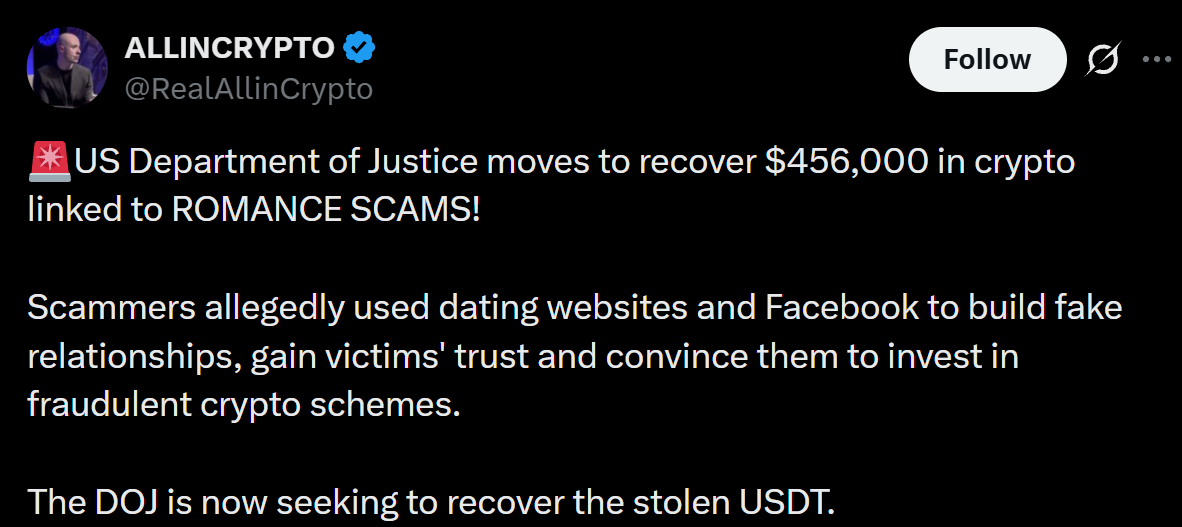
Source: Post on X
What Did the US Attorney’s Office Announce?
According to the official press release, prosecutors filed a civil forfeiture action to recover those tokens, which had an estimated value of about $456,602.
The money is described as alleged proceeds of romance fraud schemes aimed at people in Massachusetts and elsewhere.
The court complaint was filed on November 9, 2026, in the US District Court for the District of Massachusetts under case number 1:26-cv-15037.
The announcement came from US Attorney Leah B. Foley and Ted E. Docks, Special Agent in Charge of the FBI Boston Field Office.
Assistant US Attorney Carole E. Head, who leads the Asset Recovery Unit, is handling the matter. The announcement adds that all details in the complaint are allegations.
Key Case Facts in One Table
The table below pulls the main points from the press release and the court complaint.
Item | Detail |
Announced by | US Attorney’s Office, District of Massachusetts |
Date | November 9, 2026 |
Type of action | Civil forfeiture, where the property itself is named |
Amount | 456,602 Tether tokens (about $456,602) |
Where victims were approached | Online dating sites and Facebook |
Wallets involved | Two cryptocurrency wallets |
Case number | 1:26-cv-15037 |
Status | Allegations, with third-party claims to be resolved first |
How Did the Romance Scam USDT Scheme Work?
As alleged in the complaint summary, the scheme followed six steps:
Contact: scammers approached people on online dating sites and Facebook.
Trust: they cultivated a relationship of trust online.
Introduction: victims were introduced to cryptocurrency and urged to invest on fake platforms.
False hope: victims believed they were sending money to a real platform and earning profits.
Hidden wallets: the money actually went to unhosted wallets, meaning wallets not held on an exchange.
The trap: withdrawals failed, even after victims paid extra for so-called fees and taxes.
Only then did victims realize it was a scam. The proceeds were later traced to two wallets and seized by authorities.
Why Does Tether Matter in This Case?
The complaint explains that USDT, also known as Tether, is a stablecoin. Each token is worth about one US dollar, and payments made with it are recorded on a blockchain network.
The same document says the company Tether International manages the smart contracts and the treasury, which is the reserve of funds behind the tokens.
This romance scam USDT case shows how a fake investment platform can look real to a victim.
Victims believed their money was earning profits, yet it had actually been sent to wallets not hosted on an exchange.
What Happens Next and How to Stay Safe
A civil forfeiture action targets the property itself, not a person. The statement explains that outside parties may assert claims to the property, and those claims must be resolved before the funds can be forfeited to the United States and returned to victims.
This means recovery is a process, not an instant result.
The announcement names two types of federal violations behind the action:
Wire fraud: using wire communications as part of a scheme to defraud or to obtain money by false pretenses. Property traceable to such fraud can be forfeited.
Concealment: carrying out a financial transaction designed to hide the nature, source, ownership or control of criminal proceeds.
The statement says this is one of several civil forfeiture actions filed for cryptocurrency traced to fraud against Massachusetts victims.
The pattern in this case also gives readers clear warning signs:
A new online partner who steers the talk toward crypto investing
A platform that shows profits but blocks withdrawals
Requests for extra fees or taxes before you can withdraw
Instructions to send money to a wallet that is not on an exchange
Conclusion
In short, this romance scam USDT case shows how trust built online can be turned into a fake investment trap and how authorities are now working to trace and recover the money.
Be careful with anyone you meet online who pushes you toward a crypto investment.
Disclaimer
This article is for educational and informational purposes only and is not financial or investment advice. Crypto assets are high risk, their prices can be very volatile, and you can lose some or all of your money. Always do your own research and consider speaking with a licensed financial advisor before making investment decisions.






