Russia Crypto Trading Rules: How the 300,000-Ruble Cap Works


Russia Crypto Trading Rules: The 300,000-Ruble Cap Explained
Russia has opened a small door for everyday buyers. The new Russia crypto trading rules cap what most people can buy, and two dates keep getting mixed up. Here's what the Bank of Russia confirms and what reports add.
What Did Russia's Central Bank Approve for Retail Trading?
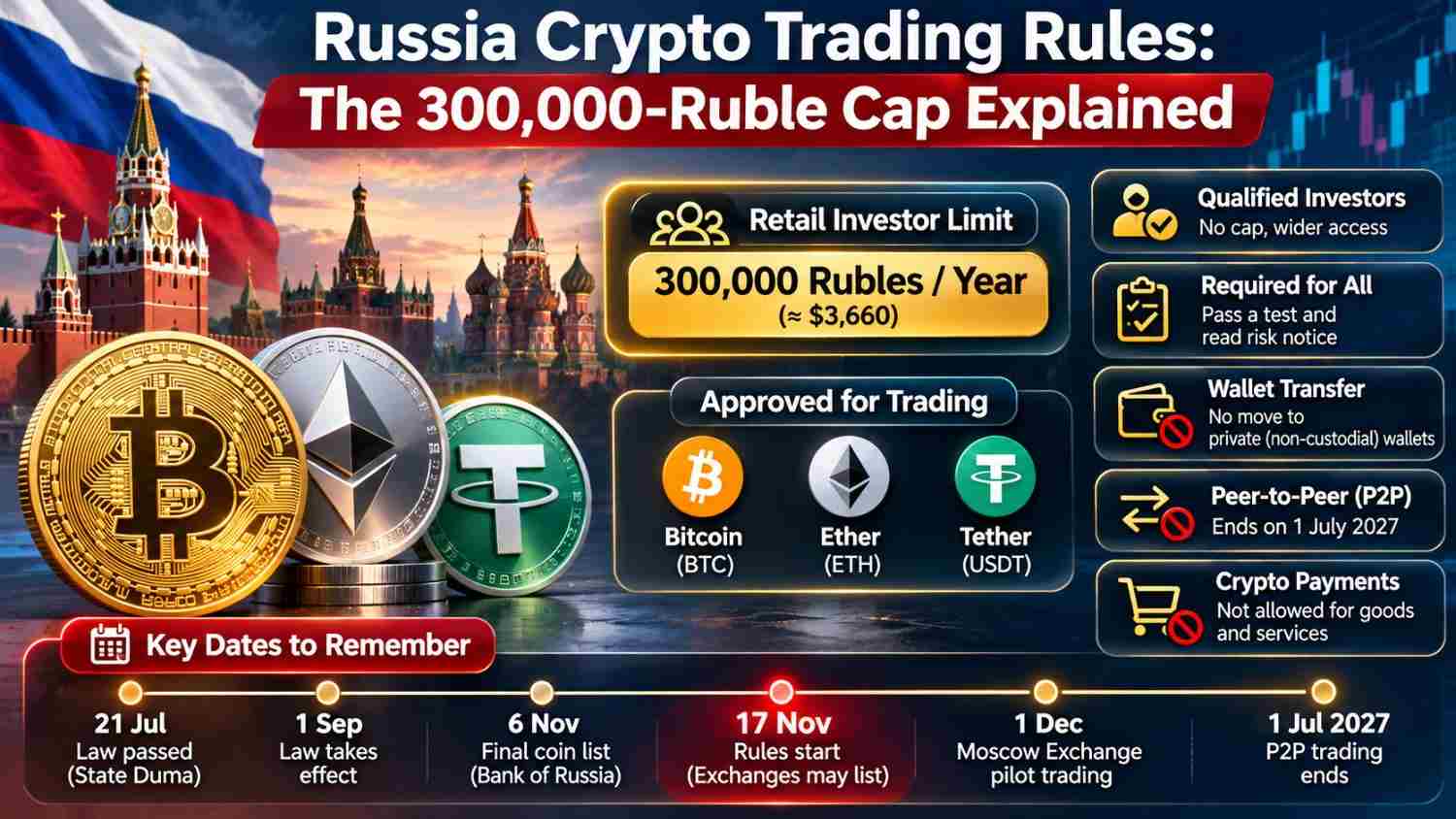
Per Anadolu Agency, the Bank of Russia published its final list of coins on 6 November 2026. They are Bitcoin (BTC), Ether (ETH), and Tether (USDT), and they can trade on Russian exchanges under the Russian crypto trading rules.
Anadolu also says USDT sits in the same list as a "foreign digital instrument," and that the regulation takes effect on 17 November. We couldn't verify either on the bank's own site. For background, read our Russia crypto law explainer.
Non-qualified (retail) investors, meaning ordinary buyers who aren't professionals, get only the most traded coins. Anadolu says the bank's criteria include market capitalization, average daily trading volume, and at least five years of price history on foreign platforms.
Why Are November 17 and December 1 Both Important Dates?
They're two different events. One is a rule date. The other is a trading start.
Date | What happens |
21 Jul | The State Duma passes the law, per the Bank of Russia. |
1 Sep | The law takes effect, per the Bank of Russia. |
6 Nov | The Bank of Russia publishes the final coin list, per Anadolu. |
17 Nov | Regulation takes effect, per Anadolu |
1 Dec | Moscow Exchange's planned start, with pilot trades |
1 Jul 2027 | Licensing transition ends, per the Bank of Russia. |
17 November doesn't mean everyone can buy that day. Reports say it means only that exchanges may list the coins from that date.
The Moscow Exchange says 1 December is its planned start. It will begin with pilot trades.
How Does the 300,000-Ruble Cap Work for Retail Investors?
Under the Russia crypto trading rules, non-qualified retail buyers can spend up to 300,000 rubles a year on crypto. The Bank of Russia says this applies to the most liquid coins, via one intermediary, after a test. The limit runs per calendar year, not per trade.
The bank's wording, "via one intermediary," reads as a per-broker cap. Its page doesn't say whether buying through several brokers is allowed or how that would be tracked.
Reports add that past buys and open orders count. For the news side, see our Russia Bitcoin trading news.
Which Russia Crypto Trading Rules Apply to Qualified Investors?
The Bank of Russia's page says qualified investors can trade any cryptocurrencies, and it describes no amount limit for them. They must also pass the test, according to the bank's page.
The reports we read don't say how to become one. Ask your broker whether you qualify before you assume you do.
Reports add that they can trade on exchanges or over the counter.
What Do You Need Before You Can Buy Crypto in Russia?
First, you take a test and read the risks of crypto. The Bank of Russia says every buyer must pass it, qualified or not. No report gives a date for when testing opens.
Second, you need an approved firm. Reports list brokers, asset managers, crypto exchange offices, and trust managers.
Firms have until 1 July 2027 to get licenses, per the bank's page, so some may not be ready yet. CoinGabbar covered the exchange license window earlier.
How Will the Moscow Exchange Pilot Work in Practice?
The exchange says it will use its stock market tech. Trades are reported to clear through the National Clearing Centre.
Reports give hours of 06:50 to 23:50 Moscow time, a 17-hour day. That matches the stock market, but crypto hours may differ.
Neither the Bank of Russia nor the exchange says which brokers will be ready for the pilot. Earlier plans are in our Moscow Exchange crypto plans report.
What Are Russia's Limits on Wallets and Peer-to-Peer Deals?
One report says direct peer-to-peer deals between people end on 1 July 2027. That date matches the end of the bank's licensing transition, but we couldn't confirm the ban itself.
The same report says you can't move crypto from a licensed account to your own wallet. That's a non-custodial wallet, where you hold the keys yourself.
The Bank of Russia does say paying with crypto inside Russia stays banned. The wallet and peer-to-peer points are reported only.
How Can You Check the Facts Before Acting on the News?
The Bank of Russia provides us info about the cap, the test, and the payment ban. It doesn't list the coins or the 17 November date. The bank's Russian-language notice for non-qualified investors may list the coins and the date, so check it too.
Then run a quick check:
Match each date to its meaning: rule start or trading start.
Ask your broker whether it is licensed and ready.
Ask your broker how it counts the cap, including open orders.
Read the test and risk notice in full.
Treat any headline that says trading is unlimited with doubt.
What Are the Risks and Limits of the New Rules?
The Russia crypto trading rules come with real limits. The cap is small, which limits how much you can buy.
Reports don't mention fees, and they don't say whether each coin will be easy to sell.
They also don't say whether USDT holders get bank-style deposit cover. Prices can swing hard, and a stablecoin can lose its peg.
Expert Opinion: What Do These Rules Mean for Crypto Users?
CoinGabbar analysis suggests the Russia crypto trading rules are a narrow, licensed entry point, not an open market. A small yearly cap and a staged start point to a slow ramp-up.
The clearest gain is clarity. Buyers know which coins count, what the cap is, and which dates matter. The gaps are in the details. Licenses, fees, and test dates are still unclear.
Disclaimer: This article is for information only. It isn't financial or investment advice. Crypto carries risk, prices can be affected and manipulated, and rules can change.
















