


Bitcoin price pressure returned on November 25 after the US Trade Representative (USTR) proposed Section 301 tariffs on 14 economies. The plan is a proposal, not law. No new duty is in effect. USTR will take public comments until January 5, 2027. As per coinmarketcap Bitcoin fell to about $57,500 that day as stocks sold off.
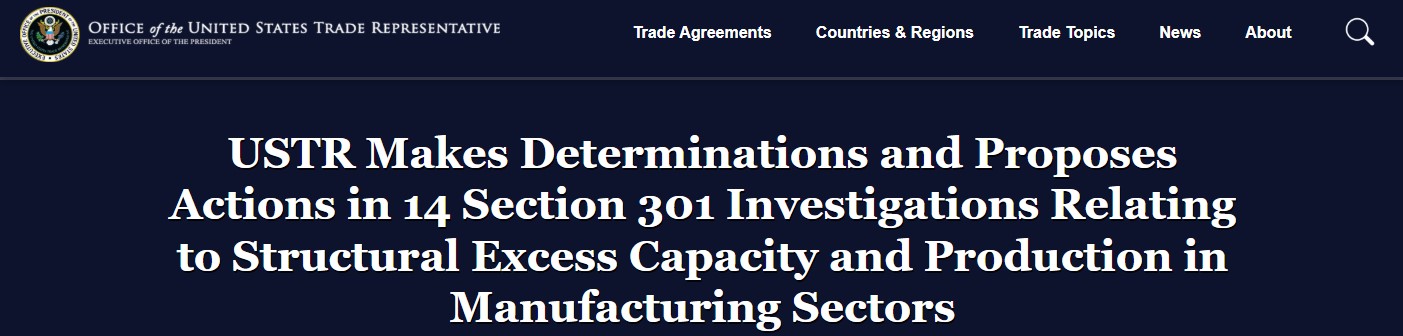
In its official release, USTR said Trade Representative Jamieson Greer found the targeted practices unreasonable. It says they hurt US commerce. USTR links structural excess capacity to industrial plans, subsidies, and other state support.
In plain terms, factories produce more than markets demand. The probe began on March 11, 2026, and covered 16 economies. USTR made no ruling on Mexico or Norway.
USTR proposes the rates below on nearly all goods. Each Federal Register notice lists product exemptions. The higher and lower rates come from Wiley, a law firm that read the draft notices. These Section 301 tariffs are not in effect.
Economy | USTR proposed rate | Higher rate if talks fail | Lower rate with a deal |
China | Up to 20% on most goods; up to 10% on Annex A goods | Up to 40% | Not specified |
Vietnam | Up to 35% | Not specified | 20% |
India | Up to 25% | Not specified | 17% |
Singapore | Up to 20% | Not specified | 10% |
European Union | 15% | Up to 20% | Not specified |
Japan | Up to 15% | Up to 20% | Not specified |
Switzerland | Up to 15% | Up to 20% | Not specified |
South Korea | Up to 15% | Up to 25% | Not specified |
Taiwan | Up to 15% | Up to 25% | Not specified |
Bangladesh | Up to 18% | Up to 20% | Not specified |
Cambodia, Indonesia, Malaysia, Thailand | Up to 18% | Up to 25% | Not specified |
Most rates are net of existing duties. Wiley says the new rate offsets July 2026 forced-labor levies for economies other than China. A Bangladeshi product that already pays 10% would face an extra 8%. The combined rate would be 18%. China is different, because older duties would still apply on top.
Written comments are due January 5, 2027. Requests to appear at hearings are due the same day. The hearing starts on January 25, 2027. Wiley says it begins at 10:00 a.m. at the US International Trade Commission in Washington, DC. Wiley adds that final rates may depend on talks with each trading partner.
As per Coinmarket Cap, Bitcoin fell near $57,500 on the morning of 25/11/2026. It had traded near $58,400 before the US inflation report on the same day.
The outlet named three drivers: a tech selloff, hot core inflation, and the new proposals. The tariff headline was one factor among several.
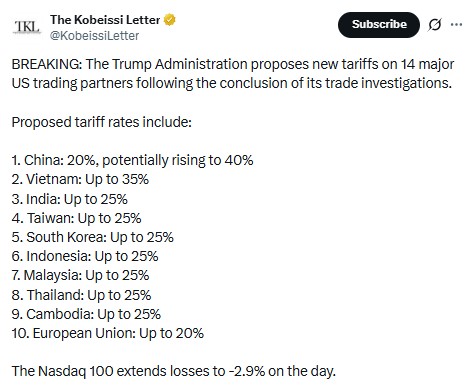
The Kobeissi Letter, a market commentary account, earlier showed the index down 2.9%.
An Investing.com analysis argued that duties on chips and servers raise costs for AI spenders.
It said they also feed inflation, which can delay rate relief that risk assets want. It also described Bitcoin as trading like leveraged tech stocks. That is an analyst view, not a proven cause of the price move.
For readers of crypto news, timing matters most. Section 301 tariffs stay proposals until USTR publishes a final action. The January 5 comment deadline and the January 25 hearing can change the rates. Every figure here reflects the proposal as of November 25 and 26, 2026.
Disclaimer: This article is for information only and is not financial or investment advice. Crypto prices are volatile. Check live data and official notices before you decide.
Frequently Asked Questions (FAQ)




Owned by:-
DCG Tech FZCO, UAE
Delivery Partner:-
Gabbar MediaTech Pvt Ltd.
Copyright © 2026 Coin Gabbar. All Rights Reserved


