SIB Price Prediction: Can a Planned Layer 1 Chain Lift Token Demand?

Sibstrate Post Puts a Chain Under the Token Story
Sible Network described Sibstrate on X at 12:58 PM IST on Nov 24, 2026. The post calls it a planned Layer 1 blockchain for a decentralized AI economy. A SIB price prediction now has to ask how demand for the asset would run through that chain.
No trading value exists for the token yet, so this report weighs sources of demand, not chart levels. It uses the post and the official whitepaper, as of Nov 25, 2026.
What the Sibstrate Post Confirms and What It Leaves Out
Role: the post describes a kernel coordinating subnets, contributors, validators and incentives
Quality checks: validators assess the quality of finished tasks through Proof of Intelligence
Demand path: business needs become work orders that eligible subnets compete to fulfil
Gaps: no launch date, fee figures or trading details are given
The roadmap lists a dedicated AI blockchain launch in Q3 2027 and exchange listing efforts in Q4 2027. The post does not tie either date to Sibstrate.
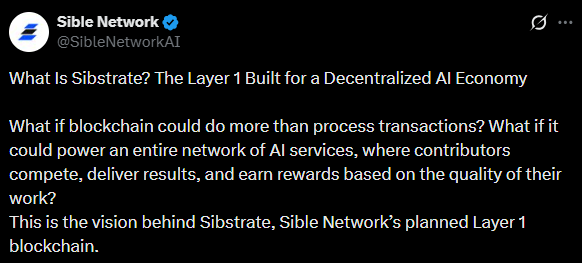
Source: Official X Post
SIB Price Prediction: Where Demand Could Come From
Demand for the asset would come from using the chain, not from client payments.
The whitepaper says Sible pays network fees for client work orders, so clients never need to hold SIB. A SIB price prediction therefore rests on operators, validators and holders who must buy or lock tokens.
Lever | How it works | Likely effect on the token |
Network fees | Each Sibstrate transaction pays a fee, and part of it is burned | Burns grow only with chain activity |
Registration fee | New subnets pay a one-off fee set in USD, burned in full | Each new subnet removes tokens for good |
Bonds | Subnet owners and providers post token or USDS bonds that can be slashed | Only token bonds lock supply |
Validator stake | Validators lock tokens to gain consensus weight | Staked tokens cannot be sold |
Delegation | Holders back validators and subnet owners and share rewards and risk | More locking if yields attract holders |
Slashing | Failed work can cost a bond, burned unless a client is compensated | Penalties shrink supply |
Fees and registration create burns, while bonds and stakes create locks. Both depend on activity that does not exist yet. A rise in chain use would raise burns and locks together, which is the core of any positive case.
Payouts Decide Whether Buying Pressure Appears
Contributors and providers can choose to be paid in the token, in USDS or in a mix. When they choose the token, Sible buys it on the market with the work order budget. That is direct buying, and it would support a SIB price prediction on the upside.
The whitepaper adds a limit. Until liquidity exists on Sibstrate, payouts are made in USDS. Early orders may therefore create little buying.
The Enterprise AI Marketplace, planned for Q1 2027, also accepts the asset for compute and data. Client contracts, however, are paid in USDS.
What Could Hold Demand Back Before 2027
Several limits sit between the design and real buying. Participation also needs verified work, because Sibstrate pays only for work that validators have verified.
Planned status: fees, bonds and stakes do not exist until the chain launches
Thin early activity: burn totals scale with use, which starts from zero
USDS payouts: early orders may not touch the open market
Unset terms: fee levels and the buyback share are not given in the sources
Listing timing: liquidity depends on exchange listings still described as goals
Each limit can delay demand, and a delay would soften any SIB price prediction.
Signals to Watch and Where the Outlook Stands
Four signals would test any SIB price prediction once the chain exists.
Launch date: a confirmed Sibstrate launch timeline
Fee data: the burned share of each fee and total burns
Subnet count: registered subnets, since each registration burns a fee
Payout mix: which share of payouts arrives in the asset rather than USDS
This SIB price prediction stays conditional. Demand depends on a live chain, active subnets and payouts made in the asset. Until those exist, the outlook rests on design, not data.
No listing, trading pair or reference value has been confirmed, so no numeric target is given.
Disclaimer: This article is for educational and informational purposes only. It is not financial advice, and it does not guarantee any price or return. Readers should do their own research before making any decision.












Frequently Asked Questions (FAQ)




