Sinbad Network Security: SNBD and C-GEM Smart Contract Scores

Sinbad Network Security: How Do SNBD and C-GEM Scores Compare?
Anyone researching a crypto project hits the same question sooner or later: can the code behind the token be checked in public? Price charts and social posts can’t answer that. The contract can. This guide looks at Sinbad Network security through tools anyone can open: a SolidityScan report, a BscScan token page and the project’s own whitepaper. The two BNB Chain tokens, SNBD and C-GEM, serve as a worked example.
Key Takeaways
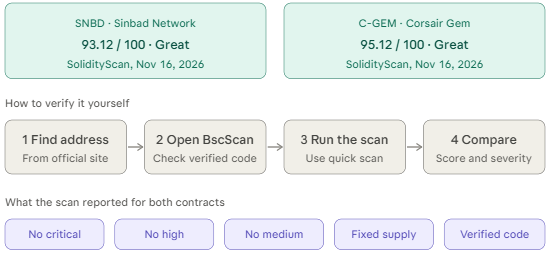
SolidityScan’s quick scan, gave SNBD a score of 93.12/100 and C-GEM 95.12/100. Both carry a “Great” label.
Both contracts show no critical, high or medium-severity findings, a fixed token supply and verified source code.
An automated scan is a snapshot, not a guarantee. Scores can shift as holders, liquidity and trading activity change.
What Is Sinbad Network?
Sinbad Network is a multi-chain Web3 project that brings together mobile mining, blockchain games, NFTs and exchange tools. According to the official whitepaper (v4.13, June 2026), it started in 2021 as Sinbad Token and returned through Google Play in 2025. Sinbad Network LLC, a company registered in the United States, handles operations.
The project’s stated principle is simple: people who help build an ecosystem should benefit from it most.
Source: official website.
Three tokens sit at the center of it:
Token | Network | Total supply | Role |
SNBD | BNB Smart Chain (BEP-20) | 500,000,000,000 | Main utility token for mining rewards and governance |
C-GEM | BNB Smart Chain (BEP-20) | 70,000,000 | Limited-supply flagship asset |
SSA | Base | 990,000,000 | Content token created through Zora |
SNBD, the Sinbad Network BEP-20 token, is the one most people search for first. The scan covered here applies to the two Sinbad Network BNB Smart Chain tokens, SNBD and C-GEM.
What Is the Sinbad Smart Contract?
The Sinbad smart contract is the program that runs the SNBD token on BNB Smart Chain. It follows the BEP-20 standard, which sets the basic rules for any token on that chain: who holds how many units, how transfers work and how spending permissions are handled. The C-GEM contract follows the same standard.
Its code is public once deployed. The whitepaper adds that the contract includes a native burn function, which allows tokens to be removed from circulation. Because the source code is verified, anyone can read these functions on BscScan and compare them with what the project says.
How Smart Contract Scores Work
A Sinbad Network smart contract is code that lives on a blockchain and runs exactly as written. Nobody can quietly edit it after deployment, which is why reading it matters.
A smart contract security score comes from an automated security assessment. The tool reads the code, looks for known weak patterns and groups what it finds by severity.
Severity | Meaning |
Critical | A flaw that could let someone take funds or control |
High | A serious weakness that may be exploitable in some conditions |
Medium | A weaker issue, often limited in impact or needing specific conditions |
Fewer findings in the top tiers push the score up. A higher number is a good sign, but it is only one input among several.
Sinbad Network and Corsair Gem Security Assessment, Side by Side
The table below shows the results SolidityScan reported on November 16, 2026.
Check | SNBD | C-GEM |
Security score | 93.12/100 | 95.12/100 |
Rating | Great | Great |
Critical findings | None detected | None detected |
High findings | None detected | None detected |
Medium findings | None detected | None detected |
Token supply | Fixed | Fixed |
Source code | Verified | Verified |
The Sinbad Network SNBD security score of 93.12 and the Corsair Gem CGEM security score of 95.12 both land in the top rating band. The gap between them is small, and both contracts came back clean on the three severity tiers.
How to Verify Sinbad Network Security Yourself
Nobody has to take a screenshot on faith. The same checks can be repeated in a few minutes.
Find the official contract address. The Sinbad Network SNBD contract address is 0xB13463f0f34BB6F8538ceC30563B4E1F4a6418cF. The C-GEM address is 0x03Dff40990E20278D707769F2A1955a61aF8E2F6. Both also appear in the official whitepaper and the website footer.
Open the token page. The SNBD BscScan page and the C-GEM BscScan page show holders, transfers and the verified source code.
Run the scan. Paste the same address into SolidityScan’s quick scan. An SNBD SolidityScan result generated today may differ from the November 16 figure, and that is normal.
Compare. Check the score, the severity counts and the supply notes against the table above.
This routine is the practical core of Sinbad Network smart contract security checks. It works for almost any BEP-20 token, not only this one.
Fixed Supply, Burns and Distribution
SolidityScan lists the supply of both contracts as fixed, which matches the totals in the whitepaper. A Sinbad Network fixed token supply means the total cannot grow past its stated number. The project also describes a burn program, activated in Q2 2026, that can only shrink circulating supply. Burn events are recorded on-chain and visible through the burn dashboard.
Supply is one half of the picture. Who holds the tokens matters too, and the whitepaper publishes the intended split:
Allocation | SNBD | C-GEM |
Mining and user rewards | 20% | 10% |
Liquidity and exchange | 25% | 10% |
Gaming ecosystem reserve | 25% | None |
Team | 10% | 10% |
Research and marketing | 10% | 5% |
Reserve and locked funds | 10% | 65% |
For C-GEM, the 65% locked reserve can only be released through community governance proposals. Mining rewards for C-GEM are capped at 7,000,000 tokens, after which C-GEM mining ends permanently. The whitepaper also notes that allocations may be adjusted for sustainability, so it is worth rechecking the latest version.
What Can Change a Score
SolidityScan itself points out that results are not frozen. Token distribution, the number of active wallets, supply concentration, trading activity and liquidity conditions can all affect how a scan reads the risk. A fresh distribution of tokens may lead to a different result later.
That is why the November 16, 2026 date matters. A score without a date tells a reader very little.
The Limits of an Automated Scan
A scan reads code for known patterns. It does not interview developers, test business logic in depth or judge how a team behaves. Readers who search for a Sinbad Network SNBD smart contract audit should know the difference: what this article covers is an automated scan, not a manual audit by a security firm.
The whitepaper lists security certifications under its Phase 5 plans for 2027. Until then, the scan is a useful first filter and nothing more.
Beyond the Code: Sinbad Network Transparency
Sinbad Network transparency shows up in several places. Contract addresses are published on the website and in the whitepaper. The official roadmap is open to read. Official channels are listed in one directory. The logos, website and social links for both tokens are public on their BscScan profiles.
Put together, these details support SNBD token security research, although each one still deserves its own check.
A Quick Checklist Before Trusting Any BEP-20 Token
The steps above work for any token on BNB Smart Chain. Here they are as a short checklist:
Check | Where to look | A healthy result |
Contract address | Official website and whitepaper | The same address everywhere |
Source code | Contract tab on BscScan | Marked as verified |
Supply | BscScan token page and whitepaper | Total matches the published number |
Scan result | SolidityScan quick scan | No critical or high findings, with a date |
Holder spread | Holders tab on BscScan | Tokens spread across many wallets, apart from labelled reserves |
Locked funds | Whitepaper and on-chain data | Reserve rules stated and checkable |
Lookalike tokens are common in crypto. A fake can copy a real project’s name and logo while using a different contract address, so the address from the official website is the one to trust. Checking it first saves a lot of trouble later.
No single row settles the question. Together they build a picture, and a gap in any row is a reason to slow down and look closer. That habit is worth keeping, whatever token is in front of the reader.
Final Thoughts
Sinbad Network security is easiest to judge when the evidence is in the open: dated scores, verified code, published addresses and a documented supply. Readers who check those items themselves, instead of relying on summaries, end up with a clearer view than any headline could give.
Disclaimer: This article is for information only and is not financial, legal or investment advice. Crypto assets carry risk. Automated scan results do not replace a manual audit and may change over time.