Sinbad Network Token Burn: Six Sources Shaping the SNBD Supply

How Does Sinbad Network Token Burn Work Across Its Six Burn Sources?
A token burn sounds simple. Tokens go out, and supply goes down. The harder part is knowing who burns them, when it happens, and how anyone can check.
Sinbad Network publishes these details on its own pages. This guide explains the Sinbad Network token burn using the official website, the whitepaper and the burn page.
Key Takeaways
The Sinbad burn program has been active since 2026 Q2 and runs through the native burn() function.
The burn page lists six sources. The whitepaper adds in-app spending as a possible seventh.
Every burn is recorded on-chain and can be checked on BscScan or BaseScan.
About Sinbad Network
Sinbad Network is a multi-chain Web3 ecosystem built around mobile mining, blockchain gaming, NFTs and an integrated exchange. It began in 2021 as Sinbad Token and relaunched through Google Play in 2025. Sinbad Network LLC, registered in the United States, runs it.
The ecosystem operates on BNB Chain and Base. SNBD is its main utility token, and the SNBD token burn is the part of the economy built to pull supply back down.
Source: official website.
What Is Sinbad Token Burn?
Sinbad token burn is the program Sinbad Network uses to remove tokens from supply for good. Instead of moving tokens to an unused wallet, the program destroys them through the native burn() function. That lowers the token’s totalSupply directly.
The whitepaper dates the activation of the program to 2026 Q2. Its stated aim is to reduce circulating supply over time. The burn page lists six sources behind it, from contract burns to fee-based burns.
Every burn is permanently recorded on-chain. That means no one has to rely on a claim or a screenshot, because the record sits on a public explorer.
Detail | Info |
Program status | Active since 2026 Q2 |
Burn method | Native burn() function |
Networks | BNB Chain and Base |
Where to verify | BscScan and BaseScan |
Official burn sources | Six on the burn page, seven in the whitepaper |
Documented in | Whitepaper v4.13, section 5 |
What Is a Deflationary Token Burn?
A deflationary token burn removes tokens from supply for good. The whitepaper describes Sinbad’s version as a multi-layered system designed to reduce circulating supply over time.
The key word is “multi-layered”. Instead of one burn event, several activities feed the same process.
How the Sinbad Network Burn Mechanism Works
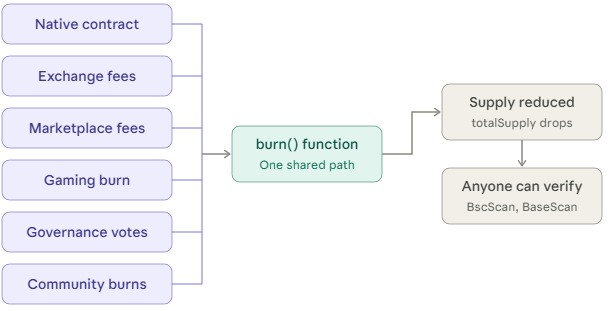
Every burn goes through the SNBD burn() function. It lowers the token’s total Supply directly. The official page says plainly that this is not a dead-wallet send.
burn() function | Dead-wallet transfer | |
What happens | Tokens are destroyed | Tokens move to an address nobody controls |
totalSupply | Goes down | Stays the same |
Used by Sinbad | Yes, for all sources | No, per the official page |
The official whitepaper dates the activation of this program to 2026 Q2.
The Sinbad Network Burn Sources
The official burn page names six sources. Each one links to a different part of the ecosystem.
Source | How tokens are burned | Linked product |
Native contract burns | Direct burn() calls reduce supply on-chain | Live |
Exchange fee burns | A portion of Sinbadex transaction fees | Sinbadex, in development |
Marketplace fee burns | A portion of P2P marketplace fees | P2P marketplace, in development |
Gaming-related burns | Token spending in the gaming ecosystem | Five mobile games live |
Governance-approved burns | Burns approved by proposal before distribution | DAO framework, still evolving |
Community burn initiatives | Voluntary burns through the native contract | Live |
Where the seventh source comes from
The whitepaper’s burn section lists seven possible sources. The extra one is in-app spending. The burn page highlights six. Since the whitepaper says sources “may include” these items, readers should treat in-app spending as a whitepaper-level mention and confirm it on the official burn page.
Fees and the marketplace
Exchange fees and P2P marketplace fees only matter once those products run. The whitepaper lists the P2P marketplace for 2026 and the Sinbadex exchange for 2027. It also says only “a portion” of fees is burned. The pages reviewed give no exact percentage.
Gaming and governance
A gaming burn comes from tokens spent inside the Sinbad games. Governance burns need a community proposal first. The SNBD roadmap places governance activation in Phase 4, which covers 2026 to 2027.
Burn vs Mining Rewards
Two forces act on supply at the same time. Mining rewards hand SNBD to users through daily sessions, tasks and games. That adds tokens to circulation.
The burn program pulls the other way. The official pages reviewed show no total-burned figure, so the net effect is best read straight from the explorer.
How to Burn SNBD Tokens Voluntarily
Anyone holding the token can burn it, in any amount. The burn page gives three steps:
Open the Sinbad app or the wallet that holds the token.
Call burn(amount) on the contract.
Confirm the transaction. The burn shows on the explorer within one block confirmation.
Voluntary burns tend to be most active during community campaigns. The team also reserves the right to coordinate seasonal burn events with community input.
How to Verify an SNBD Burn on BscScan
On-chain verification is the strongest part of this design. No dashboard has to be trusted, because the explorer shows the record.
Copy the SNBD contract address from the official site: 0xB13463f0f34BB6F8538ceC30563B4E1F4a6418cF.
Open it on BscScan.
Check totalSupply and the transfers list.
Compare totalSupply over time to see the change.
C-GEM is checked the same way on BscScan, and SSA on BaseScan. Always take the address from the official pages, never from a chat message or a random post.
Does a Burn Raise the Price?
Not by itself. A Sinbad Network token burn lowers supply, but price also depends on demand, market conditions and listings. The whitepaper states that nothing in it should be read as a guarantee of value appreciation. Burn data is best used as a transparency check, not as a price signal.
Final Thoughts
The Sinbad Network token burn rests on one clear idea: every burn should be visible on-chain. Six sources feed one native function, and the explorer holds the proof.
Some parts still depend on products that are in development, such as Sinbadex and the P2P marketplace. Readers should check the burn page, the whitepaper and BscScan before relying on any figure.
Disclaimer: This article is for information only and is not financial, legal or investment advice. Crypto assets carry risk. Features and timelines may change. Always do your own research.
















