Sinbad Network vs Sible Network: Mining Models and Token Details

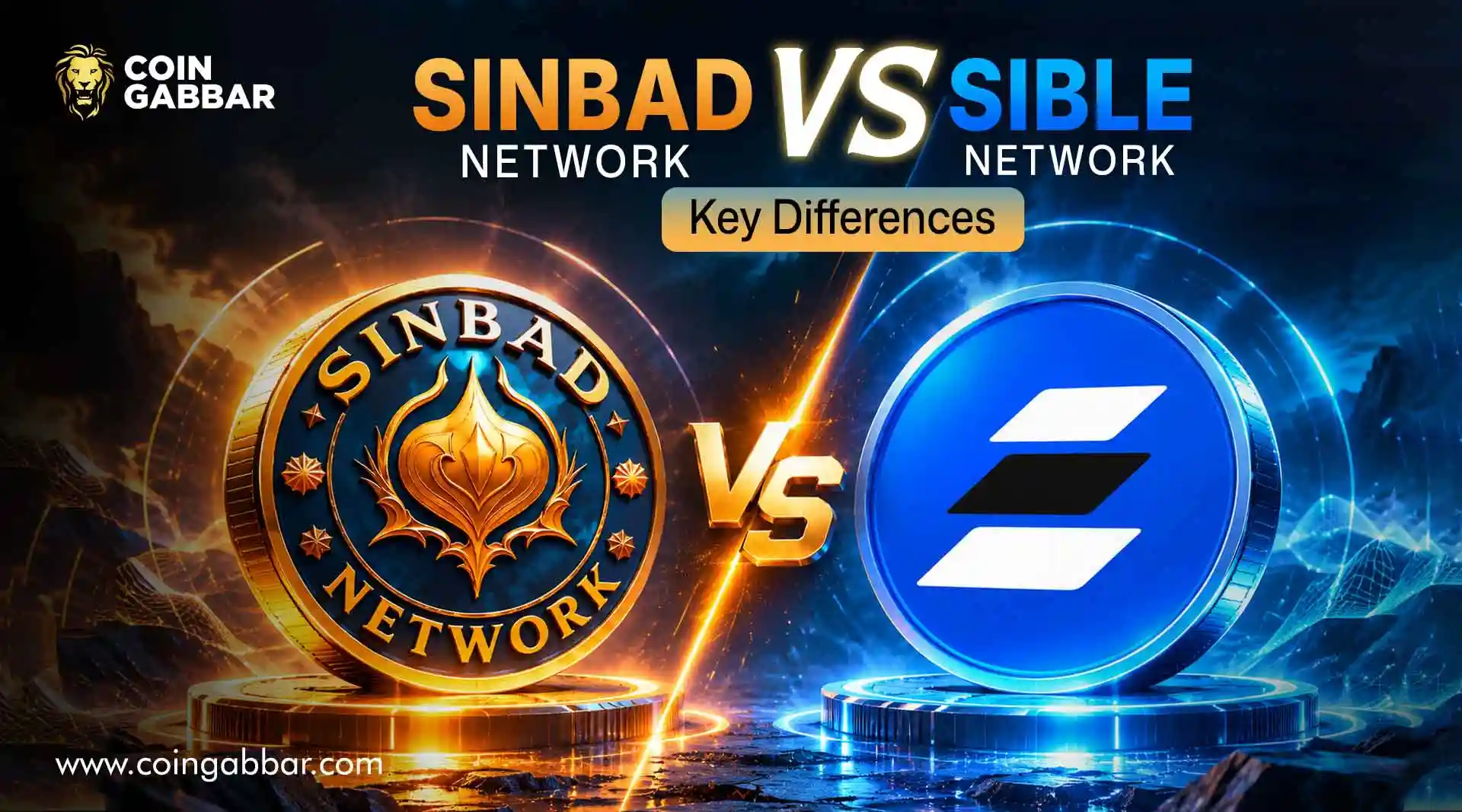
Sinbad Network vs Sible Network: How Do Their Mining Models Differ?
Mobile mining looks simple from the outside. A person opens an app, taps a button and collects tokens. The projects behind those apps are far less alike.
This Sinbad Network vs Sible Network mobile mining comparison puts two of them side by side. It works as a free mobile crypto mining apps comparison 2026 for readers who want facts before installing anything. Each project offers a mobile crypto mining app, but one leans toward Web3 gaming and NFT features while the other leans toward AI computing.
All details come from the official websites and the Sinbad whitepaper (v4.13, June 2026). None of it is financial advice.
Key Takeaways
The two projects solve different problems. Sinbad is a Web3 ecosystem. Sible is an AI infrastructure network.
Their reward rules differ. Sinbad uses daily sessions and dynamic rates. Sible publishes a fixed hourly rate that halves on a schedule.
Plans are not products. Both projects list features that are still in development, so readers should separate live tools from roadmap items.
Sinbad Network Review
Sinbad began in 2021 as Sinbad Token and relaunched on Google Play in 2025. The whitepaper names Sinbad Network LLC, registered in the United States, as the operating company.
The ecosystem includes five Play Store apps: the main mining app plus four games. It also plans a limited NFT collection of 1,500 to 2,000 pieces, built around a Captain and Crew theme.
Source: official website.
Several pieces are still unfinished. The whitepaper marks the P2P marketplace, the Sinbadex exchange and the Super App as “Development”, and the flagship game Corsair Legacy as “Planned”.
Sinbad Network Mining Explained
Sinbad Network mining centers on one tap-based session a day. The site says it needs no hardware and no capital, which makes it a crypto mining app with no hardware: Sinbad vs Sible readers often search for.
Extra rewards come from streaks, tasks, spins and chests. Dual-mining SNBD and C-GEM lets one session earn two tokens. Withdrawals to a wallet are described as a future feature for verified users.
Sible Network Review
Sible calls itself “the operating system for the AI world”. Its products include Sentinel for operations, Fabric for data and Cortex for private AI models. Nexus is an optional layer that connects them, and Relay handles deployment.
The pitch is aimed at organizations. The homepage stresses private deployment, role-based access and audit logs, with use cases like fraud detection and grid optimization.
Some claims need outside proof. The homepage shows logos such as Nvidia and Public Health England and says “Trusted by 1000+ partners”, with no supporting links. Third-party reviews also describe the technical detail behind Proof of Intelligence as thin.
Sible Network Mining Explained
According to the site, Sible Network mining ties rewards to computing. Miners contribute GPUs to train and run models, and organizations pay in SIBLE to use that capacity. Reviews also mention Sentinel daily missions, though the reward per mission is not published.
The hourly reward starts at 0.1 SIBLE and halves every four months, down to 0.003125 in era six. The homepage also shows 974,364 users, which is the project’s own figure.
Source: official Sible website.
Sinbad Network vs Sible Network at a Glance
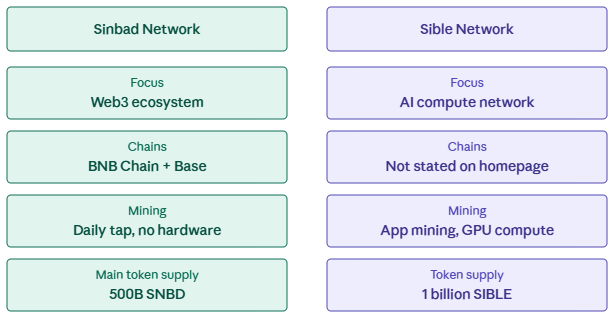
The infographic above shows the main split. The table adds the details.
Point | Sinbad Network | Sible Network |
Core idea | Multi-chain Web3 ecosystem | AI compute and data platform |
Chains | BNB Chain and Base | Not stated on homepage |
Best for | Casual tappers and gamers | Readers interested in AI infrastructure |
Live now | Mining app, four games, three tokens | Mobile app, web app, Sentinel |
Still planned | P2P, Sinbadex, Super App | Stablecoin, marketplace, developer toolkit |
SNBD Token vs SIBLE Token
Detail | SNBD | SIBLE |
Supply | 500,000,000,000 | 1 billion |
Network | BNB Smart Chain (BEP-20) | Not stated on homepage |
Role | Mining rewards, governance, future exchange utility | Fuel for the compute network |
Split | 20% mining, 25% liquidity, 25% gaming, 10% team, 10% research, 10% reserve | Not shown on homepage |
Sinbad also has C-GEM, a scarce token with 70 million supply. Its mining share is capped at 7 million, after which C-GEM mining ends for good. Another 65% sits in a locked reserve that only governance can release.
The Rewards Face-Off
The two reward styles feel very different. Sinbad spreads rewards across many small actions. Sible pays by the hour and publishes the schedule.
Sinbad’s whitepaper says rates are dynamic and may fall through halving. Sible shows exact numbers, but a halving schedule only says rewards shrink. It says nothing about the token’s price or demand.
The Transparency Scorecard
Check | Sinbad Network | Sible Network |
Detailed whitepaper | Yes, 20 sections | Page linked, details thin per reviews |
Contract addresses | Linked on BscScan and BaseScan | None seen on homepage |
Named company | Sinbad Network LLC, USA | Not seen on homepage |
Named founders | Not seen on pages reviewed | Two co-founders listed |
Reward schedule | Dynamic, no fixed table | Six-era table |
Roadmap | Six phases | Q4 2026 to Q1 2027 |
Roadmap Face-Off: What Comes Next
Sinbad’s whitepaper puts the project in Phase 3, covering KYC, Play-to-Earn, burns and P2P development. P2P launch, wallet migrations and the NFT launch follow in 2026 and 2027, with the Sinbadex exchange in 2027.
Sible’s roadmap starts with the app launch in Q4 2026. Q1 2027 lists four launches: a stablecoin, an infrastructure layer, a marketplace and a developer toolkit. No exact dates are given, and reviewers note that a roadmap is a plan, not proof of delivery.
Which Is Better, Sinbad Network or Sible Network?
Neither wins on every point.
Readers who enjoy simple daily mining and games will find Sinbad the closer fit. Its whitepaper is detailed and its contracts are public. Readers drawn to AI compute may prefer Sible, though its homepage leaves more questions open.
Sinbad Network and Sible Network compared for beginners comes down to one rule: start with the project whose documents are easiest to understand.
Risks Worth Knowing
Plans can change. Sinbad’s whitepaper says allocations and utility may be modified.
Inactive accounts can be deleted. After six months of inactivity, balances may be removed under Sinbad’s rules.
Rewards shrink. Both projects reduce rewards over time.
Nothing is guaranteed. Neither site promises a price, listing or return.
Final Thoughts
The Sinbad Network vs Sible Network question has no single answer, because the projects aim at different goals. Anyone hunting for the best mobile mining apps 2026 should read both whitepapers, verify the contracts and test with time before money. Features and numbers can change, so each official site deserves a fresh look before signing up.
Disclaimer: This article is for information only and is not financial, legal or tax advice. Crypto projects carry a high risk of loss.