Sinbadex vs Sinbad P2P: Features, Differences and Launch Timeline

Sinbadex vs Sinbad P2P: How Do Their Features and Plans Differ?
Sinbad Network lists two trading products in its whitepaper, and many readers mix them up. Sinbadex vs Sinbad P2P is not a choice between rivals. They are separate components with different launch years and different jobs. This guide explains each one, compares them side by side and shows what a user can do now. It uses the Sinbad Network website, whitepaper v4.13, the KYC page and the project’s latest app announcement.
Key Takeaways
Sinbad P2P is a marketplace for verified users and is planned for 2026, while the Sinbadex exchange is planned for 2027.
Both are in development, so neither is live today.
Both depend on KYC, and NFT holders are meant to get fee discounts on each.
What Is Sinbad Network?
Sinbad Network is a multi-chain Web3 ecosystem that combines mobile mining, games, NFTs and trading tools. It runs on BNB Chain and Base, and Sinbad Network LLC is registered in the United States.
Users start in the Sinbad app, where mobile mining pays SNBD and C-GEM. Trading is the next layer the project plans to add.
Source: official website.
What Is Sinbadex?
Sinbadex is the future trading infrastructure of the ecosystem, and it sits in the website’s Platform menu next to KYC and Migration, Governance and Sinbad Labs. The whitepaper describes it as a specialized exchange for community-driven ecosystems, mobile mining projects, digital assets and new Web3 applications.
Source: Sinbadex Exchange Documentation.
Sinbadex Centralized Exchange Explained
The whitepaper says Sinbadex is expected to combine centralized exchange functions with KYC-verified peer-to-peer trading. The exchange itself is listed for 2027. Its roadmap phase also names liquidity expansion, security certifications and regulatory preparations.
Sinbadex Supported Networks
Network | Status |
BNB Chain | Integrated |
Base | Integrated |
Ethereum | Planned |
Other networks | Under evaluation |
Sinbadex Ethereum Integration
Ethereum is planned, not active. The roadmap places Ethereum integration in the exchange expansion phase for 2027, so it is tied to the same timeline as the exchange.
What Is Sinbad P2P?
Sinbad P2P is a peer-to-peer marketplace for verified ecosystem participants. Users trade directly with each other instead of through an exchange order book. The whitepaper lists it for 2026.
How Does Sinbad P2P Work?
The official whitepaper names six possible features:
KYC-based access
A user rating system
Verified trader badges
Community reputation scoring
Ecosystem token trading
Partner project integration
The KYC page adds that verified users with on-chain balances can begin trading with other verified members. The whitepaper says the marketplace is meant to launch alongside later wallet balance migration phases.
A user’s path to a first trade would look like this:
Complete KYC.
Move an allowed share of the in-app balance to the registered wallet. The KYC page lists first-phase rates of 5% for SNBD and 25% for C-GEM.
Trade with other verified members once the marketplace opens.
Sinbad P2P KYC Requirements
KYC is the entry ticket. The KYC page lists three steps in the Sinbad app: confirm the email, register a wallet, and complete extra checks where required. The project’s latest app update also made liveness verification part of KYC for new applicants and existing users.
That update did not say whether P2P itself will check liveness. It applies to every KYC application.
Sinbad P2P User Rating System
Trading with strangers needs trust signals. The whitepaper lists a rating system, verified badges and reputation scoring for that purpose. It does not explain how ratings are earned or shown, so the exact rules are still open.
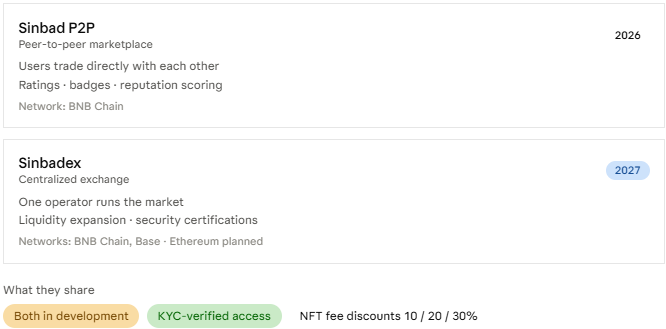
Sinbadex vs Sinbad P2P Difference
Sinbad P2P | Sinbadex exchange | |
Type | Peer-to-peer marketplace | Centralized exchange |
Planned year | 2026 | 2027 |
Status | Development | Development |
Network | BNB Chain | BNB Chain and Base |
Built for | Verified ecosystem participants | Community ecosystems, mining projects, digital assets |
Access | KYC-verified users | Planned KYC-verified services |
Trust tools | Ratings, badges, reputation | Not detailed |
The picture below shows the same split.
Is Sinbadex Live?
No. The whitepaper lists the Sinbadex exchange as in development, with deployment in 2027.
Is Sinbad P2P Live?
No. It is also in development. The KYC page says token transfers are intended to launch alongside it in 2026, with no exact date. The project’s news updates mention a waitlist, which suggests early sign-ups may come first.
Roadmap Timeline for Both Products
Phase | Years | Items for these products |
3 | 2026 | P2P development, Super App development |
4 | 2026 to 2027 | P2P launch, wallet migrations, NFT launch |
5 | 2027 | Sinbadex deployment, Ethereum integration, security certifications |
P2P vs Centralized Exchange: The General Idea
In a peer-to-peer market, buyers and sellers deal directly with each other. In a centralized exchange, one operator runs the market and matches orders. These are general descriptions, and Sinbad has not yet published how either product will handle fees, pairs or limits.
How NFTs, SNBD and C-GEM Fit In
NFT tiers: Common, Rare and Special NFTs are planned to give 10%, 20% and 30% fee discounts on both products.
SNBD: It is meant to become the native utility asset of Sinbadex, with possible fee discounts, staking benefits and governance use.
C-GEM and SSA: C-GEM has a 10% exchange liquidity allocation, while SSA lives on Base, where Sinbadex integration is also planned.
The whitepaper says these utilities may change, and that it guarantees no listings or product launches.
Where the Sinbad Super App Fits
The long-term vision is a Sinbad Super App that combines mining, games, NFTs, AI tools, payments, P2P trading and exchange functions in one place. It is in development on Base.
How to Prepare
Users can get ready without waiting:
Finish KYC and liveness verification in the Sinbad app.
Register a wallet they control, and never share its recovery details.
Keep mining regularly, since active mining is also part of the project’s withdrawal rules.
Follow the official channels for launch news, and ignore links from other sources.
Final Thoughts
Sinbadex vs Sinbad P2P comes down to timing and style. P2P is the earlier, user-to-user marketplace, and the exchange follows in 2027. Both are still in development, and the whitepaper reserves the right to change components, roadmaps and utility models, so plans may change.
Disclaimer:This article is for information only and is not financial advice. Crypto participation involves risk.