Solana News Today: New MPL-3643 Standard Unlocks RWA Tokenization

Solana News Today: How MPL-3643 Could Transform RWA Tokenization?
Here is some important Solana News Today, explained step by step.
Metaplex has launched MPL-3643, a new token standard with compliance built in. It lets real-world assets, such as securities, real estate and private funds, be issued directly on Solana. Until now, this meant relying on wrapped copies of assets that started on other chains.
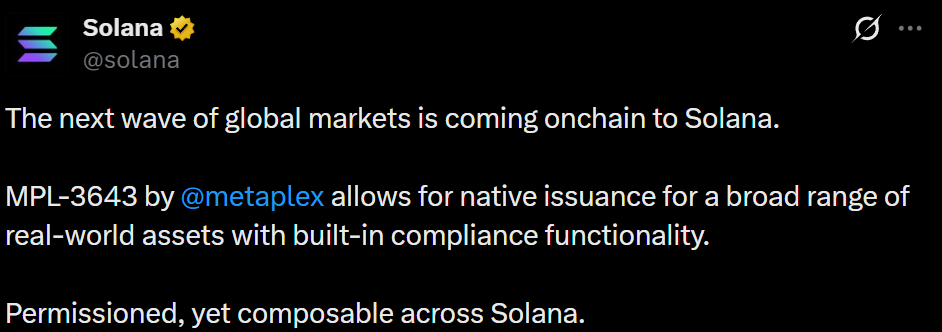
Solana’s official account shared the announcement. It called it the foundation for the next wave of global markets moving onchain.
According to Metaplex’s official announcement thread and documentation, MPL-3643 is the Solana version of ERC-3643. ERC-3643 is a widely used Ethereum standard for permissioned tokens, meaning tokens that only approved wallets can hold.
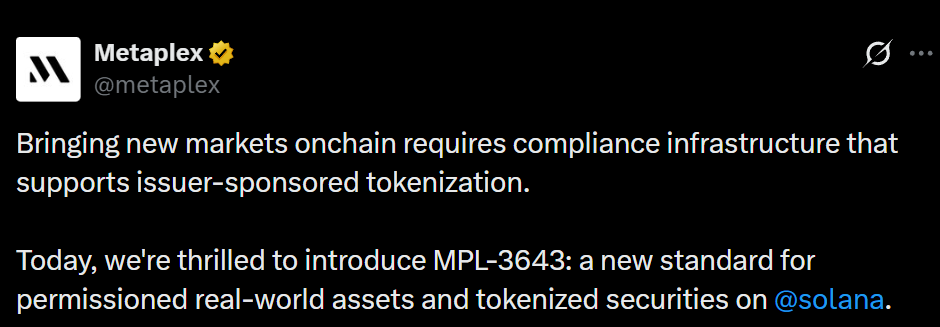
MPL-3643 is not a brand-new kind of token. It is a compliance layer that sits on top of Solana’s existing Token-2022 standard. Because of this, wallets, explorers and decentralized exchanges can support it with tools they already use.
The system lets only wallets that meet the issuer’s set conditions hold the token. These conditions can include KYC verification, country or region, or investor accreditation status.
Why This Matters: Solving the Compliance Gap
Metaplex says real-world asset tokenization has already grown on-chain. However, many of the world’s biggest markets still can’t be issued directly on Solana. They need issuer controls and compliance features that can adjust to different countries’ rules.
As the documentation puts it, every issuer launching a regulated token on Solana today has had to build this compliance setup from scratch.
MPL-3643 is meant to supply that missing piece. Solana’s repost described it as permissioned, yet still able to work across the wider network.
How the Technical Setup Works
This is where Solana News Today gets more detailed. MPL-3643 is made of four separate programs, and each one can be audited on its own. They sit on top of three existing Solana components: Token-2022, Token ACL (sRFC 37) and the Solana Attestation Service.
| Program | What It Handles |
| Identity Registry | Identity claims, trusted verifiers, and which verifiers each token trusts |
| Compliance Module | Offering rules, such as limits on holders, allowed countries, lockups and trading volume |
| Gate Program | Combines identity and compliance checks to decide every freeze and thaw (unfreeze) |
| Lifecycle Manager | Earnings payouts, vesting, company actions, and recovery with safety limits |
There is one key difference from Ethereum. ERC-3643 checks compliance inside every transfer, but Solana has no similar transfer hook by default.
So MPL-3643 checks eligibility when an account is frozen or unfrozen. Token accounts start out frozen, and only a wallet that passes the compliance checks can unfreeze one.
Rules that need a check on every transfer, such as lockups or volume limits, use a Token-2022 transfer hook instead.
Built to Connect, Not Stay Isolated
Metaplex stresses that “permissioned shouldn’t mean siloed.” MPL-3643 tokens are still standard Token-2022 tokens under the hood. So they can plug into the Solana tools people already use, instead of needing separate, isolated markets.
Early integrations already announced include Solflare, Raydium, Orca, Phantom and Jupiter Exchange. This gives issued assets a real path into wallets, DEXs and trading venues from day one, rather than leaving them in a walled garden.
Current Availability and What’s Next
MPL-3643 is live on Solana mainnet, but only in a limited-access Alpha phase. The official documentation says it is unaudited and marked “Experimental” on Metaplex’s own Stability Index. In simple terms, issuers shouldn’t hold real assets with it without first coordinating directly with Metaplex.
Fees are flat and paid in SOL, not as a percentage of assets:
-
Asset setup: 0.063 SOL
-
Holder account activation: 0.034 SOL
-
Distribution execution: 0.00085 SOL per recipient
Issuers, tokenization platforms, KYC providers and developers can request alpha access directly through Metaplex.
Conclusion
This round of Solana News Today marks a meaningful step for how regulated real-world assets could move onto Solana at scale.
MPL-3643 builds compliance directly into the token, so issuers don’t have to reinvent it each time. It also stays compatible with existing Solana tools, from wallets to DEXs. This makes it a genuine bridge for markets that have stayed off public blockchains because of country-by-country rules and regulation.
Early integrations are lined up, and mainnet access is limited to Alpha partners for now. The real test will be how quickly issuers adopt the standard once it opens up beyond early access.
Disclaimer
This article is for educational and informational purposes only and should not be considered financial or investment advice. Always conduct your own research before making investment decisions.






