Tether USDT Freeze: Are These 5 Ethereum Wallets Linked to Scams?

Tether USDT Freeze: What Links 5 Wallets to Scam Activity?
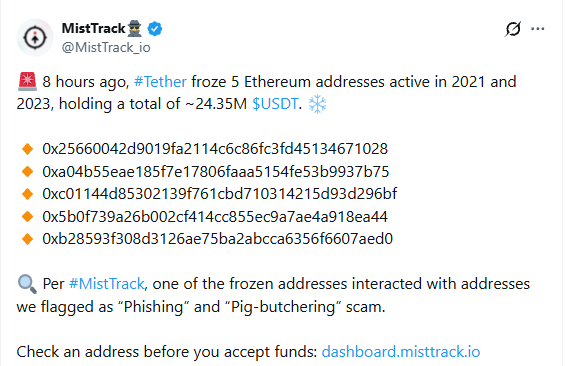
Tether USDT Freeze activity has reached Ethereum. The issuer froze five addresses holding about $24.35 million in USDT, according to a MistTrack post on X. The wallets were active in 2021 and 2023.
Source: MistTrack post on X
MistTrack added a detail that shapes the story. One of the five frozen wallets interacted with wallets the firm has flagged as "Phishing" and "Pig-butchering" scam addresses.
Pig butchering is a scam where fraudsters build trust over weeks, then steer victims toward fake investment platforms. That label is what makes this Tether Ethereum Address Freeze worth a closer look.
A separate explanation from Tether for these five addresses was not available in the sources reviewed.
Which Ethereum Addresses Are Now USDT Frozen Wallets?
MistTrack listed these five addresses:
0x25660042d9019fa2114c6c86fc3fd45134671028
0xa04b55eae185f7e17806faaa5154fe53b9937b75
0xc01144d85302139f761cbd710314215d93d296bf
0x5b0f739a26b002cf414cc855ec9a7ae4a918ea44
0xb28593f308d3126ae75ba2abcca6356f6607aed0
Together they hold roughly 24.35 million USDT, or an average of about $4.87 million each. The post does not break down balances per wallet, so individual figures remain unknown.
Their activity dates to 2021 and 2023, so these were not newly created accounts.
Do Phishing Scam Wallets Prove the Funds Were Illicit?
Not on the current evidence. MistTrack's scam note refers to one address out of five. It says that wallet interacted with addresses carrying phishing and pig-butchering labels.
An interaction shows a transaction path. It does not show who controls a wallet or why Tether chose to act. The other four addresses have no stated scam link in the post.
The labels come from MistTrack's own USDT scam investigation data, so they reflect the firm's assessment. The tracker also points users to its address risk dashboard for checking an address before accepting funds.
How Does a Tether Wallet Blacklist Work on Ethereum?
USDT on Ethereum runs as a smart contract that the issuer controls. That contract includes a blacklist function. Once an address is added, it can no longer send USDT.
This Tether Address Blocking does not move the tokens. The balance stays at the address but cannot be transferred. The public USDT contract page on Etherscan lists the read functions, including a blacklist status check.
This mechanism explains how the Tether USDT Freeze can be verified onchain, even when the issuer has not publicly disclosed the reason behind the action.
What Happens to Frozen USDT Tokens Next?
The same contract also contains a function that lets the issuer destroy balances held by blacklisted wallets. No burn, release or reissue announcement for these five wallets was found.
Any next step may depend on legal and compliance processes that are not visible onchain. Freeze powers also sit inside the wider debate on stablecoin oversight.
Expert Take: What Could Shape the Next Phase?
The data suggests a narrow but notable case. Five wallets, about $24.35 million in USDT, and one stated link to scam-flagged wallets.
The main uncertainty remains the reason for the freeze. Without a statement from Tether, the scam connection stays a tracker finding and not a confirmed cause.
Several signals could change the picture: an official Tether comment, a release or burn of the Frozen USDT Tokens, or further MistTrack tracing of the other four wallets.
Conclusion
The Tether USDT Freeze on five Ethereum addresses shows how issuer-level controls and onchain tracking can intersect in a single event.
MistTrack identified the five addresses and flagged scam-related activity involving one of them. However, Tether's reasoning behind the freeze remains unclear.
Further updates on this and other crypto news today will show whether the freeze leads to a burn, a release or a wider investigation.
Disclaimer: This article is for information only and is not financial or legal advice. Crypto assets carry high risk, and tracker labels are not proof of wrongdoing. Verify details through official sources.






