The World Ahead 2027: 10 Major Events and Global Trends to Watch

The World Ahead 2027: Ten Warnings About Politics, AI and the Economy
Every November, The Economist drops a cover that people argue about for weeks. This year is no different. The World Ahead 2027 packs flags, missiles, rockets, syringes and film reels into one crowded picture. At first glance it looks like chaos. Look closer and it reads like a warning.
This guide walks through what the cover shows and what the magazine says each symbol points to.
Key Takeaways
The World Ahead 2027 is built around ten pressure points that could hit at the same time, not one single event.
The cover covers politics, markets, war, climate, health, space and entertainment.
Everything here is The Economist’s forecast, so treat it as informed expectation, not fact.
What Is The World Ahead 2027?
It is the magazine’s annual forecast, edited by Tom Standage.
The 2027 projections were presented on November 17 in the annual special edition. The press release framed it around the post-Trump era and upheaval from bond markets and AI.
One warning before you share anything. A fake, AI-generated version of a World Ahead cover went viral earlier, and fact-checkers flagged it. Always check the image against The Economist’s own site.
The World Ahead 2027 Cover Meaning
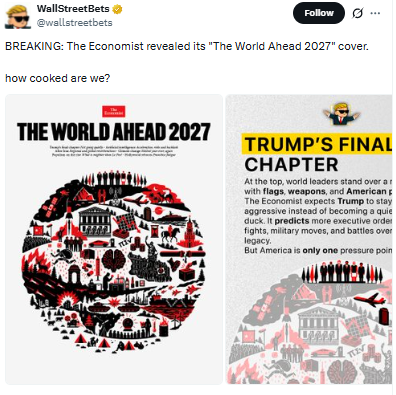
The artwork is a crowded globe. World leaders stand at the top over a map full of flags, weapons and American power. Below them sit chips, robots, falling charts, rockets and a syringe.
Each object is a clue. Readers hunting for the economist 2027 cover hidden symbols will find that nearly every icon links to one of the ten trends below. The point is the overlap. Pressure in one place spills into the next.
Economist 2027 Ten Trends List
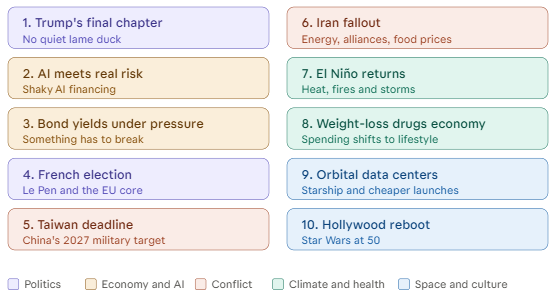
Here is the 2027 ten trends list, one by one.
1. The Post-Trump Era: No Quiet Lame Duck
Why it matters
The race to succeed Trump begins, and the world starts to imagine America without him. Many second-term presidents fade near the end. Standage expects the opposite.
What could come next
With Democrats taking charge of both chambers of Congress, Trump is expected to become even more aggressive. Standage lists more executive orders, legal spats, sudden renamings of geographical features, grand building projects and military adventures, all aimed at keeping influence and shaping his legacy.
What to watch: the early contenders to succeed him, and how much of his late agenda outlasts him.
2. Aftershocks From Iran: Energy, Alliances and Food Prices
Trust and fear
America’s allies no longer fully trust it, and its enemies no longer fear it. Standage thinks a lasting settlement is unlikely, so the effects carry through 2027.
Three things that shift
The war’s consequences are expected to reshape regional politics, reconfigure energy flows and threaten food security. This is where geopolitical risk 2027 becomes a household issue.
The grocery-bill effect
Fertiliser is in short supply, and a super El Niño adds to the pressure. A war in one region can change what people pay at the shop in another.
What to watch: energy and fertiliser prices, and shifting alliances across the region.
3. Hottest Year Ever, Again: El Niño 2027
What is forecast
Another year of droughts, wildfires and heat waves is expected. A “super El Niño” is forecast, and 2027 is expected to set a new global temperature record.
An unexpected upside
The Economist argues that Trump has, without intending to, become a powerful salesman for renewable energy. Renewables help address climate change, and they also protect countries from the ups and downs of global energy markets.
4. The AI Backlash Grows
Where the danger sits
The danger of a crash will rise as AI firms take on more debt through complex, opaque deals. When it is hard to see who owes what, trouble is hard to spot early.
What is justified, and what is not
Worries about AI’s political, financial and cyber risks are justified. Concerns about its effect on jobs and the environment, in Standage’s view, are overstated.
What to watch: AI-sector debt, and the scale of AI-assisted cyber attacks.
5. Europe’s Populist Right: The 2027 French Election
The risk
France votes for a president in 2027. A Marine Le Pen victory would throw a spanner into the Franco-German engine that powers the European Union, and the press release calls it a political earthquake.
Why debt makes it worse
France’s public finances are already a concern. A Le Pen win could spook bond markets that are already uneasy. An election shock and a borrowing shock arriving together are harder to manage than either alone.
What to watch: the French presidential campaign, and what bond investors charge France to borrow.
6. Bond-Market Pressure: Something, Somewhere, Has to Break
The core problem
It is not just France. Many rich countries are living beyond their means, and bond yields are rising. Bonds are how governments borrow, so stress there touches nearly everything else.
How could it end?
Borrowing gets more expensive until someone has to cut back. This cannot go on forever, which is why something is expected to give.
What to watch: government bond yields, and the first sign of a crack in an over-borrowed state or company.
7. Taiwan’s Moment of Peril: China’s 2027 Deadline
The 2027 target
Xi Jinping is said to have set a deadline of 2027 for China’s armed forces to be ready to capture Taiwan. The word “reportedly” matters. It describes a claim about preparation, not a confirmed plan to act. This keeps Taiwan 2027 China military planning in focus.
How technology changes the picture
Technology has changed the nature of war. Smaller powers can now fend off larger ones more easily, as Ukraine and Iran have shown. The open question is how that affects China’s plans.
What to watch: Chinese military drills around the island, and how far Washington’s attention wanders.
8. The Ozempic Effect: The Weight-Loss Drugs Economy
Where the money moves
Slimming drugs do more than help people lose weight. They are changing consumer behaviour, as newly slender people spend more on clothes, cosmetics and fitness. This is the weight-loss drugs economy in action.
Beyond weight loss
The drugs’ anti-ageing effects have renewed pharma interest in longevity treatments. For now that remains a possibility, not a result.
What to watch: which industries ride the new spending, and the race for longevity drugs.
9. Cheaper Space Launch: Starship and Orbital Data Centers
What is expected
SpaceX’s Starship is expected to make regular satellite launches, and the first private-sector space station is due to launch. Chinese firms are also making progress on reusing rockets.
Does space computing still sound crazy?
The idea of data centers in orbit starts to sound less far-fetched as launch costs fall. The question shifts from “is it possible?” to “is it worth it?”
What to watch: how often Starship flies, and the first serious plans for computing in orbit.
10. Rebooting Hollywood: Star Wars at 50
The old favourites
Star Wars is just one of several franchises trying to win new audiences, and its 50th anniversary lands in 2027.
The new competitor
Low-budget films made by YouTubers have found real success. Do audiences want something new? Perhaps.
A lesson from the story
Star Wars shows a military superpower humbled by small, cheap craft and droids with their own agendas. That makes it feel more relevant than ever, and it echoes the Taiwan trend above.
What to watch: box-office returns for the big reboots against the creator-made upstarts.
Why This Annual Forecast Is Worth Reading
Forecasts get things wrong, and this one will too. Its value is the framing. Debt, war, AI and climate rarely arrive one at a time, and the cover makes that hard to ignore.
Standage’s team is not predicting a single event. It is warning about ten pressure points hitting together.
How The World Ahead 2027 Trends Could Impact Crypto Markets
The ten forecasts could influence digital assets through changing investor sentiment, interest rates, geopolitical uncertainty and technology adoption. For crypto readers, the key question is how these global developments might affect market liquidity, Bitcoin demand, stablecoins and blockchain innovation.
Final Thoughts
The World Ahead 2027 is a map of worries, drawn as a picture. Some will fade. Others will grow faster than expected. Read it as a prompt to watch markets, elections and technology more closely over the next twelve months.
Disclaimer: The World Ahead 2027 presents forecasts and opinions, not guaranteed outcomes or confirmed future events.