Tokenized Stocks Market Hits $3.37B as Sei Pitches Its Edge

Tokenized Stocks Market Update: From $288M to $3.37B
In the latest crypto news from Sei Network, the tokenized stocks market has reached $3.37 billion as of November 23, 2026. Sei, the Layer 1 blockchain that calls itself "the blockchain for trading," says that it is up about 1,070% from $288 million in January 2025.
It argues that trading this market on-chain needs exchange-grade order books and sub-second finality.
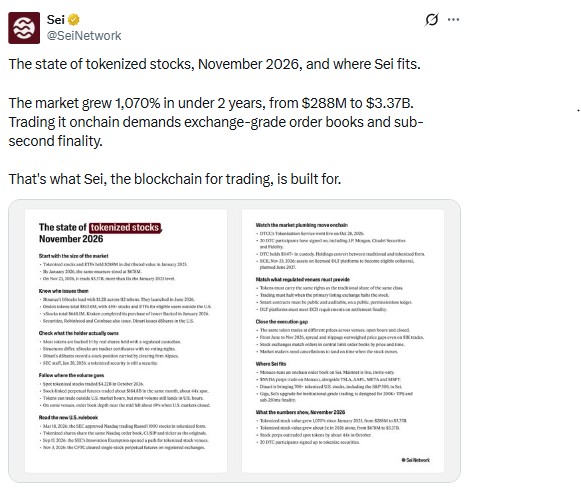
The figures come from an official @SeiNetwork post and its attached infographic. They are project-reported, and the update does not name the dataset behind them.
Date | Tokenized stocks and ETFs, distributed value |
January 2025 | $288M |
January 2026 | $678M |
November 23, 2026 | $3.37B |
Growth in 2026 alone is roughly fivefold, from $678 million to $3.37 billion.
Who Issues Tokenized Stocks and What Holders Really Own
Exchange-backed products lead issuance, according to Sei's graphic:
Binance bStocks: about $1.2 billion across 112 tokens, launched in June 2026
Ondo: about $852.6 million across 450+ stocks and ETFs, mainly for eligible users outside the US
xStocks: about $648.1 million, after Kraken completed its purchase of the issuer, backed in January 2026
Also named: Securitize, Robinhood, Coinbase, and Dinari
Ownership differs by product. Most tokens are backed 1:1 by real shares held with a regulated custodian, but legal structures vary. xStocks are typically tracker certificates without voting rights. Dinari dShares records a stock position carried by clearing firm Alpaca for eligible US investors.
SEC staff guidance dated January 28, 2026 confirmed that a tokenized security remains a security.
Why Perpetuals Dominate the Tokenized Stocks Market in 2026
Trading volume tells a different story from token supply. Spot tokenized stocks traded $4.22 billion in October 2026, while stock-linked perpetual futures traded about $184.8 billion. That is roughly 44 times the spot figure. Perpetuals are futures contracts with no expiry date.
They let traders take price exposure without holding the underlying token, which helps explain why volume can far exceed spot. Readers tracking crypto market updates should treat these as separate markets.
Tokens can trade outside US market hours, but most volume still clusters inside them. Order-book depth near the midpoint can fall about 19% on some venues when US markets close.
The same token can also trade at different prices across venues. Spreads and slippage, the gap between expected and executed price, often outweigh price gaps, even on $1,000 trades.
US Rules and DTCC Move Tokenization Into Market Plumbing
Sei's graphic lists the 2026 developments it considers most relevant:
Date | Development |
March 18 | The SEC approved Nasdaq trading of Russell 1000 stocks in tokenized form, with the same order book, CUSIP, and ticker. |
September 17 | The SEC Innovation Exemption created a path for tokenized-stock venues. |
October 28 | DTCC Tokenization Service went live, with 20 DTC participants including J.P. Morgan, Citadel Securities, and Fidelity. |
November 3 | CFTC cleared single-stock perpetual futures on registered exchanges. |
November 23 | ECB statement: assets on licensed DLT platforms to become eligible collateral from June 2027 |
The graphic also lists requirements for regulated venues. Tokens must carry the same rights as the traditional share. Trading must halt when the primary exchange halts. Smart contracts must be public and auditable on a public permissionless ledger.
Where Sei Fits: Monaco, Dinari, and the Giga Upgrade
Monaco, incubated by Sei Labs, runs an onchain order book on Sei. Sei says its mainnet is live but invite-only, with NVDA perpetuals listed alongside TSLA, AAPL, META, and MSFT. Monaco's launch post describes under 1ms execution and 400ms settlement on Sei.
Dinari is bringing more than 700 tokenized US stocks, including the full S&P 500, to Sei as dShares. They are backed 1:1 by securities held by a registered US broker-dealer and open to eligible US investors, according to the Giga Manifesto.
Giga is Sei's upgrade for exchange-grade order books. Its whitepaper targets more than 200,000 transactions per second and finality under 250ms, and Sei says its Autobahn consensus has been tested under 250ms. Every validator proposes transactions at once, so no single validator can block a trade or a market maker's order cancellation.
Status matters here. Sei v6.6 brought Giga's first execution and storage components, Ares and Eidos, to mainnet on August 4. The upgraded consensus layer will run first on a Giga testnet, so the speed targets are not yet mainnet results. Sei publishes a public roadmap for tracking each milestone.
The tokenized stock market is growing quickly, but most evidence for Sei's role is project-reported. Mainnet results for Giga and wider Monaco access will show whether the order-book case holds. This is crypto news, not investment advice, and tokenized securities carry risk.
Disclaimer: This article is for information only and is not financial advice. Crypto prices are volatile, and you can lose money. Do your own research before making any decision.






