Treasury Auction Guide: Interpret $125B Refunding Without Price Claims


What Is a Treasury Auction and How Does It Work
This Treasury Auction Guide answers a simple question: how does the US government raise money, and why is the November 2026 refunding in the news? It covers the size of the sale, the dates, the buyback plan, and the risks, with facts checked on November 10, 2026.
A Treasury auction is a public sale. The government sells bills, notes, and bonds to investors, and the cash pays off old debt and funds federal spending.
The phrase "without price claims" is easy to explain. The article shares facts only and makes no guess about where yields will go.
What Are the Main Features of Treasury Bond Auctions?
Treasury bond auctions follow the same rules each time. That steady routine is a big reason large banks and small buyers trust them.
Two types of bids: Big institutions name the yield they want. Small buyers can place a non-competitive bid and take whatever yield the auction sets.
One price for everyone: All winning bidders get the same final yield, which keeps things fair.
A public calendar: The Treasury auction schedule is posted early, so buyers can plan their cash.
Primary dealers: A group of large banks is expected to bid at every sale, which keeps demand steady.
Direct buying: Individuals can buy on the TreasuryDirect website without a broker.
How Does the Treasury Auction Process Work Step by Step?
Every sale follows the same five steps, and this Treasury Auction Guide goes through them in order.
Announcement: The Treasury posts the amount, the type of security, and the date a few days before the sale.
Bidding: Dealers, funds, and individuals send bids before the 1:00 PM ET close for notes and bonds. Non-competitive bids are capped at $10 million per bidder.
Allocation: Non-competitive bids are filled first. Competitive bids are accepted from the lowest yield upward until the full amount is sold.
Results: Each Treasury auction result is published within minutes of the close, along with the high yield and the bid-to-cover ratio.
Settlement: Buyers pay, the securities are delivered, and the cash lands in the government's account.
Understanding the $125 Billion Treasury Refunding Announcement
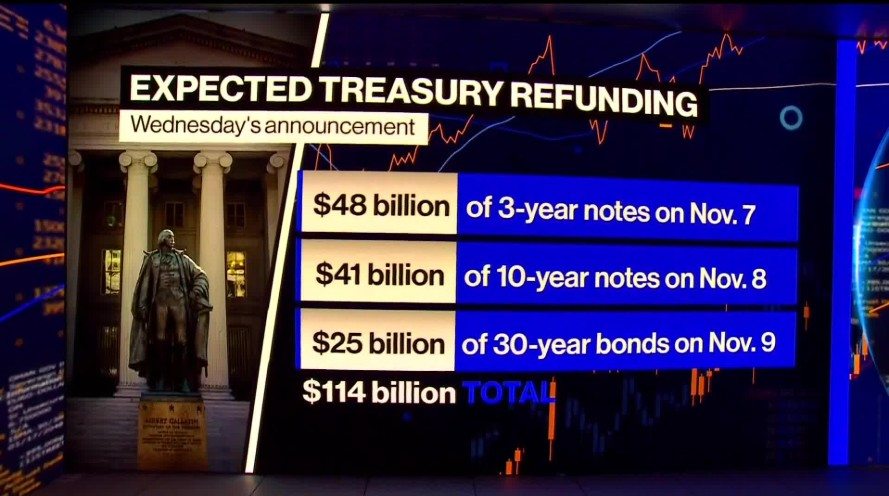
A refinance is a quarterly sale of new debt that pays off older debt coming due. The Treasury refunding 2026 package for November totals $125 billion. About $97 billion covers maturing debt held by private investors, and the other $28 billion is fresh cash from the private sector. Auction sizes for notes and bonds stay the same for at least the next several quarters.
Part | Size | Auction Timing | Market Role |
3-Year Note | $58B | Nov 9, 1:00 PM ET | Short-to-medium institutional cash |
10-Year Note | $42B | Nov 10, 1:00 PM ET | Global cost-of-capital benchmark |
30-Year Bond | $25B | Nov 12, 1:00 PM ET | Favored by pension funds |
Buybacks | Up to $70B | Variable schedule | Liquidity support for dealers |
What Does the Treasury Auction Schedule Show This Week?
Dates matter just as much as size, so this Treasury Auction Guide treats the calendar as a core fact. The 3-year note sale was set for November 9. The 10-year note sale is today.
The 30-year bond sale comes on November 12. Anyone searching for a Treasury auction result should visit the TreasuryDirect results page after each close, since this article does not report or predict outcomes.
Why Is the US Government Borrowing Leaning on T-Bills?
Note and bond sizes are flat, but borrowing needs keep growing. Net borrowing for a normal quarter is estimated at $618 billion. Early 2027 needs are estimated near $800 billion, based on published projections.
With notes and bonds capped for now, the gap is expected to be filled mostly by Treasury bills and cash management bills. These are short-term securities, and money market and Treasury funds hold many of them. That makes short-term funding the main tool for now.
What Changed in Forward Guidance and Treasury Bond Buybacks?
Dealers read the new guidance as a hint that 20-year and 30-year supply could shrink as early as May 2027. That is an interpretation, not a confirmed policy. One change is clear. The 7-year note moves to a quarterly new issue with two reopenings, much like the 10-year note.
The Treasury buyback announce schedule adds another layer of support. US Treasury buybacks mean the government buys back older, less traded securities from the market. The plan covers roughly $38 billion to $70 billion this quarter, which gives dealers more room on their balance sheets to handle new supply.
How Does This Connect to Crypto Treasury and India Crypto News?
A crypto treasury is the reserve a company or protocol keeps, and it can hold cash, treasury funds, stablecoins, and digital assets. Stablecoin issuers keep much of their reserves in short-term government securities, so bill supply can matter to that market.
Readers following India crypto news also watch US yields, since dollar liquidity can shift global risk appetite. The link is indirect, and it can change quite quickly.
What Should Investors Watch After the November 2026 Refunding?
This Treasury Auction Guide points to five things worth tracking in the coming weeks.
Bid-to-cover ratio: Total bids divided by the amount offered, a quick read on demand.
Tail or stop-through: The gap between the high yield and the market yield before the sale.
Buyback participation: How much debt the Treasury accepts at each operation.
May 2027 guidance: Any formal word on lower long-end supply.
Bill issuance: Weekly bill sizes and any new cash management bills.
What Are the Causes and Risks Behind the Refunding?
The causes are simple: a growing deficit, a large pile of maturing debt, and higher interest costs. The risks covered in this Treasury Auction Guide deserve equal weight. Heavy use of short-term bills creates rollover risk, since that debt must be refinanced often.
A weak auction could also strain trading in the secondary market. Buybacks may ease the pressure but cannot remove it, and a shift in deficit forecasts could change the plan quickly.
Conclusion
This Treasury Auction Guide shows a refunding that appears calm on the surface. The real story sits in bill reliance, buyback support, and possible long-end supply cuts in 2027.
Readers should verify every figure on the official Treasury and TreasuryDirect pages and keep following US Treasury news before drawing conclusions.
Disclaimer
This article is for information only and is not financial, investment, or legal advice. Treasury securities and crypto assets carry risk, and market conditions can change quickly. Readers should research independently and consult a licensed advisor before making any decision.
















