US Senate Bills 2026: Why 5 Major Bills May Be Delayed Until November?

US Senate Bills 2026: 10 Days Left for Farm Bill, NDAA, AI and Funding
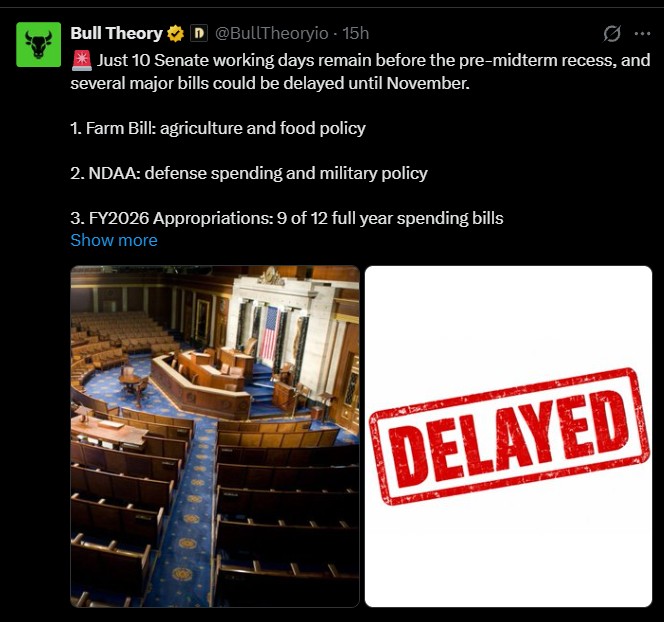
Washington is entering a compressed stretch of the legislative calendar. With only about 10 Senate working days remaining before lawmakers break for the pre-midterm recess, several significant regulation bills covering agriculture, defense, government funding, energy permitting, and artificial intelligence regulation are competing for limited floor time.
The Senate will be largely absent for October and the first week of November around Election Day, meaning anything not resolved soon could be pushed into the post-election session.
At a Glance:
Senate has roughly 10 working days left before its pre-midterm recess
Farm Bill, NDAA, FY2026 appropriations, permitting reform, and AI legislation all at risk of slipping to November or later
Agricultural Act of 2026 cleared committee on a 12-11 party-line vote
Fast-tracked data center ratepayer bill was blocked on the Senate floor
Lawmakers face a genuine race against the calendar before Election Day
Senate Has Just 10 Working Days Before Pre-Midterm Recess
Lawmakers are working against a narrow window. Once the chamber departs for its pre-midterm break, it will remain out of session for most of October and into early November, spanning Election Day itself.
That leaves five major legislative priorities in limbo: the Farm Law, the National Defense Authorization Act (NDAA), FY2026 appropriations, permitting reform for energy and infrastructure, and AI and data center regulation. Any of these that fail to advance in the coming days will likely wait until after the midterms.
Source: The Bull Theory
Farm Bill Clears Senate Agriculture Committee on 12-11 Vote
The Senate Agriculture Committee advanced the Agricultural Act of 2026, known as the Farm policy, in a party-line 12-11 vote. Every Republican supported the act, and every Democrat opposed it.
The vote succeeded after Senator Mitch McConnell returned from a health absence to cast the deciding Republican vote, reversing an earlier setback in August when the committee split against advancement.
Senate Majority Leader John Thune has indicated he wants to move the bill toward conference negotiations with the House as quickly as floor time allows.
Major Bills Facing the Senate Deadline
Legislation | Current Status | Main Issue | Next Step |
Farm reform | Committee approved 12-11 | Prop 12, SNAP provisions, bipartisan support | Full Senate |
NDAA | Pending | Defense policy and authorization | Senate consideration |
FY2026 | 9 of 12 bills pending | Funding deadline | Senate action |
Permitting Reform | Pending | Energy and infrastructure approvals | |
AI Legislation | Pending | AI and data center regulation | Further Senate action |
Prop 12 and SNAP Disputes Could Complicate Farm Bill Passage
Senator Joni Ernst pushed unsuccessfully for a floor vote on an amendment addressing California's Proposition 12 and its effect on livestock producers outside the state. Chairman John Boozman held that the amendment window had closed, setting up a continued fight once the bill reaches the floor.
Separately, Democrats cited unresolved SNAP cost-shift provisions and a lack of bipartisan input as reasons for their opposition. Committee passage does not guarantee a Senate floor win, since the bill will likely need 60 votes to clear procedural hurdles.
Source: Politico Data
What the 2026 Farm Bill Would Change for Farmers and Consumers
Among its most notable provisions, the bill would make E15 fuel available nationwide, year-round, a change supporters say could add billions to the corn economy while trimming several cents off gas prices.
It also restores mandatory country-of-origin labeling for beef, expands farm credit access, shifts the Food for Peace program to USDA, and updates several conservation programs.
Reaction has been mixed: commodity groups and ethanol producers broadly welcomed the measure, while some family-farm and conservation advocates argue it does not go far enough.
Data Center Ratepayer Bill Hits Senate Roadblock
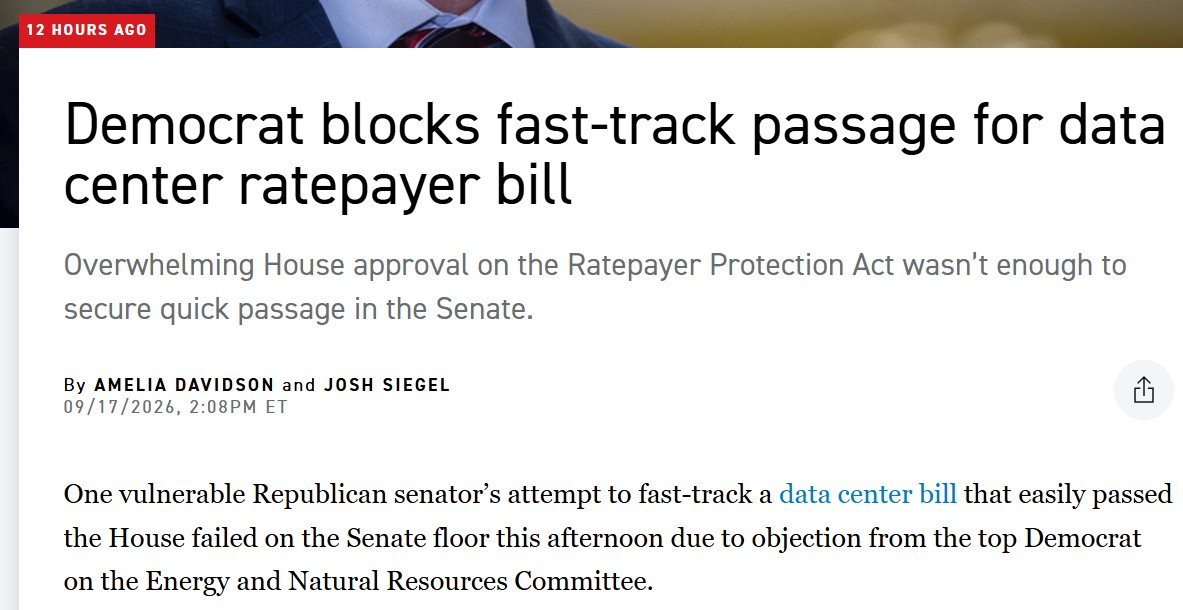
Separately, an attempt to fast-track the Ratepayer Protection Act, aimed at limiting how data centers affect consumer electricity bills, failed on September 17.
Senator Jon Husted sought unanimous consent for quick passage after the bill cleared the House by a wide margin. Senator Martin Heinrich objected, arguing the measure lacked enforcement strength, and offered his own GRID Savings Act as an alternative, which drew a competing objection from Senator Bernie Moreno. The standoff illustrates how even bipartisan-leaning bills can stall in a Senate short on time.
Appropriations, NDAA and Permitting Reform Face the Same Time Crunch
Nine of twelve FY2026 full-year appropriations bills remain unresolved, with the current funding patch set to expire December 11. The NDAA, covering defense policy and spending, is also competing for limited floor time, as is permitting reform legislation tied to energy and infrastructure approvals.
AI Legislation Adds Another Pressure Point Before the Recess
AI and data center regulation remains an unresolved thread tied closely to the electricity cost debate playing out around the Ratepayer Protection Act. Disagreements over how far federal requirements should extend could make swift, bipartisan action harder to reach before the recess.
Senate Timeline: What Happens Before and After the Midterms?
September 2026: Farm legislation clears committee (Sept. 16); Ratepayer Protection Act fast-track blocked (Sept. 17).
Next 10 working days: Compressed window for remaining floor action.
October 2026: Extended pre-midterm recess begins.
Early November 2026: Senate remains largely out around Election Day.
After the Midterms: Unfinished bills return to the agenda, pending post-election scheduling.
Conclusion
The next two weeks represent the critical window for Senate action, but committee approval alone does not guarantee final passage. Outcomes for the Farm Bill, appropriations, NDAA, permitting reform, and AI legislation will hinge on floor scheduling, bipartisan negotiation, and how much time the Senate can carve out before the midterm recess.
Disclaimer: This article is for informational purposes only and does not constitute financial, legal, or investment advice. Cryptocurrency and financial markets are volatile and involve risk; readers should conduct their own research and consult a qualified professional before making financial decisions.