Variational Mainnet Explained: How Omni Works After Public Launch

How Does Variational Mainnet Work? Omni Features and Trading Fees
Variational Mainnet introduces a different approach to decentralised derivatives trading by bringing multiple asset classes together on one platform. Through Omni, traders can access perpetual markets covering cryptocurrencies, stocks, commodities, indices and more without switching between different trading platforms.
Built on Arbitrum, the platform combines quote-based execution, cross-margin accounts and on-chain settlement to simplify the trading experience. Its zero-fee model and dedicated liquidity provider also set it apart from traditional order-book exchanges. But how does the Variational Mainnet work, what powers Omni, and how does its trading mechanism operate? Let's explore the protocol, platform features and benefits for traders.
Key Takeaways
The beta has ended. Sign-up no longer needs a referral code, and the platform lists 550+ markets.
Omni charges 0% trading fees. The docs say it earns by keeping the market-making yield instead.
Every trade settles on-chain, but leveraged trading still carries real risk.
Variational Omni: What It Is
Variational Omni is a perps DEX built on Arbitrum. Users trade perpetual futures on crypto, stocks, commodities and indices from one cross-margined account. The official site also lists FX and pre-IPO assets.
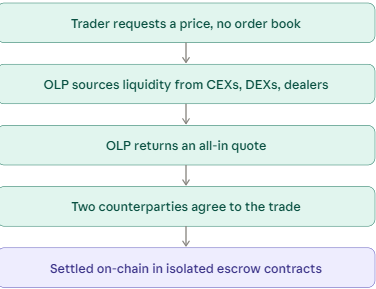
There is no order book. Traders use request-for-quote, and the Omni Liquidity Provider (OLP) answers with a price. The docs say OLP pulls liquidity from CEXs, DEXs and TradFi dealers. That is how Omni lists hundreds of markets without building a book for each one.
Source: official website.
Variational Protocol: The Layer Underneath
The Variational Protocol handles peer-to-peer trading, clearing and settlement of derivatives on-chain. Each trade is between two counterparties who agree to its rules. It settles in isolated escrow smart contracts.
Isolation matters. A liquidation between two parties never touches anyone else’s margin.
Omni is the first app on this protocol. Pro is built for institutions that trade customizable OTC derivatives, which are often negotiated over chat today. The docs say Pro automates booking, clearing and settlement on-chain.
Omni vs Protocol at a Glance
Point | Omni | Protocol |
Built for | Everyday traders | Institutions |
Products | Perps and swaps | Customizable OTC derivatives |
Pricing | Request-for-quote, 0% trading fees | Terms agreed between counterparties |
Settlement | On-chain, escrow contracts | On-chain, segregated escrow contracts |
Omni Private Beta to Public Mainnet: The Timeline
The beta began on Arbitrum in January 2025. At first, only whitelisted addresses from the testnet and a Discord waitlist could get in.
When | What happened |
January 2025 | Invite-only beta begins |
During the beta | Zero fees made permanent, referral and points programs launched, interface revamped twice |
Beta, later stage | First TradFi markets listed |
September 2026 | Swaps launched |
11 November 2026 | Beta ends, open sign-up begins |
What Changed With the Variational Mainnet Launch
Point | Beta | Now |
Access | Referral code required | Open sign-up |
Trading fees | 0% | 0% |
Markets | Crypto first, TradFi added later | 550+ crypto and traditional markets |
Settlement | On-chain | On-chain |
The Variational referral program began during the beta, and codes were the way in. Sign-up now works without one.
Variational Zero-Fee Perps: How the Model Works
Trading fees is always 0%, whether a position is $100 or $1,000,000. That is a real feature.
The docs explain where the money comes from. Omni’s liquidity provider is part of the platform. So it keeps the market-making yield that outside market makers usually take.
Still, a quote-based venue has a cost somewhere. It sits in the price quoted. Fair comparison between venues means checking the final price, not only the fee line.
What Traders Gain After Mainnet
The Variational public mainnet changes who can use the platform. Here is what that means in practice.
Benefit | What it means |
Open access | No waitlist spot or referral code needed |
One account | Crypto and TradFi positions share one margin account |
Wide choice | 550+ markets, with more added regularly |
Flat cost | 0% trading fees at any position size |
On-chain settlement | Trades clear in escrow contracts, not on a private ledger |
Contained risk | A liquidation stays between two counterparties |
Who Omni Is Built For
Omni suits traders who want several asset types in one place. Someone holding a Bitcoin position can open a gold or stock position without moving funds to a second venue. One margin account covers both.
It also suits people who dislike fee tiers. The 0% rate does not change with size, so a small trade and a large one carry the same fee line.
Institutions have a different path. Pro is the app aimed at them, with custom margin and liquidation rules set per trade.
None of this makes Omni a fit for everyone. Perpetual futures reward discipline, and beginners are better off learning the mechanics first.
What to Watch
Omni relies on its own liquidity provider. That makes the platform simple, but it also puts weight on one counterparty. Volume will test that setup as more users arrive.
Leverage cuts both ways. Positions can be liquidated, and losses can move fast. The docs cover automatic deleveraging, and beginners should read that page before depositing.
Availability also depends on location. Variational’s legal pages include a Restricted Persons list, which is worth checking first.
Final Thoughts
The Variational mainnet launch turns an invite-only beta into an open platform. The market list is wide, the fee model is clear, and settlement stays on-chain.
The next proof is scale. Readers can track real progress through the official docs and Variational’s X account.
Disclaimer: This article is for information only and is not financial advice. Perpetual futures use leverage and can cause losses. Figures are reported by Variational and may change. Nothing here is an offer to buy or sell any token or product. Please read the official documentation and do independent research before trading.