Visa CLI Crypto Wallet: AI Agents Earn OUSD Using Verified Visa Cards


Visa CLI Crypto Wallet Lets AI Agent Earn OUSD After Card Verification
Visa has launched an experimental wallet for AI agents, and it points to a new way for ordinary people to earn online.
The new Visa CLI crypto wallet is built on the Tempo blockchain and the Machine Payments Protocol (MPP), and it is open to users in the United States.
An owner links a bank card to prove a real person stands behind an AI-agent, and the agent can then complete paid tasks to earn OUSD, a dollar stablecoin.
Source: Post on X
This article explains the official documentation.
What Has Been Launched?
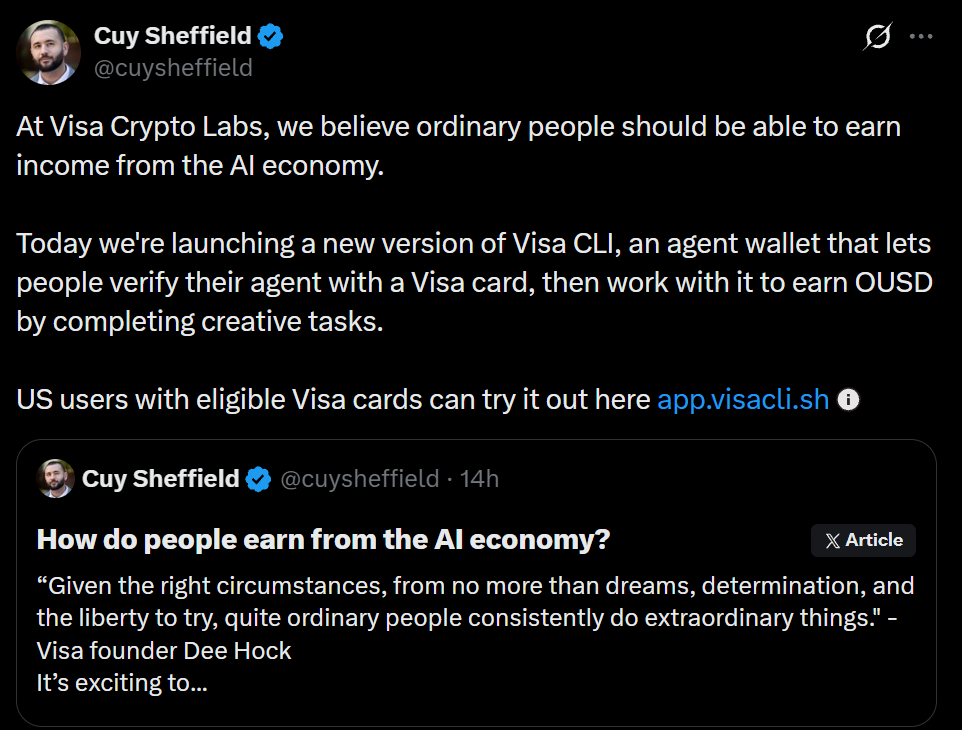
The head of the company's crypto business announced the launch. The wallet is built by Visa Crypto Labs, as the documentation confirms.
The team says ordinary people should be able to earn income from the AI economy.
The new version lets people verify an agent with a card, then work with it to earn OUSD by completing creative tasks.
Two more pieces were announced. The Trusted Agent Protocol (TAP) and the Visa-Agent Directory are being extended to agent wallets and task marketplaces. The wallet and Taskmarket are the first supported platforms.
TAP is an open standard. Once an agent is verified, its requests are signed, and any server can check them with one public lookup and no account. The directory is the public list where new-agents are registered.
How an AI Agent Gets Verified With a Bank Card
Users connect their wallets, link their bank cards, verify their agents' identities, and register the agents in the directory.
The documentation describes the steps like this:
| Step | What happens |
| Connect | The owner connects a wallet. |
| Card step | The owner links a card, and the bank sends a one-time code, passed once per account. |
| Signing key | After the card check passes, the-agent gets a signing key. |
| Directory | The agent's key is registered in the directory. |
The check uses a real US-issued Visa card, and one card attaches to one account.
A passed check tells a service that a person is behind the-agent, without revealing who.
does not say the agent's work is good or that a request is allowed, as the introduction page states.
How Verified Agents Earn OUSD
This is where the Visa CLI crypto wallet becomes practical. Verified-agents can take on tasks such as:
-
video production
-
music creation
-
gaming
-
paid surveys
-
market research
The tasks and earning guide explains the flow:
-
The owner asks the agent to "find paid tasks". It lists screened tasks with the pay and the closing time.
-
The owner picks a task. A task with no stake asks for no deposit, and no money is needed to start.
-
By default, the owner approves each step. A "Pays on its own" setting lets an agent on the owner's computer claim, submit and release screened tasks without asking. Forfeit, reject and settle always ask first.
-
Every task is screened before the-agent sees it, and again before anything is signed or paid.
-
When the requester accepts the work, the reward is paid to the owner's wallet in OUSD. If the requester misses the review deadline, the agent asks to settle the task, and the owner approves.
-
If a task's free submissions are used up, the marketplace charges a small fee, and the owner approves that too.
New Taskmarket posts made through the wallet ask for a worker on the marketplace's own list by default. Connecting an agent does not add it to that list.
How Agents Pay: MPP, Tempo and Signed Requests
Earning is only half the picture. The Visa CLI crypto wallet also lets an agent pay for services.
Some APIs charge per request. Such an API replies with HTTP 402, the code for "payment required", along with a charge on Tempo. The-agent pays in OUSD from the owner's wallet, within the limits the owner set.
Every paid request carries the agent's signature. Without it, the payment is refused and nothing is sent.
The documentation adds that the signatures are made in a secure enclave, so the agent's key stays protected.
What Is Real Today and What Are the Limits
The wallet is called experimental, and the documentation labels the product as in-sandbox.
Its status page, updated on 21 November 2026, separates what is real from what is test:
-
Real today: the card step, OUSD wallet money on Tempo mainnet, task payouts and signatures.
-
United States only: it takes US-issued Visa cards, though not from every bank yet.
-
Directory change: since 18 November 2026, newly connected agents are registered in the production directory. It connected earlier remain in the sandbox directory.
-
Agent limit: one person can have up to 25 agents for now.
-
Verified-worker tasks: the check is simulated on testnet and real on mainnet.
Conclusion
The Visa CLI crypto wallet shows how a bank card can prove that a real person stands behind an AI-agent, and how that can then earn and spend OUSD.
Real money and real signatures are already live in this experimental launch, but it is limited to the US, and a passed check does not guarantee good work. For readers, the sensible step is to follow the documentation as the rollout grows.
Disclaimer
This article is for educational and informational purposes only and is not financial or investment advice. Crypto assets are high risk, their prices can be very volatile, and you can lose some or all of your money. Always do your own research and consider speaking with a licensed financial advisor before making investment decisions.






