Web3 Gaming Projects Shutdown: Five Games That Could Not Last

What Factors Led to the Shutdown of Five Web3 Gaming Projects in 2026?
Crypto had a hard year. Prices fell, funding dried up, and many teams switched off their products. Blockchain gaming was hit hard.
Key Takeaways
Five Web3 gaming projects shutdown between February and August 2026 are covered here.
Most teams blamed weak revenue or a model that did not fit games, not hacks.
Players got different outcomes: refunds, open-source assets or a fan-led restart.
What Happened to the Web3 Gaming Ecosystem in 2026?
Many GameFi projects launched in the last cycle expecting token rewards to bring in players. In 2026, the Web3 gaming ecosystem ran into weak revenue and thin audiences.
This guide covers Web3 Gaming Projects Shutdown in 2026 cases, with dates taken from official sites and news reports.
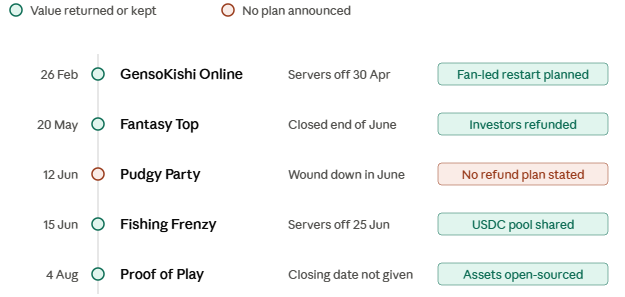
Web3 Gaming Projects Shutdown in 2026: Quick Snapshot
Project | Type | Announced | Closing | Main reason |
GensoKishi Online | Polygon MMORPG | 26 Feb | 30 April | Monthly deficit |
Fantasy Top | Trading card game | 20 May | End of June | Volume too low |
Pudgy Party | Mobile game | 12 June | June | Focus on Pudgy World |
Fishing Frenzy | Ronin game | 15 June | 25 June | No product-market fit |
Proof of Play | Game studio | 4 Aug | Not given | No sustainable business |
Web3 Gaming Projects Shutdowns
1. Proof of Play
Proof of Play was the studio behind Pirate Nation, an onchain RPG. Its website lists more than 485 million transactions and over 360,000 unique users. The PIRATE token now has an independent foundation behind it.
Why the Studio Closed
The team announced the closure on 4 August. It said it could not build a sustainable business or a product proving that blockchain games could bring a decentralized internet to scale. It had raised $33 million in 2023, co-led by a16z and Greenoaks. A co-founder had already called play-to-earn gaming “fundamentally broken” in July 2025, and Pirate Nation itself shut in September 2025.
What Players and Builders Got
The studio open-sourced Pirate Nation’s code, smart contracts and art under a CC0 license through four GitHub repositories. The foundation continues to support PIRATE. It is reported that the whole workforce was affected.
Source: official documentation.
2. Pudgy Party
Pudgy Party was a Fall Guys-style mobile game co-developed by Pudgy Penguins and Mythical Games. It launched globally in August 2025 and passed one million downloads. Players could optionally mint and trade items as NFTs.
Why It Closed
Decrypt reported that Pudgy Penguins wound the game down less than a year after launch. Games.gg noted that the team did not fully control a co-developed product, while Pudgy World, built in-house, removes that problem. It also pointed to the weak NFT market, now near $1.5 billion against over $17 billion at the 2022 peak.
Impact on NFT Gaming Assets
The game disappeared from the iOS and Android stores. At the time of the announcement, no refund or asset migration plan was mentioned. The Pudgy Penguins collection of 8,888 items and about 5,100 holders stays active. The official site now warns about fake sites impersonating Mythical Games and Pudgy Party.
3. Fantasy Top Shutdown
Fantasy Top was an onchain trading card game with NFT cards of crypto influencers, scored on their X engagement. It launched in 2024 on Blast and moved to Base in July 2025.
Why Fantasy Top Closed
The team announced the closure on 20 May after about two years. Co-founder Kipit said the model was “never built for crypto,” and The Block reported that it attracted people who wanted to profit from cards rather than card-game fans. The team also said trading volume could not support long-term operations.
Timeline and Payouts
Prediction markets, jackpots and arenas closed on 21 May. The final competition ran until 18 June, and the platform shut at the end of June. It had paid out over $20 million to users and $3.2 million to featured influencers. Pre-seed and seed investors were refunded in full, and the official site now reads “Fantasy has closed.”
Source: official website.
4. Fishing Frenzy Shutdown
Fishing Frenzy was a game from studio Uncharted, launched on Ronin in April 2025 as its first permissionless game. Its FISH token ran on Ronin.
Why Uncharted Closed
On 15 June, Uncharted announced it would close both the studio and the game. The team said it could not prove its thesis on crypto gaming and did not find enough product-market-business fit.
Source: shutdown announcement.
What Happened to the Gaming Token Economy
USDC package sales ended, and FISH became spend-only and untradable. Servers went offline on 25 June at 2:00 UTC. The team returned USDC from the FISH/USDC pool to the community and stakers, based on Karma scores from a 15 June snapshot. It also made the Karma data public.
5. GensoKishi Online Shutdown
GensoKishi Online is a 3D fantasy MMORPG on Polygon, the successor to Elemental Knights Online. Its tokens were MV and ROND. The official site says the series has passed 8 million downloads.
Why It Closed
At an AMA on 26 February, the team called its finances unsustainable. Monthly fixed costs came to about JPY 10 million, which left a significant monthly deficit, according to PlayToEarn.
A Fan-Led Restart
Servers, the marketplace and MV Wallet closed on 30 April, and staking rewards stopped. On 21 April, operations moved to a Japanese company, Hanabitei, which two players had set up for the purpose, according to PC Games. The reboot was to start in mid-May, with a relaunch targeted for August or September. The official site now carries notices asking users to unstake and relink their login.
Why Are Web3 Gaming Projects Shutting Down?
The reasons behind blockchain gaming project shutdowns differ, but a few themes repeat.
Theme | Examples |
Token-first model | Proof of Play, Fantasy Top |
Thesis not proven | Fishing Frenzy, Proof of Play |
Costs above revenue | GensoKishi Online, Fantasy Top |
Strategy shift | Pudgy Party |
Final Thoughts
Web3 Gaming Projects Shutdown in 2026 followed one pattern: tokens and NFTs drew early users, but games did not earn enough to stay open. Players should check each team’s official page for refunds, withdrawal windows and scam warnings before acting.
Disclaimer: This article is for information only and is not financial advice. Details come from public reports and may change.