What Is EVAA Protocol? Why the Token Jumped as TVL Fell

What Is EVAA Protocol and How Does Its Telegram App Work?
A lending app inside Telegram sounds like a niche idea. Then its token roughly tripled in a week while the money deposited in it kept shrinking. So what is EVAA Protocol, and why do those two lines point in opposite directions? This guide explains the product, the data, and the risks.
EVAA is a lending market on TON that runs inside Telegram. Its token jumped sharply in a week, yet deposits sit far below their early peak.
Price shows attention. Deposits show use. Read both before you decide anything.
What Is EVAA Protocol, and How Does Lending on TON Work?
It is a decentralized lending protocol on the TON blockchain. Think of it as a pool run by code instead of a bank. Users supply assets to a pool and earn interest. Others borrow from that pool by locking collateral worth more than the loan.
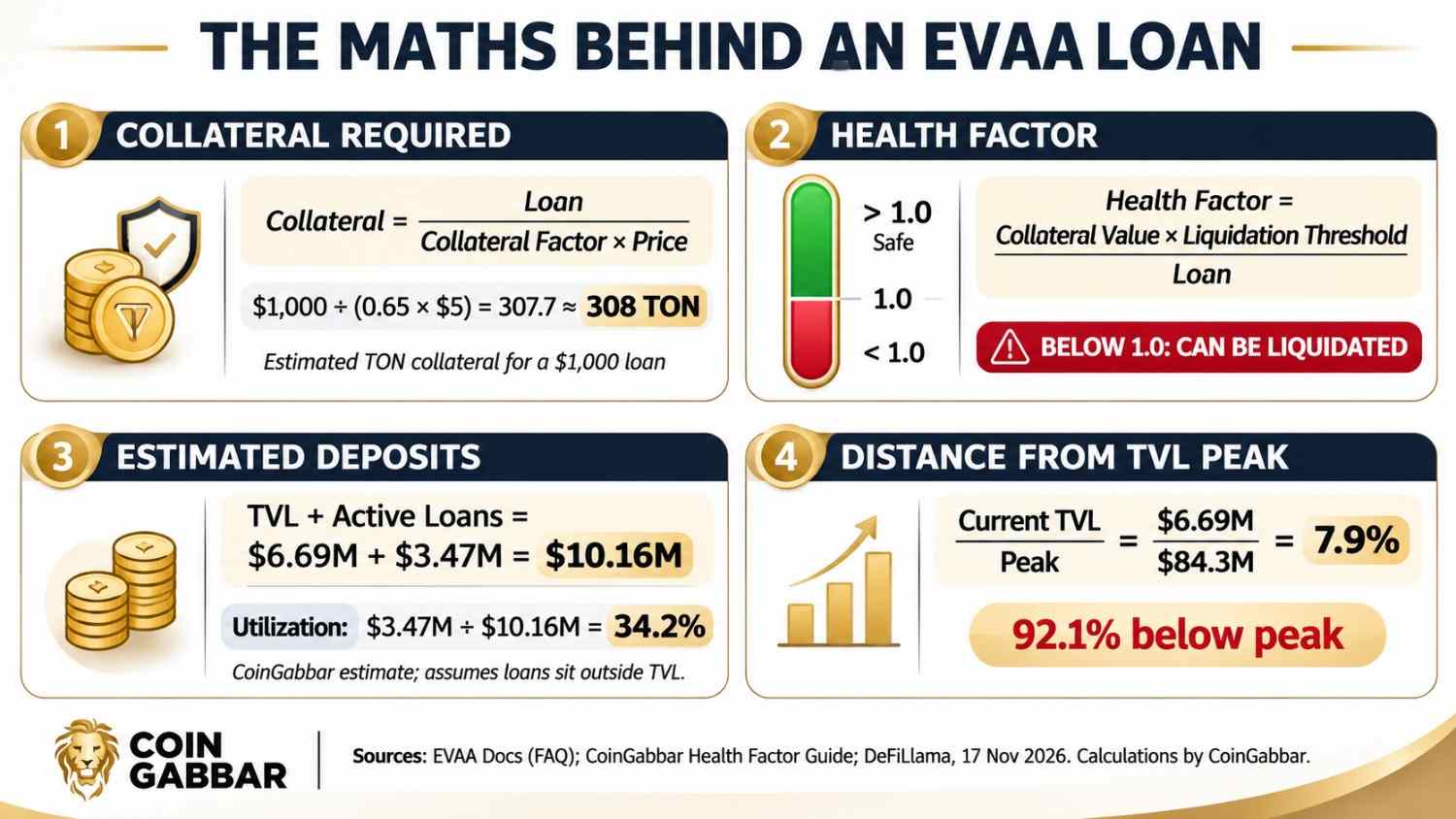
The project’s docs give a clear example. To borrow 1,000 USDT with TON priced at 5 USDT and a 65% collateral factor, you need about 308 TON. Interest builds every block, and no repayment date is fixed. Everything happens on chain, with no bank in the middle. Stablecoins like USDT are explained in our stablecoin guide.
If collateral falls in value, the position can be liquidated. That means the protocol sells it to repay the loan.
Why Does Telegram Matter for This Lending Market?
Most DeFi asks users to install a wallet, find an app, and approve each step. This one is reachable as a Telegram Mini App, so the first click happens where users are already chatting.
That is a distribution edge. It is not proof of adoption. A shorter path helps only if people stay and keep money in the pool.
The data below shows how far that has gone so far.
What Is the EVAA Token Used For, and What Is Still Planned?
The project’s token page lists fee discounts, boosted yields, treasury use, and yield features. It also describes payments, cards, and AI finance tools as planned.
Separate what is live from what is promised. We could not confirm that every listed use works today.
Supply matters too. Of 50 million tokens, only about 6.6 million circulate. That is roughly 13% of the total, so most of the supply is still to come.
How Big Is EVAA Protocol Really, and What Is Its TVL?
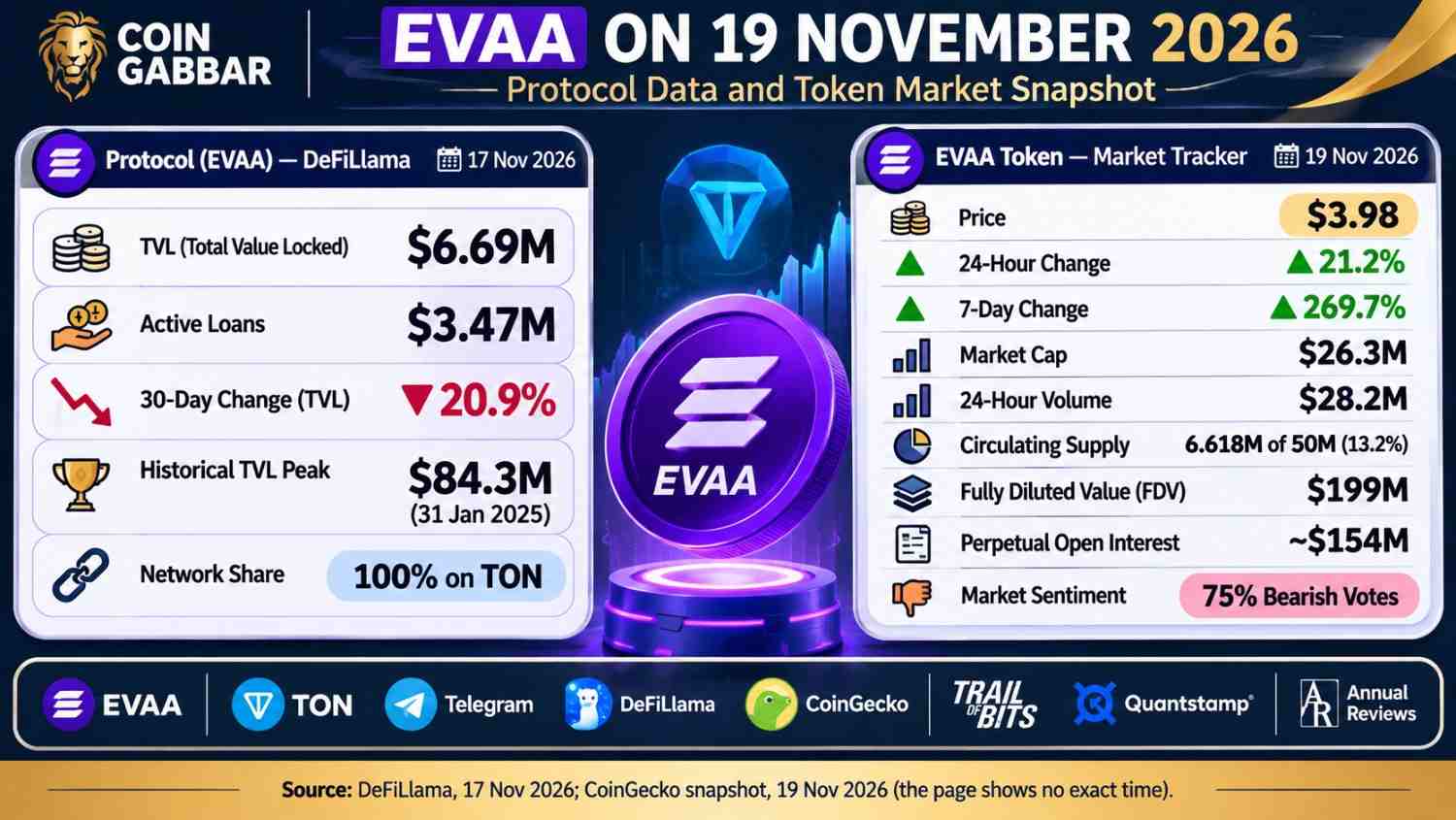
Independent TVL data showed about $6.69 million deposited on 17 November 2026. It also showed $3.47 million in active loans, charted apart from TVL. The 30-day change was down 20.9%.
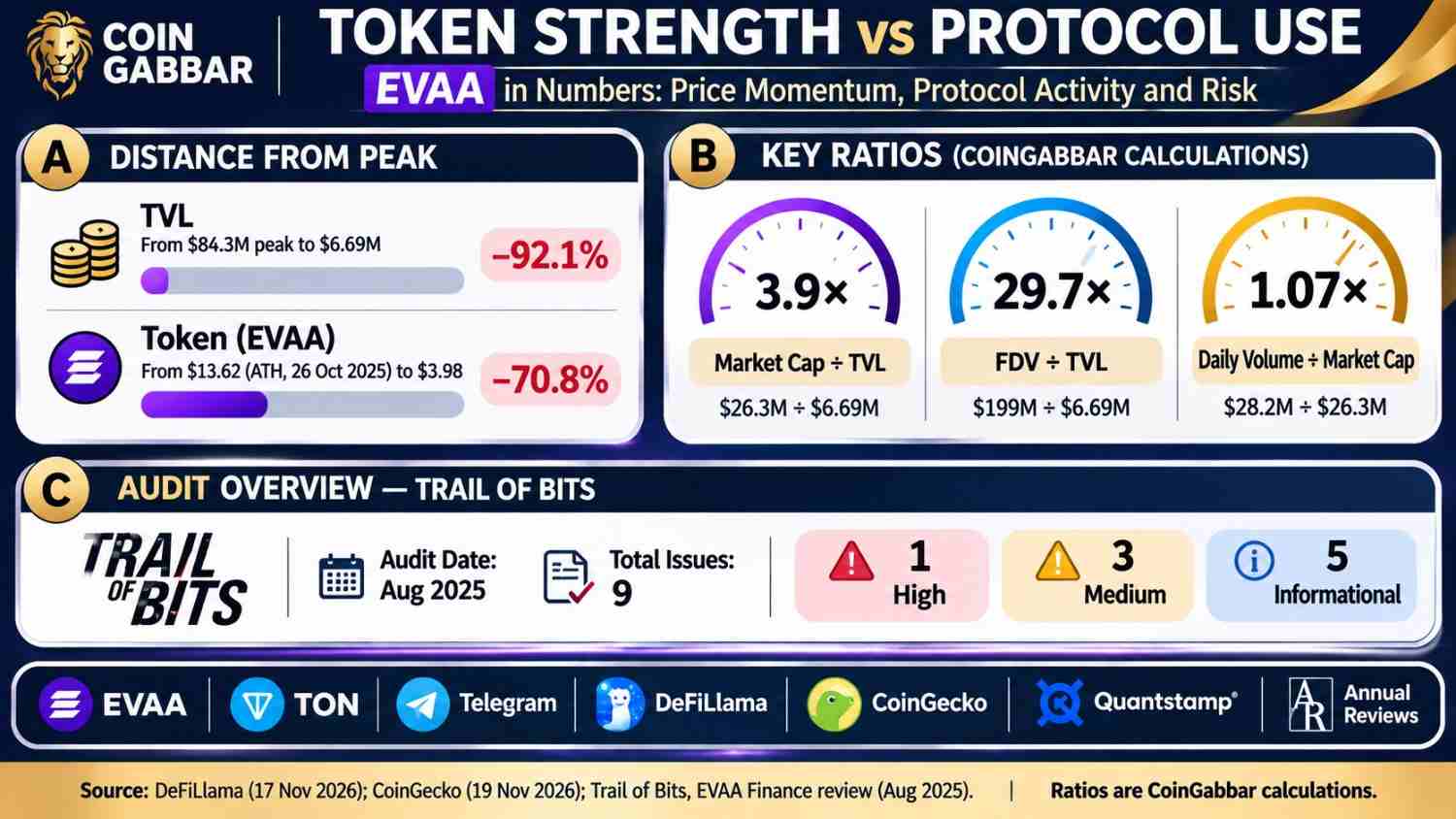
The peak was $84.3 million on 31 January 2025. Today’s figure is about 7.9% of that peak, a fall of roughly 92%. That is our calculation.
Total value locked is the money sitting in a protocol. Our TVL explainer covers the basics. If loans sit outside TVL, deposits would be near $10.2 million, and about 34% of them would be lent out. That is our estimate.
Why Did the EVAA Token Jump While TVL Kept Falling?
A market tracker showed the token near $3.98, up 21.2% in a day and 269.7% in a week. Market cap was about $26.3 million. Volume was about $28.2 million, so trading in a day nearly matched the whole cap.
Fully diluted value was about $199 million. Against TVL, that is roughly 30 times. Market cap alone is about 3.9 times TVL. Both ratios are our calculations.
We found no verified event behind the jump. Open interest in perpetual futures was near $154 million, which hints at leveraged bets. Votes on the tracker leaned 75% bearish.
What Do the Published Audits Say About Its Security?
Trail of Bits published a review dated August 2025. It lists nine issues: one high, three medium, and five informational. The high one says weak fee checks could lock a user contract’s state.
Quantstamp has also published a report, which readers can open from the project’s docs. We could not read its counts, so we do not quote them.
An audit lowers risk. It does not remove it. Code can change after a review, and each fix needs its own checking.
What Risks Should You Check Before Using EVAA?
Start with liquidation. A common health factor is collateral value times the liquidation threshold, divided by the loan value. Below one, a position can be sold. Our health factor guide shows the math.
Next, prices. Smart contracts cannot see the outside world alone, as an Annual Review of Financial Economics paper notes. They depend on price feeds that can fail.
Then liquidity and unlocks. All of the tracked TVL sits on TON, and most tokens are not yet circulating.
Expert Opinion: Is EVAA Token Strength Real Adoption?
CoinGabbar analysis suggests the rally reflects attention more than use, for now.
This view rests on the reported TVL, the 92% fall from peak, and the thin circulating supply.
A rising TVL and loan book would change our reading. Until then, the divergence is the signal to watch.
Disclaimer: This guide explains a lending protocol and its data. It does not tell you to buy, lend, or borrow. Prices, yields, and deposits can change fast. This is not financial, legal, or tax advice. Nothing here is promised or assured, and you can lose all the money you put in. Check with a qualified adviser before you act.