What Is Hyperliquid? How On-Chain Perpetual Trading Works


What Is Hyperliquid? How On-Chain Perpetual Trading Works
What is Hyperliquid? It is a decentralized exchange, built on its own blockchain, where people trade perpetual futures from their wallets. Its token is HYPE.
Perpetual futures, or perps, are contracts that track a price and never expire. The platform runs them on-chain, so positions are public. This guide covers where it started, what is new, and where it may go. Our Hyperliquid price outlook covers market levels.
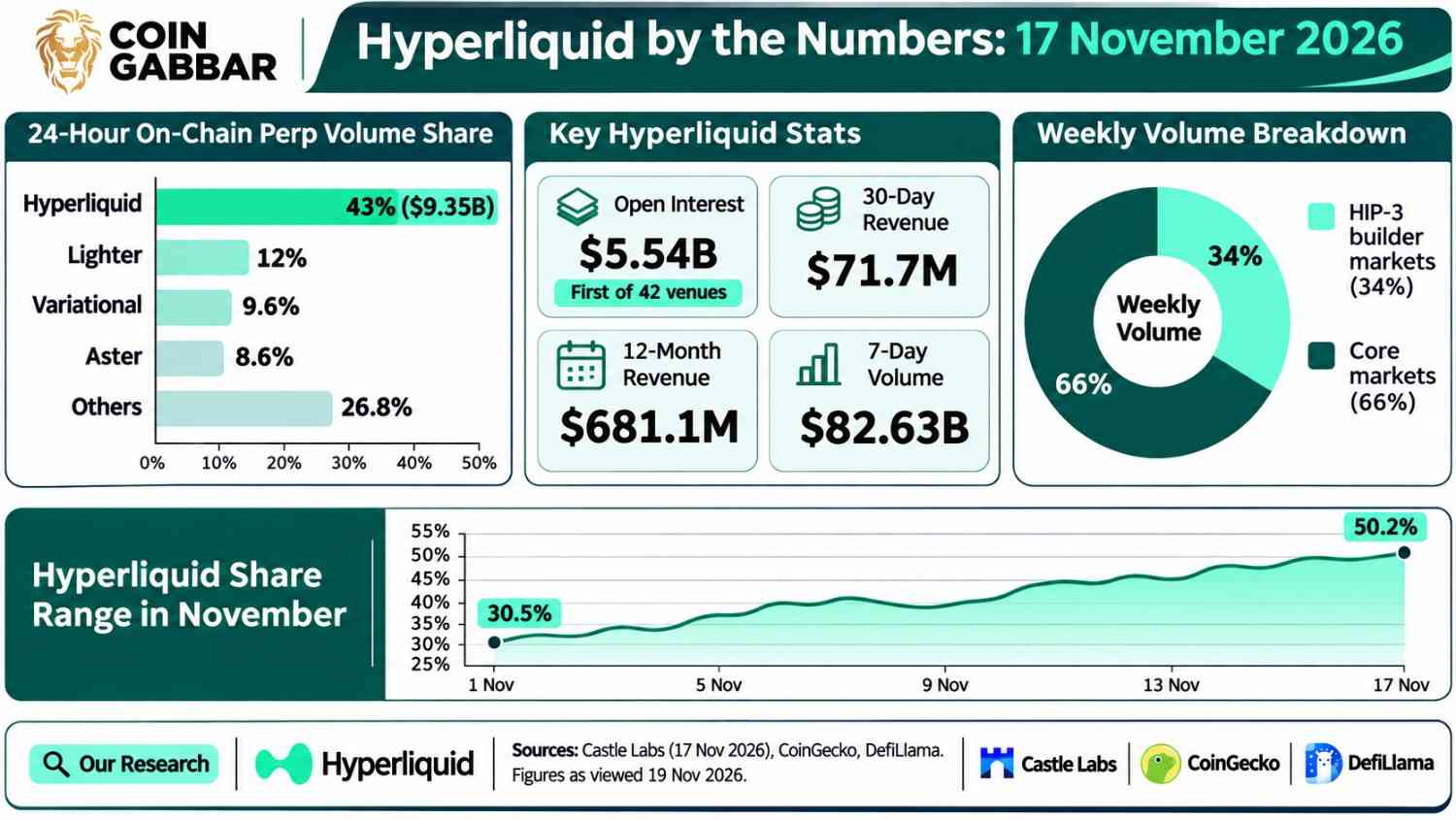
It grew from a trading firm into one of the largest venues in DeFi. On 17 November 2026, it handled about 43% of on-chain perp volume and 54% of open interest, according to Castle Labs.
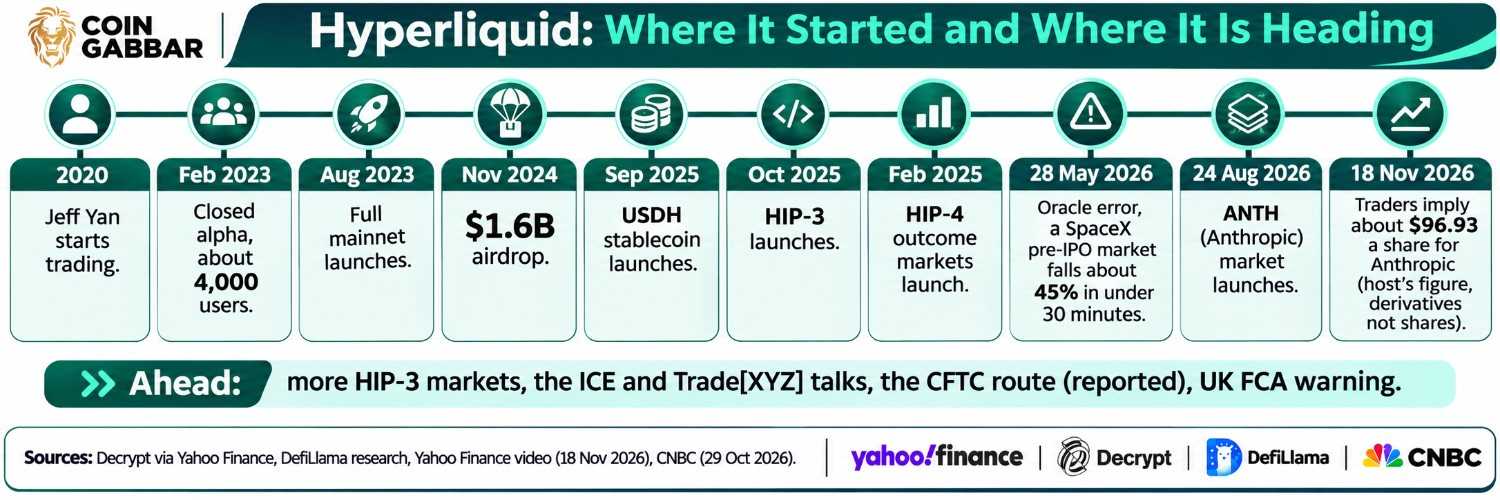
Origin: self-funded, built by 11 people, mainnet in 2023, and a $1.6 billion airdrop in November 2024.
New: public positions, builder-run markets called HIP-3, and pre-IPO contracts.
Scale: $82.63 billion of volume in seven days to 17 November 2026.
Risk: leverage up to 40x, oracle errors, and a UK regulator warning in May 2026.
What Is Hyperliquid, and How Did It Start?
Jeff Yan began trading crypto in 2020 and founded a market-making firm, the seed of the project. By 2022 that business had capped out.
The team stayed small and turned down venture capital. Yan said it was self-funded and built by 11 people. A closed alpha opened in February 2023 with about 4,000 users and 28 assets in five months. The full mainnet followed in August 2023.
The turning point came in November 2024. A $1.6 billion airdrop led to rapid growth, and HYPE later rose into the top 10 by market cap.
How Does On-Chain Perpetual Trading Work on Hyperliquid?
A perpetual future follows an asset’s price with no expiry date. Traders post collateral and can borrow to enlarge a position. That borrowed size is leverage. It offers up to 40x, and the maximum falls as position size rises. Our guide to how perpetual futures work covers the basics.
If losses eat the collateral, the platform closes the position. That is liquidation. On the platform, the block explorer shows a wallet’s positions, profit, and liquidation price. Centralized exchanges usually keep such data private.
Fees are tiered. Spot taker fees run from 0.07% to 0.025%. Perp maker fees fall to 0% for high-volume traders.
What New Does Hyperliquid Bring to Decentralized Trading?
Three features stand out. It runs its own layer-1 chain built for trading. HIP-3, launched in October 2025, lets outside teams deploy their own perp markets. HIP-4, added in February 2026, introduced fully collateralized outcome markets.
HIP-3 now matters for volume. Markets built by outside teams made up 34% of volume in the seven days to 17 November 2026, per Castle Labs research.
Fees also feed the token. Castle Labs counts $71.7 million of HYPE bought back in 30 days. A native stablecoin, USDH, launched in September 2025.
What Do the Numbers Say About Hyperliquid Right Now?
Castle Labs puts 24-hour volume at $9.35 billion on 17 November 2026, about 43% of the $21.58 billion traded on on-chain perp venues. Open interest was $5.54 billion, the first of 42 venues. Binance futures traded $63.20 billion that day, so it was about 15% of its size.
Revenue was $71.7 million in 30 days and $681.1 million over 12 months. Perps made about 98.6% of weekly revenue.
CoinGecko’s HYPE page showed a price near $68.5 and a market cap near $16.3 billion. It listed 237.7 million tokens in circulation of 1 billion, with an all-time high of $97.96. The page has no timestamp.
By our division, $16.3 billion divided by $681.1 million is about 23.9 times annual revenue.
How Is Hyperliquid Linked to Anthropic and Pre-IPO Trading?
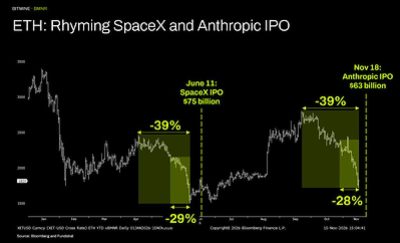
HIP-3 lets traders take price exposure to private companies before a listing. DefiLlama research says SpaceX traded on Hyperliquid for weeks before its June 2026 listing. A tokenized Anthropic market, ANTH, launched on 24 August.
On 18 November 2026, a Yahoo Finance video with host Scott Melker said traders implied about $96.93 a share, a value near $1.7 trillion. He estimated that it was 20% to 25% above the IPO range. These are derivatives, not shares, and the figures are his.
Pricing is the risk. On 28 May 2026, a SpaceX pre-IPO market fell about 45% in under 30 minutes. The oracle misread a 5-for-1 split, liquidating about 400 traders, the research says. It is promotional for Oracle firm Redstone.
Why Are Big Investors and Exchanges Watching Hyperliquid?
On 29 October 2026, CNBC reported on investor Stanley Druckenmiller’s first post on X about an investment in Trade, a project on the chain. HYPE rose more than 20%. His family office reportedly holds about $23 million through a related entity.
The exchange blocks US users today. DefiLlama research notes that on 19 August, President Trump said the CFTC was working to bring it into the US.
Where Is Hyperliquid Heading Next, and What Could Slow It?
Growth paths are clear. More HIP-3 markets, more pre-IPO contracts, and a possible US route through ICE would widen the user base.
Competition and concentration are the brakes. Lighter held 12% of 24-hour volume on 17 November 2026, Variational 9.6%, and Aster 8.6%. Its own share swung between 30.5% and 50.2% in November.
Regulators matter too. The UK Financial Conduct Authority warned in May 2026 that the platform lacked permission to offer services there. A 2025 delisting episode led Bitget’s CEO to call a possible “FTX 2.0” risk.
What Measures Can Readers Take Before Using Hyperliquid?
These are general steps, not advice. Numbers here are snapshots, not investment signals.
Check local rules first, since regulators have warned and US users are blocked.
Read the liquidation price before any position. Higher leverage leaves a smaller buffer. Our liquidation guide explains the math.
Treat pre-IPO contracts as derivatives with oracle risk, not as shares.
Verify the official site before connecting a wallet.
Consider position size, since a leveraged loss can exceed expectations.
Our DeFi safety checklist adds more.
What Do Key Perpetual Trading Terms Mean for Readers?
Perpetual future: a contract that tracks a price and never expires.
Open interest: the total value of open contracts.
Liquidation: the forced closing of a position when collateral runs low.
HIP-3: a platform upgrade letting outside teams launch perp markets.
Oracle: a feed that supplies outside prices to a smart contract.
Buyback: the protocol buying its own token on the market.
Expert Opinion: Is Hyperliquid a New Exchange or a New Market?
CoinGabbar analysis suggests the platform is becoming a market for assets that lack a regular venue, not only a crypto exchange. The evidence is HIP-3 volume at 34%, the pre-IPO contracts, and the ICE talks. This is an editorial reading.
The cost is concentration. Perps made 98.6% of revenue, and one oracle error erased 45% in a market within minutes. This view is not a forecast.
Disclaimer: This article is for information only and is not financial, legal, or tax advice. Returns are never promised or assured. Leveraged products can cause losses larger than expected, digital assets are volatile, and rules differ by country, so all money put in can be lost. Readers should consult a qualified adviser.