Yellow Network: How It Works and What Makes It Unique


Can Off-Chain Trading Really Fix Crypto's Split Markets?
Yellow Network is trying to solve a problem most traders already feel: crypto markets are split across dozens of chains and exchanges.
Liquidity ends up scattered, fees add up, and moving funds between networks takes time and carries risk. This guide covers how the project works, what YELLOW does, and how its supply splits. Research ended November 21, 2026.
What Is Yellow Network, and How Does It Actually Work?
Yellow Network is a Layer-3 clearing network. A clearing network tracks who owes what between trading parties, then settles the final balance. Basically, it works as a shared back office for crypto trading.
The official whitepaper describes three layers. Smart contracts on Ethereum-style chains hold assets, the Clearnet ledger handles off-chain clearing, and an application layer runs apps on top.
Nitrolite is the state channel protocol, built on the ERC-7824 standard. Clearnet is the separate decentralized clearing network. The project describes the design as non-custodial, which means participants keep control of their own funds.
And no single node can move funds alone. A supermajority of guardian nodes must sign each balance change.
How Do State Channels Keep Trades Fast and Settled?
A state channel is a private line between two or more parties. They lock funds on a blockchain, trade off-chain, and only report the final result back.
A bar tab works the same way. Every drink goes on it, and payment happens once at closing time. In most designs, when settlement time arrives, the channel closes and then the final net result lands on the base chain.
In a typical channel, smart contracts act as the referee if a dispute appears. The latest signed state wins. Turns out, that's the main trick. Fewer on-chain steps means lower fees and faster trades.
What Does the YELLOW Token Do Inside the Network?
YELLOW is an ERC-20 token with a fixed supply of 10 billion. The whitepaper confirms there's no inflation or burning.
Users pay service fees for clearing, transactions, and app subscriptions in YELLOW. Holders who pay this way get a discounted rate. Node operators must post YELLOW as a security deposit. Misconduct can trigger automatic slashing, which means the network takes part of the deposit.
Broker registration, app listings in the AppRegistry, and dispute services need YELLOW too. Here's the thing: YELLOW isn't equity. Holders get no ownership, voting, or profit-sharing rights in the issuer, Layer3 Fintech Ltd.
Governance sits with node operators, not passive holders. And utility isn't the same as demand.
What Is the YELLOW Tokenomics Model and Supply Split?
The whitepaper lists six allocation groups across the 10 billion supply.
| Allocation | Share | Purpose and vesting |
| Founders | 10% | 6-month cliff, then 60-month linear vesting |
| Token sales | 12.5% | Private and public sale buyers |
| Community treasury | 30% | Grants for app builders |
| Foundation treasury | 20% | Research, development, and delivery |
| Network growth incentives | 25% | Protocol-governed node operator subsidies |
| Ecosystem accessibility reserve | 2.5% | Keeps YELLOW available on trading platforms |
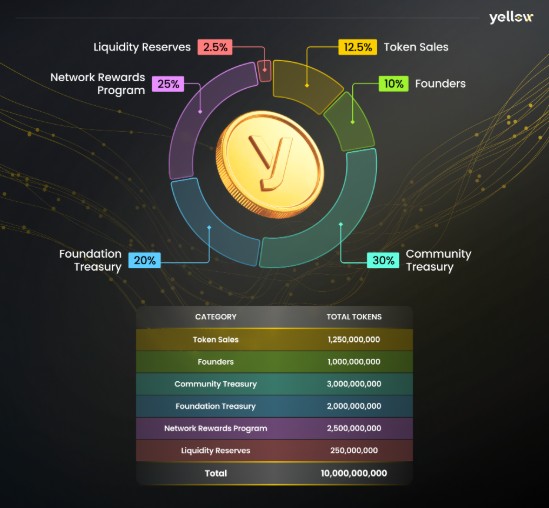
Only the founders' vesting is detailed in the text: a 6-month cliff, then 60 months of linear release. A cliff is a waiting period before tokens unlock.
Treasury and growth pools make up 75% of supply, so release pace matters. Allocation isn't circulation either. The most recent public sale closed on August 25, 2025, at $0.011 per token. That price is history, not a price target.
How Does the Yellow Network Differ From Bridges and DEXs?
Bridges move tokens between chains, and they've been a repeated target for attacks. Yellow Network aims to avoid that step.
Instead, brokers settle balances through channels linked to each chain, giving users one unified balance across networks. Turns out, the reach is wider than a single-chain DEX, or decentralized exchange. A DEX only sees liquidity on its own network.
Traditional order-book exchanges usually keep trade matching on their own servers. The project says Yellow's channels let brokers share liquidity without giving up custody.
What Is the Timeline From Token Launch to Mainnet?
March 5, 2026. The YELLOW contract went live on Ethereum.
March 8, 2026. Trading opened and Yellow Pro launched.
March 17, 2026. The project announced the protocol deployment on the Ethereum mainnet.
Three dates, three different events. Token launch isn't protocol launch. The whitepaper adds a caveat. Its ledger layer and application layer sat on testnet when the document came out, with the mainnet expected within six months.
That window has passed. But the documents checked here don't confirm the ledger layer's mainnet status.
What Does the Available Data Say About Adoption?
The whitepaper reports 100+ third-party apps launched in 2025 and over 500 developer projects building on the protocol.
But launched apps and hackathon projects aren't active brokers. The document doesn't publish broker counts, settlement volume, or collateral locked in channels.
At first glance, the cross-chain claim sounds like every other pitch. Actually, scratch that: the published documents describe a real settlement model with collateral and slashing. But a model isn't a market. Is a clearing network useful without deep liquidity?
The stronger signal is the audit trail. An independent 2024 review of the smart contracts found no critical issues, per the whitepaper, while a ledger layer audit is ongoing. Basically, the technology seems credible, but the market case is unproven. Evidence of usage matters more than launch headlines.
What Are the Main Risks Before Anyone Gets Involved?
Every crypto project carries risk, and this one has several.
-
Adoption risk: a clearing network needs many brokers before liquidity sharing pays off.
-
Smart contract risk: collateral sits in contracts, so bugs or exploits could cause losses.
-
Slashing risk: node operators could lose collateral for misconduct or weak service.
-
Token risk: price swings can be sharp, and scheduled unlocks may add selling pressure.
-
Regulatory risk: cross-border trading tools may face different rules in different regions.
A partner announcement isn't adoption, and a mainnet launch isn't safety. Audit reports, contract addresses, and docs deserve a direct check.
Is Yellow Network Worth Watching After Its Launch?
Yellow Network builds a clearing layer on state channels, aiming to link brokers and exchanges across chains without relying on bridges. What stands out is the open Nitrolite standard, a fixed 10 billion supply, and audited contracts. But real trading volume and broker counts are still unclear.
Readers should check the official site, whitepaper, token contract, and audit reports before drawing conclusions about long-term value.
Disclaimer
This article is for informational purposes only and isn't financial advice. Crypto assets are volatile and high risk, and losses can happen. Readers should research independently and consult a licensed adviser before any decision.