Zenora Network Mining Price Prediction: Can ZNR Rewards Hold Value?

Zenora Network Mining Runs Ahead of Any ZNR Market Price
The token has no listing, so every unit earned in the miner app today is a pre-mainnet point balance, not a traded asset. Sessions last 8 hours and start with one tap, with no hardware or fees.
The official explainer says those points convert to on-chain coins at launch under published rules. That makes conversion day, not a chart, the first real price test.
Zenora Network Mining is therefore a supply story before it is a demand story. The sections below size the reward pools, the release curve and what a mined balance could be worth at assumed prices.
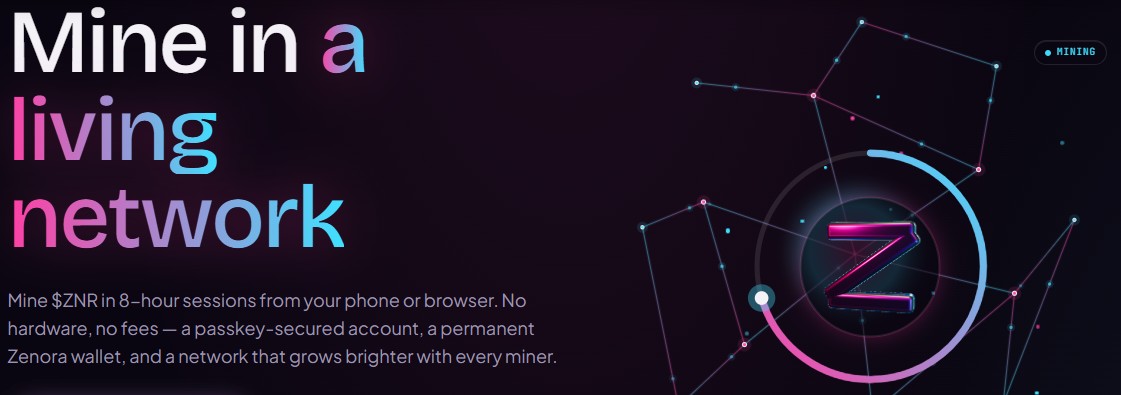
Source: Official Website
The 200M Community Pool: Where 120M Goes to Miners
The community allocation is 20% of total supply. The explainer splits it across six programs, and miner rewards take the largest share.
Program | Tokens | Share |
Miner rewards | 120M | 60% |
Referral | 30M | 15% |
Airdrop | 20M | 10% |
Tasks | 14M | 7% |
Giveaways | 10M | 5% |
Reserve | 6M | 3% |
Sixty percent of a 20% slice means Zenora Network Mining can draw at most 12% of the fixed 1 billion supply.
Halving Curve Sets the Pace of New Supply
Phase 1 releases at 100% of the launch rate, then 50%, 25% and 12.5% in phases 2 to 4.
The bulk of the 120M is meant to flow over 2 to 3 or more years.
Early miners earn roughly one coin a day, up to a capped daily maximum.
Phase lengths, daily caps and global emission limits stay unpublished.
Unreleased emission is removed from circulation, not carried forward.
Spread evenly, 120M over 2 to 3 years is about 110,000 to 164,000 coins a day. Zenora Network Mining uses a halving design, so early emission would run above that average.
Referral Ladder Pays From a Separate 30M Pool
Ten levels run from 1.0 coin per verified referral at L1 to 3.0 at L10, which needs 2,000 or more referrals.
Milestone bonuses range from +5 coins at L2 to +1,000 at L10.
Only verified, active accounts count, which keeps duplicate accounts from draining the pool.
At the top rate of 3.0 coins, the 30M pool covers at most 10 million verified referrals before bonuses. That is the pool’s limit, not a forecast of use.
Conversion Day: Where Mined Balances Meet the Market
Conversion day is the first moment Zenora Network Mining rewards can reach buyers. The site gives no separate schedule for the miner pool, so this sketch assumes it follows the community rule of 25% at TGE.
Assumed day-one release from miner rewards: 30M coins.
Liquidity allocation unlocked at TGE: 70M tokens.
Combined: 100M units, or 10% of supply, before airdrop, task or giveaway releases.
Tokens earned for free can be sold faster than tokens bought, so a low opening price may bring heavy selling. That is the main downside driver in this outlook.
Price Sensitivity Ladder for a Mined ZNR Balance
The ladder values the early pace of about one coin a day at assumed prices. The prices are inputs chosen for this article, not forecasts.
Assumed price | 30 days (about 30 coins) | 1 year (about 365 coins) | 120M pool value |
$0.01 | $0.30 | $3.65 | $1.2M |
$0.03 | $0.90 | $10.95 | $3.6M |
$0.08 | $2.40 | $29.20 | $9.6M |
$0.15 | $4.50 | $54.75 | $18.0M |
Later halving phases pay less, so the one-year column overstates later years. At these inputs Zenora Network Mining pays a single miner small sums, so direction depends on how many miners sell together.
What Could Move the ZNR Outlook Before Testnet
Signal | Official status |
Participation data | About 97.9K miners and 83K mining now on both official pages (November 19, 2026) |
Conversion rules | Points convert at launch; reward formula and caps stay private |
Final vesting | Schedules to be confirmed ahead of Mainnet prep |
Exchange listing | Not yet listed or tradable |
With close to 98K miners already active, conversion terms will matter to a wide base. For Zenora Network Mining, valuation will follow those terms, vesting and a first listing, and none of the three is final today.
Disclaimer: This article is for informational and educational purposes only and should not be taken as financial or investment advice. Crypto markets are volatile, and details such as roles, plans, or figures mentioned here can change over time. Readers should do their own research before making any decisions based on this content.