Zenora Network Tokenomics: ZNR Supply, Allocation and Vesting Guide

How Does Zenora Network Tokenomics Divide the 1 Billion ZNR Supply?
A token with no price yet can still say a lot about a project. Its supply, its split and its unlock plan are already written down. Zenora Network tokenomics is one of those cases, so the numbers can be checked before anything trades.
This guide walks through them in plain words: the fixed supply, the seven allocation groups, what unlocks on day one, what the token does and what is still undecided.
Details come from the official website, the whitepaper and the project’s X account.
Key Takeaways
ZNR has a fixed supply of 1,000,000,000 tokens, and the whitepaper says nothing is minted after genesis.
58% of the supply goes to community, ecosystem and staking rewards, while team and investor tokens sit behind a cliff.
ZNR is not yet listed or tradable, and the unlock terms are planning targets that can still change.
What Is Zenora Network?
Zenora Network is a new Layer-1 blockchain that is still being built. It is EVM compatible and uses Polygon CDK, an open-source framework that other networks already run in production. Solidity contracts and wallets like MetaMask are meant to work with it directly.
The build order is unusual. A community app called Zenora Miner came first. The chain follows in stages: Core protocol, public testnet, mainnet prep and mainnet. The roadmap shows status, not calendar dates.
One point is easy to miss. The whitepaper says the miner does no proof-of-work hashing. It tracks contribution and does not secure the chain. Block production belongs to validators later.
The whitepaper is also marked as a draft, and it says no live chain or live token exists today. So Zenora Network tokenomics describes a plan, not a running market.
Source: official website.
ZNR Token Supply and the Fixed Supply Model
ZNR tokenomics starts with one rule. ZNR is the Zenora Network token, also called Zenora Coin, and the total supply of 1 billion tokens is fixed at genesis. The whitepaper says no mechanism creates more.
That makes it a fixed supply token. Many proof-of-stake chains pay validators by printing new coins. Zenora pays them from a pool set aside in advance.
Item | Detail |
Name | Zenora Coin |
Max supply | 1,000,000,000 |
New minting | None after genesis |
Headline launch circulation | 250,000,000 (25%) |
Status | Not listed or tradable |
How Is ZNR Token Allocated?
The ZNR token allocation has seven parts that add up to exactly 100%. The published allocation breakdown splits them into two buckets.
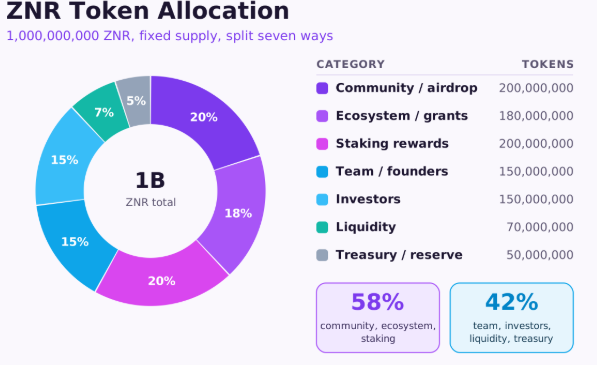
Bucket 1: aligned with network participants (58%)
Category | Share | Tokens | Role |
Community / airdrop | 20% | 200,000,000 | Rewards real pre-launch contribution |
Ecosystem / grants | 18% | 180,000,000 | Funds builders, dApps and tools |
Staking rewards | 20% | 200,000,000 | Pays validators and delegators |
Bucket 2: team, investors and reserves (42%)
Category | Share | Tokens | Role |
Team / founders | 15% | 150,000,000 | Ties the team to long-term results |
Investors | 15% | 150,000,000 | Funds engineering, audits and infrastructure |
Liquidity | 7% | 70,000,000 | Gives trading depth from day one |
Treasury / reserve | 5% | 50,000,000 | Governed reserve for future needs |
The project says the 58% bucket is a deliberate lean toward people who use and secure the network, not people who simply hold. The percentages are described as the settled part of the plan.
Source: official tokenomics.
ZNR Vesting Schedule and the Token Generation Event
Unlocks begin at the token generation event, or TGE. After that, each group follows its own timeline.
Category | At TGE | Cliff | Vesting |
Community / airdrop | 25% | None | 12 months, linear |
Ecosystem / grants | 0% | None | 36 months, linear |
Staking rewards | 0% | None | 60 months |
Team / founders | 0% | 12 months | 36 months, linear |
Investors | 0% | 6 months | 24 months, linear |
Liquidity | 100% | None | Unlocked at TGE |
Treasury / reserve | 0% | None | 48 months, by governance vote |
Team and investor tokens are the strictest. Neither is liquid at launch. The team waits 12 months and investors wait 6 months before linear release starts.
What Actually Unlocks on Day One
The site’s own unlock chart shows a smaller launch picture than the headline figure.
Source | Share of total supply |
Community / airdrop (25% of its 20%) | 5% |
Liquidity | 7% |
Total at TGE | 12% |
That is 12%, or 120 million, while the headline says 25%, or 250 million. The site does not explain the difference. The chart itself is labeled illustrative, and the whitepaper calls all vesting durations planning targets, to be confirmed before mainnet prep. Both figures are best read as drafts.
ZNR Staking Rewards After Launch
Validators bond ZNR to help secure the network. Their staking rewards come from a fixed pool of 200 million tokens, emitted over the network’s lifetime. Nothing new is minted.
A harder question follows. Once that pool runs out, transaction fees are meant to pay validators. Whether fees are enough depends on real network usage, and the whitepaper admits it cannot predict that.
Penalties come in two kinds. Double-signing is treated as provable misbehavior and slashed severely. Long downtime is treated as an operational fault and carries a smaller penalty. Delegators share the same risk as the validator they back.
ZNR Token Utility
The official token details say ZNR “works” instead of just sitting in a wallet. The token utility covers five jobs, shown in the graphic below.
ZNR utilities graphic showing gas, staking, governance, app tier and dApp fees around the token
Function | What it does |
Gas fees | Every transaction and contract call is paid in ZNR |
Staking and validation | Validators bond ZNR to secure blocks |
Governance | Voting on upgrades, parameters and spending |
App premium tier | Optional upgrade with extra features, not a better reward rate |
dApp fees | Apps built on Zenora settle fees in ZNR by default |
There is no separate gas, governance or staking token. One asset covers all five.
Governance, Treasury and Liquidity
Governance is planned as stake-weighted, so people who stake get more say than people who only hold. No governance body is live today, and the whitepaper says major decisions stay with the founding team for now.
The treasury holds 5%, or 50 million ZNR, and is designed to be released only by governance vote. Until governance activates, it is a governed pool in design only.
Liquidity gets 7%, or 70 million ZNR, fully unlocked at TGE so trading has some depth from the start.
Where Free Nodes Fit In
Free nodes make up 10% of all nodes. They are not a new token allocation, so the fixed supply and the percentages above do not change. Node rewards begin after mainnet, and how they are funded will be published with the final tokenomics during mainnet prep.
What to Keep in Mind
ZNR is not listed or tradable, and no listing is confirmed.
The whitepaper is a draft that the team says will change.
Vesting terms and launch circulation are planning targets, and two figures on the site (12% and 25%) do not match yet.
Validator pay after the staking pool ends depends on fee income that does not exist yet.
This article is for education only. It is not financial advice.
Final Thoughts
Zenora Network tokenomics is clear on paper: a fixed supply, seven groups and a slow unlock. The open questions are the final vesting terms, the real launch circulation and how validators are paid once the staking pool runs out.
Check the official website, the official whitepaper and the X account for updates before relying on any number here.
Disclaimer:This article is for information only and is not financial advice. Crypto participation involves risk.