Zest Protocol (ZEST): Ecosystem, Features, and ZEST Airdrop

Zest Protocol (ZEST): Ecosystem, Key Features, and Airdrop
Bitcoin is the largest crypto asset, yet most of it sits idle. Zest Protocol (ZEST) is one of the projects trying to change that by letting BTC holders borrow, earn, and swap without handing their coins to a custodian.
Zest Protocol (ZEST) is a Bitcoin-focused DeFi project with a lending market on Stacks and a Bitcoin Collateral Vault product that keeps BTC on Bitcoin.
ZEST is its native token, with a fixed supply of 1 billion. The Season 1 airdrop closes on December 10, 2026, at 12:00 UTC, and only wallets that qualified at the May 13 snapshot can claim.
What Is Zest Protocol (ZEST) and Why Does Bitcoin DeFi Matter?
A Bitcoin-focused DeFi platform that offers lending, yield strategies, and swaps built around BTC.
Bitcoin holders usually must wrap their coins into another token to join DeFi, which adds trust in a bridge or custodian. Zest Protocol (ZEST) aims to shorten that path and make Bitcoin productive without the usual wrapped-BTC model. The official Zest Protocol (ZEST) website describes it as an on-chain, open-source capital layer for Bitcoin.
Zest Protocol (ZEST) grew up around Stacks, a Bitcoin layer-2 network. The Stack STX Bitcoin DeFi guide explains how that network adds smart contracts around Bitcoin. ZEST, the native token, arrived in May 2026, and its role is covered further below.
ZEST Season 1 Airdrop Details: Snapshot, Allocation, and Deadline
Season 1 rewarded users of the Zest Protocol lending market during its points era. The table lists the confirmed terms from the official ZEST airdrop documentation.
Detail | Information |
Token | ZEST |
Total supply | 1 billion ZEST |
Season 1 allocation | 1% of supply (10 million ZEST) |
Snapshot date | May 13, 2026 |
Remaining allocation unlocked | November 19, 2026 |
Claim deadline | December 10, 2026 |
Deadline time | 12:00 UTC / 5:30 PM IST |
Unclaimed tokens | Returned to the community treasury |
One detail needs care. The documentation cites both a 1% Season 1 allocation and a 0.9% claim. The figures appear to match, since 0.1% of the total supply was unlocked at launch and 0.9% became claimable during month 6, but the page does not spell this out.
ZEST Tokenomics and Distribution: Who Holds the 1 Billion Supply?
The official token distribution page lists four groups:
Community: 27.83%
Ecosystem development: 24.82%
Investors: 22.35%
Team: 25%
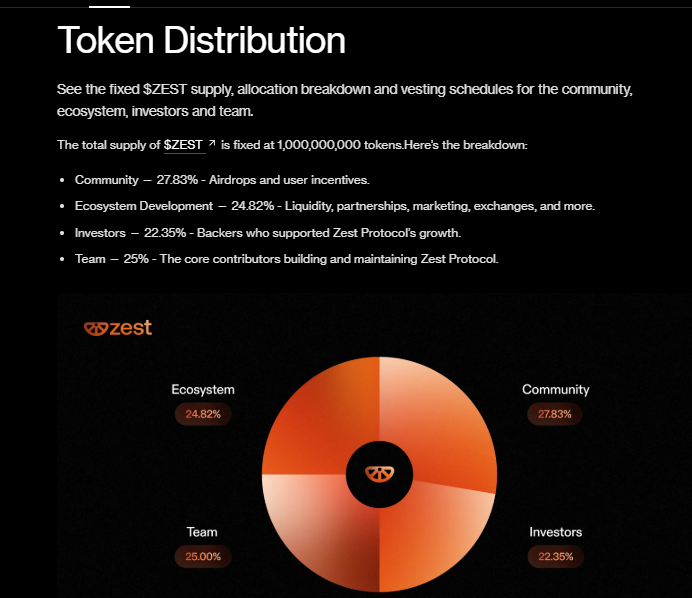
Season 1 is only one slice of the community share, and the rest vests over time. Team and investor tokens are described as following a one-year lock, then three-year linear vesting. Future unlocks can add supply to the market, which is worth watching.
How Does Zest Protocol Ecosystem Turn Idle ?
The ecosystem has two layers. The first is a live lending market on Stacks. Users deposit supported assets, such as sBTC, STX, and USDC, to earn yield or borrow against their collateral. overview of the ZEST listing and Stacks Market walks through that setup.
The second layer is newer. Bitcoin Collateral Vaults let BTC stay locked on the Bitcoin network while its value supports borrowing on another chain. The BTC does not need to be wrapped or bridged. Around these two layers sit yield vaults and a swap tool, which together form the product suite.
Key Features of Zest Protocol (ZEST) That Defines Its Bitcoin DeFi Stack
Bitcoin Collateral Vaults: Borrowing Without Leaving Bitcoin
Lock native BTC in a self-custodial vault and borrow against it.
BTC stays on Bitcoin, while a matching collateral record supports the loan on another chain.
No wrapping and no third-party custodian.
Bitcoin-Native Security and Recovery: What the Design Relies On
The long-term design uses BitVM, which verifies outside events through cryptographic proofs and open challenges.
Full BitVM verification is not yet production-ready, so early versions rely on extra controls.
The rollout is phased, and these are project claims, not independent guarantees.
Stacks Market: Lending and Borrowing Inside the Stacks Ecosystem
The original product: supply assets to earn yield or borrow against collateral.
Version two added pair-specific risk settings, partial liquidations, and optional non-rehypothecation.
Stacks Vaults: Automated Yield Strategies for Supported Assets
Yield strategies packaged into a single deposit.
The first vault was announced around stBTC, a liquid staking Bitcoin token from Stacking DAO.
Stacks Swap: Token Swapping Inside the Full Stacks Product Suite
Token exchanges inside the Zest suite.
Built to route trades across supported liquidity sources.
Flexible Withdrawals and Partial Liquidations Explained Simply
Partial withdrawals: take out part of a position instead of closing all of it.
Partial liquidations: a weakening position is reduced step by step.
Neither removes liquidation risk.
What Is the ZEST Token, and What Utility Does It Have Right Now?
ZEST is the native token of the ecosystem, with a fixed supply of 1 billion. It went live on May 19, 2026. The official ZEST token documentation describes its role, and governance and staking are planned but not active at this stage.
Zest Protocol (ZEST) is currently focused on Bitcoin Collateral Vaults and protocol liquidity, so any future governance role is a plan, not a promise.
Who Is Eligible for the ZEST Airdrop, and How Are Multipliers Set?
Eligibility comes from wallets on the final points leaderboard at the May 13, 2026, snapshot. Points stopped accruing on that date, so new activity cannot qualify any wallet for this allocation.
Two multipliers adjust each allocation:
Open-position bonus: 1.25x for wallets with at least one active supply position at the snapshot.
Genesis NFT bonus: Bootstrapper 1.5x, Champion 1.6x, and King 1.7x. Only the highest eligible NFT applies, once per wallet.
The open-position and NFT multipliers stack multiplicatively, and no wallet may receive more than 5% of the total airdrop allocation. Excess from capped wallets is redistributed proportionally to other eligible wallets.
For a wider list of campaigns, see the page on the latest crypto airdrops.
How to Check and Claim ZEST Tokens Before the December Deadline
The steps are short:
Open the official Points page from the project's website or its verified X account.
Connect the wallet used during Season 1.
Check the final points allocation and the remaining claim amount.
Follow the on-screen claim instructions.
Finish before December 10, 2026, at 12:00 UTC.
The Points page also says Season 2 is coming soon, but no participation rules have been published, so none should be assumed.
The guides on fake airdrop scams and hardware wallet safety cover the basics. A real claim never asks for a seed phrase.
Risks and Challenges of Using Zest Protocol Before Depositing Bitcoin
Every lending product carries risk, and this one is no exception. The main points are:
Price volatility: A sharp drop in BTC or collateral prices can trigger liquidations.
Liquidation risk: Borrowers can lose part of their collateral if a position weakens.
Smart contract and cross-chain risk: Bugs, bridges, and verification layers all add failure points.
Thin liquidity: Smaller markets can make exits harder.
Strategy risk: Automated yield vaults depend on how well the strategy performs.
Unverified claims: Security statements from a project are not independent guarantees.
No design makes BTC risk-free. The recovery approach and its technical dependencies deserve a careful read before any deposit.
Bottom Line: Can Zest Protocol (ZEST) Expand Bitcoin's Role in DeFi?
Zest Protocol (ZEST) makes a clear pitch: let Bitcoin work as collateral without wrapping it. Its Stacks products are live, and the vault design is still maturing.
Long-term growth will depend on security, liquidity, adoption, and whether the ZEST token gains real utility beyond today's plans. For anyone holding Season 1 points, the practical step is simple: check the official Points page and claim before December 10.
Disclaimer: This article is for information only and is not financial, investment, or legal advice. DeFi lending involves a risk of loss, and airdrop terms, deadlines, and token details may change. Readers should verify information on official project channels and do independent research before acting.