zkML Verification Limitations: What Zero-Knowledge Proofs Cannot Prove

zkML Can Prove a Model Ran Without Proving Its Data Was Honest
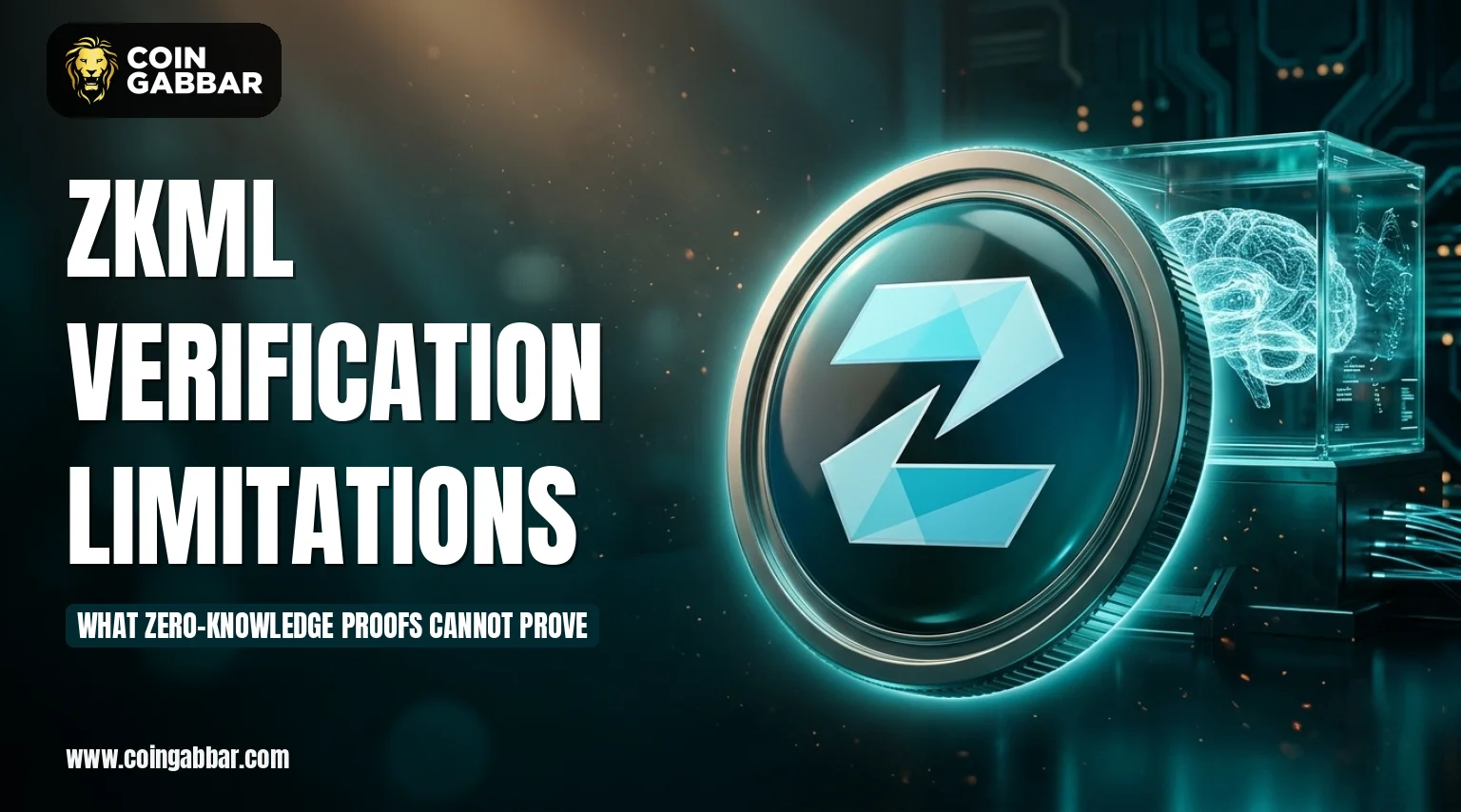
zkML Verification Limitations come down to one idea: a valid proof is evidence about a defined computation, not a certificate that the AI system is trustworthy.
A proof can show that a committed model processed specified inputs and produced an output. It does not show that the inputs were accurate, that the data came from the claimed source, or that private data stayed confidential across the wider pipeline.
What Does a zkML Proof Actually Verify?
Zero-knowledge machine learning, or zkML, uses cryptographic-proofs to show that a machine learning computation was carried out correctly. A prover runs the model and generates a proof.
A verifier then checks that proof-quickly, without repeating the whole computation. For readers new to the idea, how zero-knowledge proofs work is a useful starting point before the details of zkML verification limitations.
The guarantee depends on the exact statement being proven. That statement covers the model commitment, the inputs, and the outputs included in the proof. Anything outside it is not covered, and that edge is where zkML verification limitations begin.
Inference and training are also different. Most practical systems verify inference, meaning one run of a trained model. Verifying training, where a model is built from a dataset, is a much harder problem. A proof of inference says nothing about how the model was trained or what data shaped it.
Model Integrity Does Not Mean Data Integrity
A proof can bind an inference to a particular model or model version. Model commitments can cover the weights, the architecture, the computation circuit, and the verification key.
A draft Ethereum proposal, ERC-7992, describes registering such commitments and verifying inference proofs. It is a draft, not an adopted standard, so it works as an illustration of the idea and not as settled practice.
If the wrong model version or an outdated commitment is used, the proof may still be valid for what it states, yet it describes something other than what the reader assumed. That is one of the quieter zkML verification limitations, because a green check hides which model was actually committed.
A healthcare example shows these limits in action. A service receives a medical dataset and uses a committed model to produce a risk score. A proof can help show that the specified model performed the defined computation.
It cannot show that the medical records were accurate, representative, or free from deliberate manipulation. A correct computation can still run on misleading inputs.
Why Data Provenance Remains a Separate Problem
Data integrity and data truth are different things. A hash or commitment can show that a dataset has not changed since it was recorded. It cannot show that the original data was honest. If inaccurate, manipulated, or poisoned data was committed first, the hash faithfully preserves the bad data.
Provenance asks where data came from and how. The questions include:
Source identity: who supplied the dataset.
Timestamps: when it was collected and whether it is stale.
Collection methods: how the records were gathered.
Chain of custody: who handled it before the proofs was generated.
Unreliable external sources, manipulated datasets, and poisoned training examples all sit outside what a computation-proof checks. This is why zkML verification limitations cannot be solved by better proofs alone. They need separate evidence about the data, which is the point of the next section.
What Verifiable Credentials Can Add
Verifiable credentials can carry claims about a dataset's issuer, source, collection time, or processing history. The Verifiable Credentials Data Model describes claims made by issuers and the way their authenticity is checked. Issuer identity and credential status, such as whether a credential was revoked, can be verified.
The limit matters for zkML verification limitations. An authentic credential proves who made a claim, not that the claim is true. The standard itself separates verifying a credential from judging whether its claims are correct.
The newer revision of the standard is still a working draft, while the earlier version is a finished recommendation, so the status should be stated whenever it is cited. It is supporting context here, not an implementation guide for zkML.
In the healthcare example, a signed credential can identify the organization that supplied the dataset and document its claimed collection process. It does not make that organization reliable. Readers interested in how verifiable AI supports blockchain applications can look at AI agent token applications.
Confidentiality Is Different From Both Integrity and Provenance
Zero-knowledge proofs can limit what a verifier learns. They can hide model weights, private inputs, or intermediate values, depending on the design.
What is actually hidden depends on the proof-design and on what is revealed publicly. Under zkML verification limitations, confidentiality does not stop at the proof. Metadata, logs, API requests, storage systems, and operational access controls can all leak information, and each needs its own review.
A privacy claim that mentions only the proofs is incomplete, which is one more of the zkML verification limitations to check. For the wider risk picture around automated systems, see the notes on AI agents with crypto wallets.
A Practical Framework for Judging zkML Verification Limitations
A short checklist helps when weighing zkML verification limitations in a given system:
Check the model identifier and commitment.
Identify exactly which inputs and outputs the proof-covers.
Check whether input hashes, timestamps, nonces, and source credentials are used.
Review the dataset issuer and the provenance evidence.
Check whether the proof-covers preprocessing as well as inference.
Review privacy disclosures, logs, and data-retention practices.
Examine upgrade controls, verification-key changes, and proof-system assumptions.
Upgrade controls matter because verification logic often lives in smart contracts that someone can change.
Research surveys describe challenges with circuit expressiveness, computational cost, and deployment complexity, and a recent AI-lab prototype shows that proving large-model inference remains demanding and rests on specific assumptions.
Early research systems that optimize inference proofs show how much engineering is involved, and no single benchmark represents every zkML system.
zkML Verification Limitations: What a Proof Cannot Guarantee
The table sets out what each security layer can and cannot establish. It is the central idea of the article: these properties can work together, but each needs its own controls.
Security layer | What it can establish | What it does not automatically establish |
Model integrity | A proof matches a specified model-commitment and computation | That the model is unbiased, safe, or factually correct |
Data integrity | A hash or commitment matches the data previously recorded | That the original data was accurate or honest |
Data provenance | Signed records can identify an issuer and document source-related claims | That the issuer is trustworthy or its claims are true |
Confidentiality | A proof can hide specified inputs, weights, or intermediate values | That logs, APIs, metadata, or other systems cannot expose information |
Read together, the rows show the zkML verification limitations: a valid proof should not be described as proof of an honest dataset. No layer says the answer is correct or fair.
Zero-Knowledge Projects and Market Coverage
Zero-knowledge technology also has a market side, and readers following zk news will meet many token and presale stories. The roundup of the top four ZK tokens covers one slice of that market.
Presale pages carry extra risk, because early-stage tokens are speculative and a project's marketing says little about how sound its proofs are. The overview of a zero-knowledge crypto presale shows how such launches are usually described.
A separate page on a Zero Knowledge Proof presale covers an AI-powered blockchain project. Neither page is evidence about any proof system's security, and a valid proof still says nothing about whether a token is a sound purchase.
Final Thoughts
zkML can help prove that a defined model-computation was performed correctly, which is valuable. Trustworthy AI still needs reliable data sources, verifiable provenance, and separate privacy controls.
That is the practical meaning of zkML Verification Limitations, and it is why a proof should be read as evidence, not as a verdict.
Anyone assessing the zkML Verification Limitations of a verifiable AI claim can ask four questions. Which model was committed, which inputs were covered, who vouches for the data, and what else could leak.
Keeping those questions apart avoids the most common mistake in discussing zkML verification limitations. For ongoing coverage, the latest crypto news page tracks new developments.
Disclaimer: This article is for educational purposes only and is not security, legal or investment advice. Standards and proposals mentioned may be drafts and can change. Verify every detail with the official specifications before relying on any system.