Zoi Network ZMesh Map: How Zoi Visualizes Its Growing Network

How Does the Zoi Network ZMesh Map Work and What Do Its Lights Mean?
Most crypto apps rely on a stable internet connection, but Zoi Network takes a different approach. It is designed to support connectivity in areas where signals may be limited or unavailable. The Zoi Network ZMesh Map brings this concept to life by showing where Zoi phones are syncing and how the network is growing across different areas.
The map is a live picture of where Zoi phones are syncing. Every glowing patch is a real area with real users in it. There are no names, no numbers and no exact spots. Just light.
This guide covers what Zoi is, what the map does, what the lights mean and where it fits in the bigger plan. Everything here comes from the official Zoi website, the whitepaper and the launch announcement.
Key Takeaways
The map lives inside the Zoi app and on Zoi.network.
A brighter area means more Zoi phones synced there. Stop syncing and the glow slowly fades back to dark.
The map shows the network, not the users in it. It never shows names, numbers or exact spots.
A Quick Look at Zoi Network
Zoi Network is an offline-first payment network. The whitepaper says it is built for the places the signal forgets, like night markets, metro tunnels, ferries, border towns and blackout zones.
The core idea is "accepted offline, settled on-chain." Phones pass payments to each other over Bluetooth. The payment settles on a purpose-built chain once any phone on the path reaches the internet.
The whole system runs on one asset. The Zoi token, written Zoi, is the unit that notes are denominated in and the reward for verifiable work. Anyone searching for Zoi crypto will land on this same idea: crypto that keeps moving when the internet does not.
Source: official website.
What Is ZMesh Map?
ZMesh Map is a live map of the Zoi network. Each phone adds light to its own city, and the places with the most phones glow the brightest. The official ZMesh Map page puts it simply: watch the network light up, city by city.
The team says it is built, it is in the app and it is not a mockup. The roadmap lists it as an in-progress Q4 2026 product. In the first version, the city comes from the network connection, so the map needs no location permission.
ZMesh Map Launch Date
The rollout has been a countdown, and each step had its own date.
Date | What happened |
November 5 | One photo of every Zoi signal on Earth, shared as a teaser |
November 16 | Eight riddles, one for each drop landing in December |
December 1, 00:00 UTC | The map opens in the Zoi app and on Zoi.network |
The launch post labels this Drop 01 of 09. It also gives early users a deadline: if an area is still dark, there is until December 1 to light it up.
How Does ZMesh Map Work?
The process follows four simple steps:
A user syncs. Their phone adds light to the surrounding area on the map.
The area begins to glow. More syncs from the same area make the glow stronger.
Friends expand the network. When users invite friends to sync, their activity adds more light. Their friends can contribute too, helping the area glow brighter.
The glow gradually fades. If syncing stops in an area, its light slowly returns to dark.
The network grows as more users sync and invite others.
One user | → | Friends sync | → | More users join | → | A brighter city |
One phone | More phones nearby | Wider network | Stronger, steadier glow |
Privacy is part of the design. The roadmap says the map shows density only: no numbers, no names, no single phones.
What Do the Lights Mean on ZMesh Map?
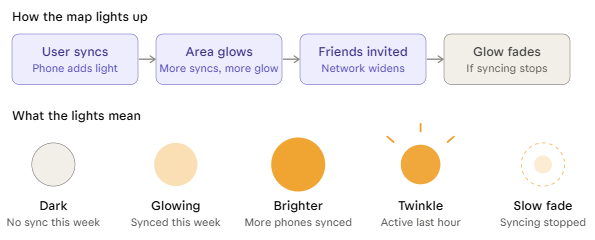
The light is a simple language, and the announcement spells out the main parts.
What users see | What it means |
A dark area | No Zoi phone synced there this week |
A glowing area | Zoi phones synced there this week |
A brighter glow | More people synced in that area |
A twinkle | Busy area, with people syncing in the last hour |
A slow fade | Syncing stopped, so the light is dimming |
Why Brightness Matters: Bluetooth Mesh Coverage Map
The lights are more than decoration. They hint at how well messages can travel when the internet is down.
Zoi's own page explains it clearly. ZMesh carries chat and SOS from phone to phone over Bluetooth, and offline payments will take the same path. Every hop needs a Zoi phone nearby. A bright area has more phones close by to pass a message along. A quiet area has too few, and the message stops at the gap.
That makes the map a rough Zoi Network coverage map in practice. Think of it as a Bluetooth mesh coverage map where light stands in for the number of phones. It shows density, so treat it as a guide to reach, not a promise of it.
This is also why the idea belongs in any mesh network map crypto conversation. Most coverage maps show cell towers. This one shows people.
Zoi App Sync and Zoi App Streak
The Zoi app map is fed by one habit: syncing. According to the roadmap, the app asks users to sync every four hours, keep a streak and invite friends, and users earn Zoi from day one. That is the whole Zoi app sync routine in a sentence.
A Zoi app streak counts the consecutive days a user maintains their syncing routine. This activity also contributes to the area's glow on the map, helping the city appear brighter through regular participation. The app does not require an ID document for syncing, making it easier for users to join the network.
Zoi Network Roadmap: Where the Map Fits
The map is one step in a longer plan. The whitepaper's Zoi Network roadmap lists named products with target quarters. Dates are targets, not promises, and any change is posted in the changelog.
When | Product | Status | What it is |
Live now | Zoi App | Live | Sync, streak and invites |
Q4 2026 | Zoi Handshake | In progress | Two phones meet and both get a "met" badge |
Q4 2026 | ZMesh Map | In progress | A live map of where Zoi phones are |
Q4 2026 | Zoi Lab | In progress | Send test tokens phone to phone over Bluetooth |
Q4 2026 | Zoi Wallet | In progress | Keys made on user’s phone, holding test tokens first |
Q1 2027 | ZMesh | Planned | Chat and SOS with no internet |
Q2 2027 | Zoi Send | Planned | Send Zoi to verified users, online |
H2 2027 | Zoi Offline | Planned | Real Zoi phone to phone, low limits first |
The order makes sense. The Zoi Network ZMesh Map grows the crowd first. Zoi Lab then tests offline transfers with test tokens that have no value, before real Zoi payments moves offline. Sending and receiving real Zoi will also need identity verification, which is planned for 2027.
Zoi Network Review: Strengths and Open Questions
A fair Zoi network review has two sides.
What stands out
The launch has a firm date and time, not a vague "soon."
Privacy is part of the map's design.
The plan is public, with phases and statuses anyone can read.
What to keep in mind
The map shows density, not guaranteed coverage.
Real offline Zoi payments are planned for the second half of 2027.
Roadmap dates can move.
This is not financial advice. Read the official whitepaper before making any decision about a token.
Final Thoughts
The Zoi Network ZMesh Map turns the idea of phones connecting with other phones into a visible network experience. Users can download the app, sync regularly and invite friends to contribute to their area's activity. As more phones sync, the city may appear brighter on the map when it opens.
Disclaimer: This article is for general information only and is not financial, investment or legal advice. Always check Zoi.network and the whitepaper for the latest updates. Crypto assets carry risk, so do your own research before making any decision.












Frequently Asked Questions (FAQ)




