Zoi Settlement Chain Explained: Payments, Nodes and Validation

How Does Zoi Settlement Chain Process Offline Crypto Payments?
Picture a night market with no signal. A buyer taps a phone, the vendor receives a payment, and neither of them has a single bar of data. The vendor is left with one worry: will this money still be good tomorrow?
That worry sits at the heart of offline crypto payments. Sending value is easy. Trusting it without a live connection is hard. The Zoi Settlement Chain is built to answer that doubt, because it makes the final call once a phone reaches the internet again.
Over a billion adults have no bank account, yet far more of them carry a phone. Here is how Zoi tries to close that gap.
Key takeaways
A Zoi payment is accepted offline, but it becomes final only when it reaches the chain.
The chain allows one spend per note. A second try becomes a proof against the cheater.
Only the Zoi App is live today. Real offline payments are targeted for the second half of 2027, and dates can move.
What the Zoi network is
Zoi is an offline-first payment network. Phones pass signed digital banknotes, called bearer notes, to each other. A phone can verify a note with no connection at all.
Bluetooth mesh payments carry a transfer from one phone to the next. Public relays carry it the rest of the way. The idea is old. Cash, cheques and card terminals all work like this: accept fast, trust a little, settle later. Zoi’s own line says it best: accepted offline, settled on-chain.
Source: official website.
What the chain actually does
Every other layer in Zoi moves signed data toward one place. The Zoi Settlement Chain is that place. The official whitepaper says it finalises one spend per note, adjudicates conflicts, keeps reputation and pays contributors.
Think of an exam hall. Students can write whatever they like, but nothing counts until the examiner stamps it. Phones do the writing. The chain does the stamping.
The chain’s eight jobs, in simple words
Job | What it means |
Note issuance and ownership | Records who holds which note |
Ordering of transfers | Decides which transfer came first |
Double-spend adjudication | One real spend per note, proofs for the rest |
Settlement receipts | Proof a wallet or shop can verify |
Reputation | Scores for users, witnesses and certified points |
Registry | Lists issuers, certified witnesses and their bonds |
Reward distribution | Pays contributors after settlement |
Data availability and finality | Gives other builders something to rely on |
On top of this sit thirteen transaction types, from IssueNote to SlashBond.
How a Zoi transaction travels
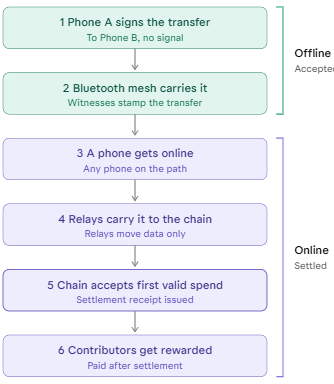
A Zoi transaction begins as a signed note transfer. The receiver sees a valid signature and a risk score right away, and the Trust Ladder tells them how much to accept. That is acceptance. It is not finality.
On-chain finality arrives when the transfer reaches the chain. One phone on the path getting online is enough.
A simple example
This example is ours, not from the whitepaper.
Asha pays Ravi 10 ZOI for tea at a mela with no signal. Ravi’s phone checks the signature, shows a risk score, and he accepts. Later Asha tries to pay Meena with the same note.
Both transfers travel toward the chain. The first valid one the chain accepts is the real one. The other, paired with it, becomes a double-spend proof. Asha loses reputation, and loses a bond if she has one.
Which payment wins depends on which reaches the chain first. That is why witnesses and the Trust Ladder matter. They help Ravi decide how much to accept before the chain ever sees the note.
Offline payment vs on-chain settlement
Offline acceptance | On-chain settlement | |
Where | On the receiver’s phone | On the chain |
Internet needed | No | Yes, on one device in the path |
What you get | Valid signature and risk score | One canonical spend and a receipt |
Trust level | Priced by the Trust Ladder | Final |
Acceptance gives speed. Settlement gives certainty.
What happens to cheaters, and to honest receivers
When a conflict appears, the cheating signer is penalised. Their reputation drops, and a bond is slashed where one exists. An honest receiver of a well-witnessed transfer can be compensated from the fraud reserve, where policy allows.
Who runs the chain
Node | Job |
Wallet node | Your phone. Holds notes, relays and witnesses on the mesh |
Relay node | Moves data. Produces no finality |
Validator node | Runs state transitions and produces blocks |
Indexer node | Makes settlement and fraud-proof data searchable |
Issuer node | Signs credentials and limits, revocable on-chain |
The chain starts with a federated validator set running Byzantine fault tolerant consensus. The plan then moves to a stake-weighted set, then permissionless validators, then light-client proofs. With light clients, any phone can check a settlement receipt, even one that was offline when the receipt was made.
Where the ZOI token fits
The ZOI token is the unit notes are denominated in, and the reward for work the network can verify. Today you earn by syncing every four hours, keeping a streak and inviting friends. Later, phones will also earn for carrying and witnessing real transfers.
Where things stand
The Zoi App is live. Zoi Lab (Q4 2026) lets early users send tZOI test tokens over Bluetooth. They have no value and never become ZOI. Zoi Offline, with real ZOI and low limits, is targeted for H2 2027. The chain itself sits in Phase 6, the Chain MVP, which is still planned. Zoi says dates are targets, not promises.
Conclusion
The Zoi Settlement Chain is what turns a quiet handshake between two phones into a payment that holds. Offline speed comes from the mesh. Trust comes from the chain. For offline crypto payments, that split is the whole design.
Disclaimer: This article is for information only and is not financial advice. Crypto assets carry risk, so research carefully before making any decision.