

Crypto news today includes a security update about a popular app that stores exchange and wallet logins. The 1Password security breach began when an attacker reached an employee's corporate GitHub account.
On November 19, 2026, the company began investigating signs of that access. In its official incident post dated November 25, 2026, the company said customer vault contents were never accessed. The disclosure came six days after the investigation began.
According to the company, the attacker used the compromised account to:
Access source code in private repositories.
Push malicious code to backend services, which then downloaded administrative data about customers.
Reach the CI/CD system, the tools that build and deploy software.
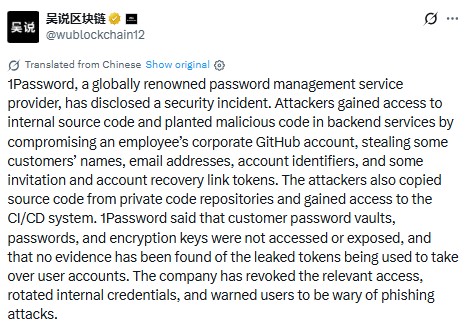
Wu Blockchain also shared the update on X.
The attacker downloaded user records for a subset of customers, not for everyone. The company listed these items:
Names and email addresses
Account and user identifiers
Account creation and last sign-in times
Public keys, which are public by design
Secure Remote Password parameters, which the company says cannot open an account
Tokens inside certain emailed links for invitations, provisioning, and account recovery
Other non-secret metadata, such as version and file numeric identifiers
The table below separates what was affected from what the company says was not.
Area | Status per 1Password |
Names and email addresses | Copied for a subset of users |
Invitation and recovery tokens | Copied |
Source code and CI/CD system | Accessed; internal credentials rotated. |
Vaults and stored items | Not accessed |
Keys that protect vaults | Not affected |
Account recovery keys | Not affected |
Password and Secret Key | Not stored by the company |
Apps and browser extensions | Not affected |
the company also said the incident had no impact on service availability or product security.
These tokens were the most sensitive-sounding item in the 1Password security breach. They sit in emails sent for invitations, account recovery, and provisioning. Provisioning invites are used with the SCIM Bridge and Hosted Provisioning tools.
A token alone cannot open an account, the company said. It must be paired with an SSO sign-in or a code sent to the registered email address.
A small number of users with pending invitations or recoveries were notified directly. As a precaution, the company lengthened the code from six numeric digits to ten alphanumeric characters, which it says makes brute-force guessing practically impossible.
The company also said it found no internal evidence of account takeovers using the exposed tokens. That finding comes from 1Password's own validation, so the post is the place to watch for any later change.
1Password listed these actions:
Disabled the affected GitHub account, revoked the stolen token, and removed access the attacker created.
Rotated or revoked internal credentials that may have been exposed.
Lengthened invitation and recovery codes.
Tightened GitHub, CI/CD, and endpoint controls and added new detections.
Brought in independent cybersecurity experts to check containment and remediation.
For customers, the company said no account changes are required. Its advice is to stay alert to phishing:
Treat unexpected emails, texts, or calls about 1Password, invitations, or recovery as suspicious.
1Password says it will never ask for an account password or secret key. Enter them only in the official app or on the official site you open yourself.
Report anything suspicious to support@1password.com.
The company points to its Security Whitepaper, published since 2015, to explain why vault data stays encrypted with keys only users hold.
It also said it will update its post if new findings change the picture, so check that page before acting on any later crypto update.
This section is an analysis, not a finding from the company. The company did not say crypto users were targeted.
The entry point was one employee's GitHub account, which shows how developer tools can become a path into backend systems. Access to CI/CD also matters because those tools build software. The company said product security was not affected.
For crypto readers, the practical risk is phishing. Real names and emails can make fake "account recovery" messages look convincing. The earlier Keystone hardware wallet data breach was another case where customer details, not wallet access, were in focus.
Readers who keep exchange logins in a password manager can also review security settings on their crypto exchange accounts. Based on the company’s statement, vault contents were not exposed, but the 1Password security breach is a reminder to verify every message before clicking.
Disclaimer: This article is for information only and is not financial or security advice. Verify details on 1Password's official site.
Frequently Asked Questions (FAQ)




Owned by:-
DCG Tech FZCO, UAE
Delivery Partner:-
Gabbar MediaTech Pvt Ltd.
Copyright © 2026 Coin Gabbar. All Rights Reserved


