How AI Agent Crypto Payments Work: x402, Wallets and Risks

What Are AI Agent Crypto Payments, and Why Do They Matter Now?
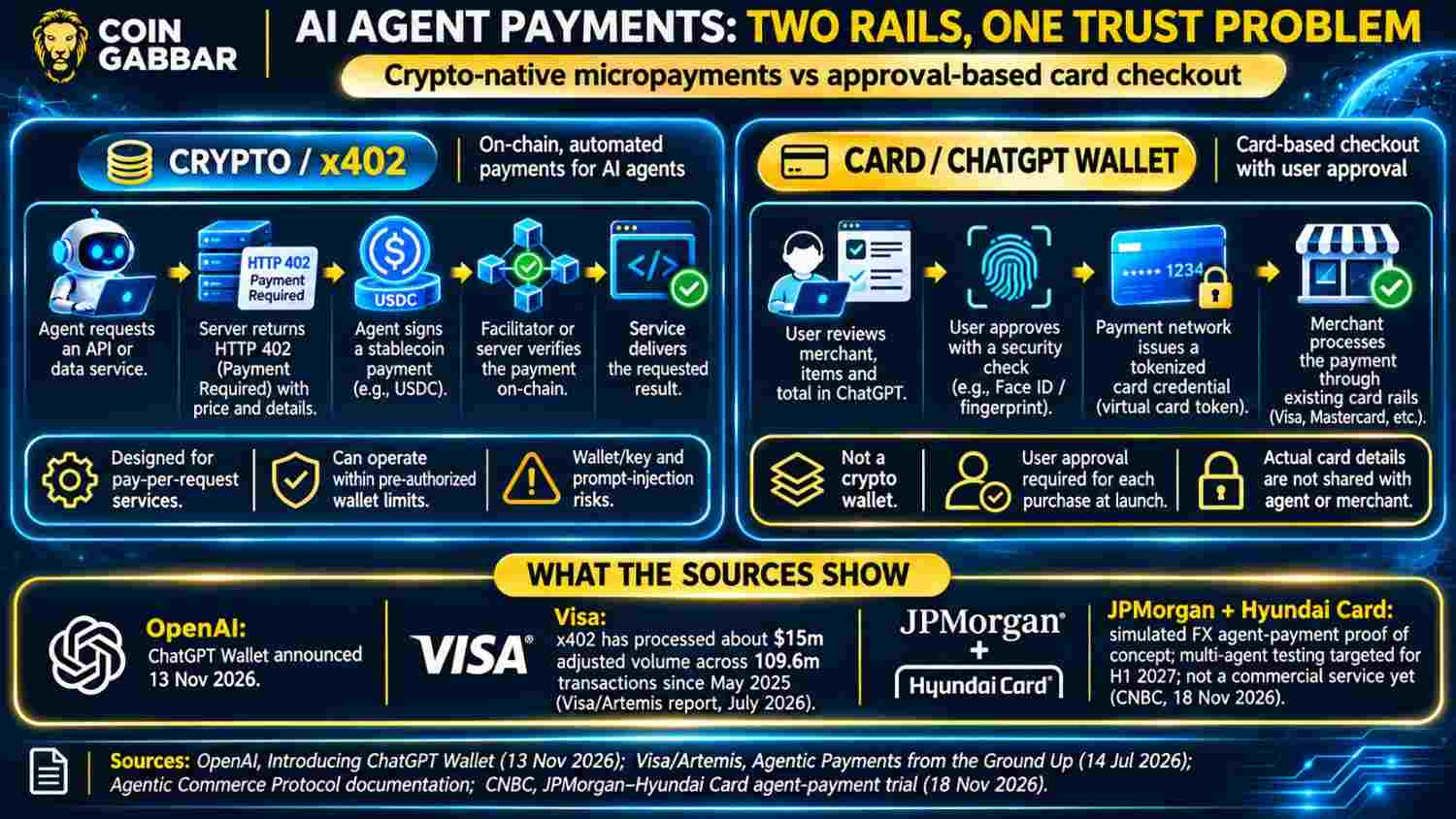
- The AI calls a service. The service replies that payment is due. It pays in a stablecoin and gets the answer, with no person approving each call.
A wallet with spending limits keeps control. ChatGPT Wallet is different because it uses tokenized cards, not crypto.
What Are AI Agent Crypto Payments, and Why Do They Matter Now?
Until now, paying online meant a person, a card, and a checkout page. Agents break that model. They make hundreds of small requests for data, computing power, and tools. Each one needs a tiny payment.
A stablecoin wallet suits that job. It moves money in seconds and handles very small amounts.
On 13 November 2026, OpenAI announced ChatGPT Wallet, which lets its agents buy with approved cards. It is a different rail from crypto, as a later section explains.
How Does an AI Agent Pay for an API Call Without Approval?
x402 is an open payment standard. It revives HTTP 402, a web status code long reserved for "Payment Required." The software asks for a resource. The server answers with a price, a network, and payment details.
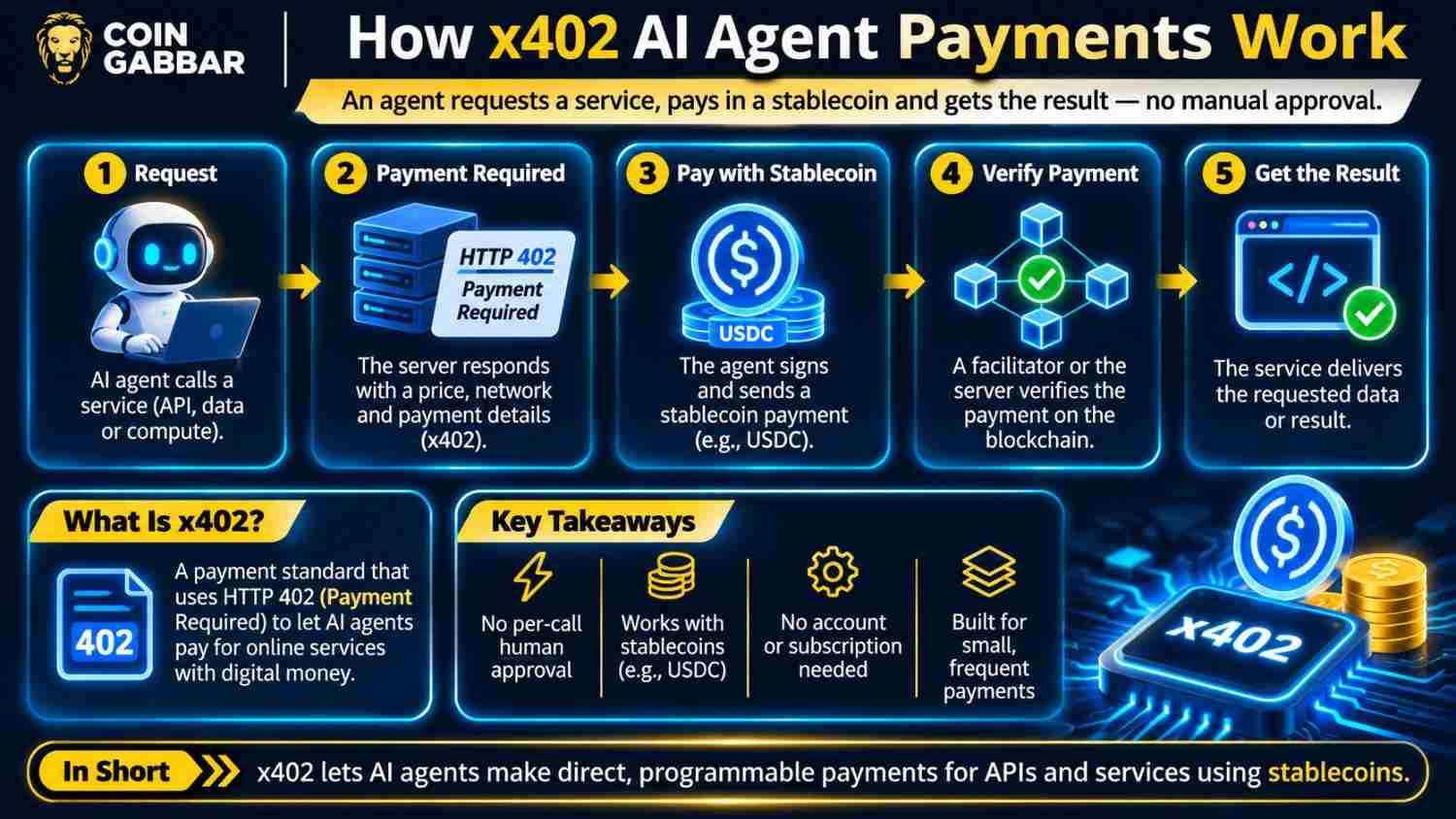
The software then signs a payment, often in USDC, and sends the request again with proof. A facilitator, the service that checks and settles the payment, confirms it on the blockchain. Then the server delivers. No account, subscription, or API key is needed.
Our x402 payment rail guide goes deeper on each step. One hosted facilitator is reported to charge nothing for the first 1,000 transactions a month, then $0.001 each. The first image shows the steps.
Why Do Stablecoin Micropayments Suit AI Agents Better Than Cards?
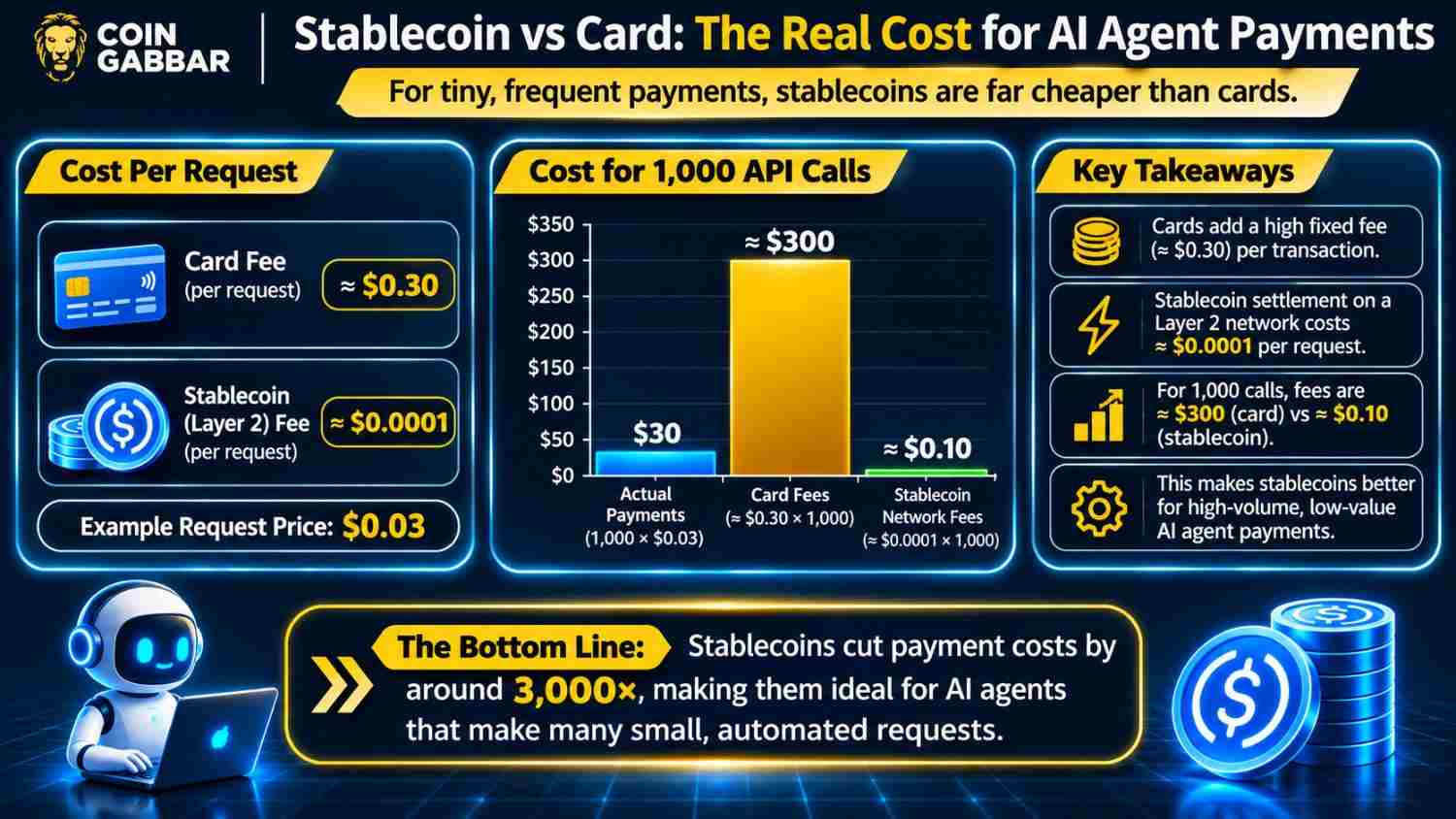
Keyrock's May 2026 report on AI payments says cards carry a fixed fee of about $0.30. That is ten times a $0.03 request. It puts stablecoin settlement on a layer 2 network at about $0.0001.
By our division, 1,000 calls at $0.03 cost $30 in total. Charged one by one by card, the fees alone would add about $300. The network cost would be about $0.10. These assume a flat card fee and calm network traffic. Real prices vary. The second image shows the gap. Our guide to agents paying each other compares both rails.
Keyrock reports over $73 million settled across 176 million payments, with 98.6% in USDC, the dollar-backed coin in the USDC guidelines. The third image shows more. Treat these as reported, not audited.
How Do Agent Wallets and Spending Limits Keep Control?
An AI wallet gives software a blockchain address and signing keys. Our guide to AI agents with crypto wallets lists three designs. They are hosted wallets, wallets linked through MCP (a standard that connects AI tools to outside services), and session-key smart wallets, which use a temporary key with set limits.
Whoever holds the signing keys controls the funds. A hosted wallet's provider holds them. In your own wallet, you do, and a lost key can't be recovered.
Keyrock also notes that Google's AP2 lets a user hand software spending power through signed mandates, meaning pre-approved spending rules. Providers describe caps per payment and per session. These are provider claims, not audited results.
Is ChatGPT Wallet a Crypto Wallet or Something Different?
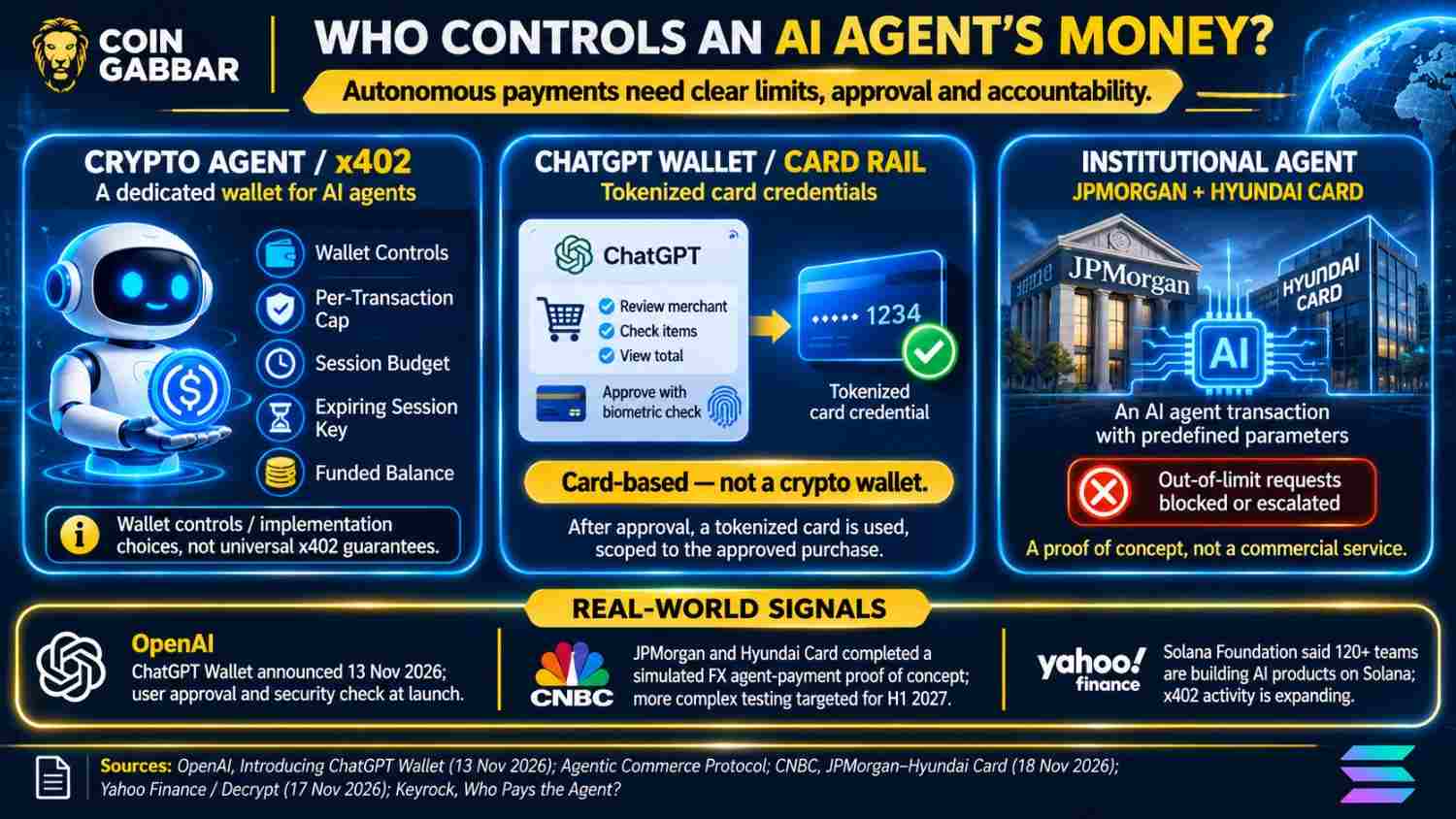
No. As of 13 November 2026, ChatGPT Wallet uses tokenized card credentials. A token stands in for your card number. The business and the AI never see the real number.
OpenAI built it with American Express, Mastercard, and Visa. At launch it runs through its personal agent for US adults with ChatGPT Pro and eligible US cards. You approve each purchase with a face or fingerprint scan. Check OpenAI's page for current availability.
So there are two paths. Cards add a person's approval to each purchase. x402 lets software pay small amounts inside set limits. The fourth image sets them side by side.
What Fraud and Safety Risks Come With Agent Payments?
In prompt injection, bad instructions hide in a web page or file. A fooled AI may send funds to an attacker. Our guide to securing your crypto funds covers key safety.
Other risks include stolen keys, smart contract bugs, and a de-peg, when a stablecoin falls below its $1 target. Crypto payments are also final once confirmed. There is no chargeback.
Rules lag too. In the US, the GENIUS Act covers payment stablecoins. In the EU, MiCA covers crypto assets, and the EU AI Act covers AI systems. Keyrock says none of them specifically covers machine-to-machine payments.
What Should You Check Before Funding an AI Agent Wallet?
Start with limits. Set a cap per payment and per day and an expiry date on every key.
Then limit where it can pay. Use a merchant allowlist if the wallet offers one. Keep the balance small.
Last, watch the payment log and know how to revoke a key. Limits don't stop prompt injection or key theft, so treat them as a safety net, not a shield. Who bears the loss after a bad payment is unclear, so read your provider's terms.
Expert Opinion: Will Agents Become Everyday Crypto Spenders?
CoinGabbar analysis suggests AI agent crypto payments will grow first in small, repeat buys such as data and computing power. The basis is the fee gap at tiny prices, the reported payment volume, and the fact that card purchases still need a person's approval.
Wallet limits and key safety will decide how far agentic payments spread. This view is not a forecast.
Disclaimer: This article is for information only and is not financial, tax, or legal advice. Nothing here is promised or assured. Stablecoins can lose their peg, software can make costly mistakes, and rules can change. You can lose money, so check with a qualified adviser first.