Stablecoins Power AI Agents Payments as Agents Pay Each Other Now

Software Is Learning to Pay: What Is Changing Now?
AI agents payments are no longer just a lab idea. Software programs are starting to pay each other for real services, and stablecoins are the money they use. An AI agent is a program that can plan a job, make choices, and act with little human help.
But every job costs something. The agent may need data, computing power, or access to another tool, and someone has to pay for it. Cards and bank transfers were made for people, not for machines that never sleep.
Stablecoins are digital tokens built to hold a steady price, usually tied to the US currency. This article explains how the system works, why stablecoins fit it, and where the risks sit. The details reflect public documentation available on 27 October 2026.
What Are AI Agents Payments, and Why Do They Matter?
The process of AI agents making payments occurs when one piece of software transfers money to another software application or service without the need for human involvement.
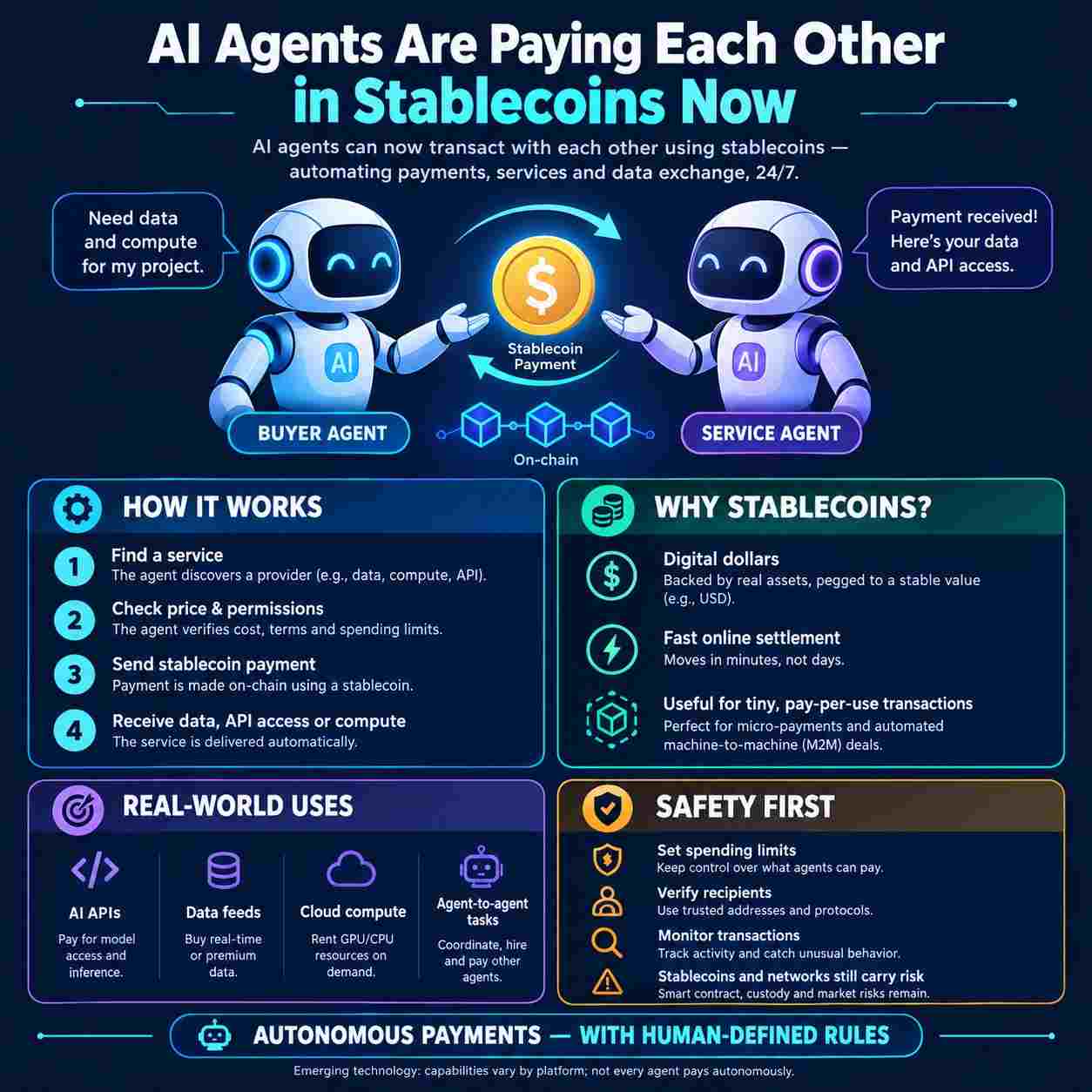
For example, consider a buyer agent looking for a market data feed and a service agent providing that data. They agree on a price, the money moves over a blockchain, and the data arrives within seconds.
Some call this machine-to-machine commerce. It is now a growing part of the AI agent crypto conversation.
Agents handle more work every month. A single task can mean dozens of tiny purchases, like one database search or one call to a language model. A normal checkout page cannot keep up with that.
How Do AI Agents With a Crypto Wallet Make Payments?
A digital account is managed by an AI agent that possesses a crypto wallet safeguarded by special codes known as private keys. A private key is a code that is used to perform different transactions. The user deposits stablecoins into his account and sets limits on paying. From there, the process usually runs in four steps:
Discovery: The agent finds a provider that sells data, computing power, or API access.
Price and permission check: The agent confirms the cost, the terms, and its own spending limit.
Payment: A stablecoin transfer goes out over a blockchain.
Delivery: The service hands over the data or access once the payment clears.
One open standard, called x402, shows the idea in action. Its public documentation says it revives the old HTTP 402 “Payment Required” status code. A server asks for payment. The agent replies automatically, often with USDC.
Why Are Stablecoin AI Agents Preferred Over Cards and Banks?
Stablecoin AI agents are a perfect fit for stablecoins since they operate like software. The fixed budget remains unchanged throughout the crypto market as prices remain fixed. Settlement may take just minutes rather than days.
Blockchains run nonstop, which suits agents that never pause. Fees can be small enough to allow payments worth a fraction of a cent. On cards, a fixed fee would eat up a payment that small.
Factor | Stablecoin Rails | Cards and Bank Transfers |
Settlement | Minutes or less | Hours to days |
Small payments | Practical | Often limited by fixed fees |
Reversals | Generally irreversible | Chargebacks possible |
A payment that cannot be reversed protects sellers, yet buyers get less protection.
Key Features of Stablecoin AI Agents Payments
Spending limits: Owners can cap the amount per transaction, per day, or per provider.
Programmable rules: Smart contracts, which are pieces of code that are executed by a blockchain, can be programmed to release funds only when certain conditions are met.
Micropayments: A per-use pricing strategy can be implemented, allowing a charge for each request.
Clear records: Anyone can trace transfers on a public blockchain explorer.
Real-World Uses and the Role of AI Agents in Banks
Agents already pay for access to AI models, buy live data feeds, and rent cloud computing power. Some also hire specialist agents to finish part of a bigger job. Open AI agents and crypto networks take this further. Any developer can list an agent there, and other agents can hire it and pay in stablecoins.
Banks and card networks have talked in public about payment tools built for agents. AI agents for banks may one day offer wallets, spending controls, and compliance checks for software users. Right now, the public record shows pilots and early products, not mass use. How fast that changes is still unknown.
What Is Driving Agents to Pay Each Other in Stablecoins?
Four main reasons stand out. Agents are getting better, so they need to buy services on their own. Many digital services now charge per request, and that creates demand for very small payments.
Stablecoins have grown up too, with several issuers, many blockchains, and wide wallet support. And rules are getting clearer in some regions.
In July 2025, the United States enacted the GENIUS Act, establishing a federal framework for payment stablecoins, and the European Union (EU) has introduced its MiCA rules to stablecoin issuers.
Risks and Security Concerns in AI Agents Payments
Key theft: An agent wallet can be emptied in a matter of minutes if the private key is stolen.
Prompt injection: Hidden text deceives an agent to comply with the attacker. That can mean payments that the owner did not want to make.
Smart contract bugs: Coding mistakes in payment contracts may freeze funds or result in the loss of funds.
Stablecoin risk: Stablecoin may lose its peg; issuers may freeze stablecoins or have reserve issues.
Compliance gaps: If a transaction does not have a person signing off on it, the rules for checking identities and anti-money-laundering procedures are not clear.
Liability: Nobody has a clear answer on who pays the bill when an agent overspends or pays a fraudulent service.
What Does the Data Say About the Road Ahead?
The strongest signal for AI agents payments is real demand. Agents already buy data and computing power, and stablecoins solve a pricing problem for small, frequent payments.
But most public claims about future volume come from projects and vendors, not from audited usage numbers. Who will be accountable when something goes wrong? That question hangs over the whole field, and regulators have not settled it yet.
Readers who follow AI crypto news should check transaction counts on public explorers and read the official documentation for each protocol. It also helps to separate working products from plans that were only announced.
Conclusion
AI agents payments rest on a simple idea. Software buys services from other software and settles in stablecoins. Speed, low fees, steady prices, and nonstop access explain the appeal.
The reason for the caution is the issues of security, compliance, and liability. The following can be tracked by readers by reference to official protocol documents, regulatory news, and confirmed on-chain activity.
Disclaimer
This article is for informational purposes only and is not financial, investment, or legal advice. Crypto assets, including stablecoins, carry a high level of risk and can lose value. Readers should conduct independent research and consult a licensed professional before making any decision.
















