AI Bubble Fears: Could Fed Liquidity Trigger the Next Crypto Rally


Why AI Bubble Fears Are Spreading Across Markets
AI bubble fears are shaking tech stocks and crypto alike. The big question is whether central bank money could lift Bitcoin after equities fall first.
Bitcoin traded between roughly $58,000 and $61,000 in late November 2026, with sentiment close to extreme fear. This article covers the Fed liquidity argument, the strongest counterpoints, and the signals to watch.
An AI stock sell-off would likely hit BTC first, since investors sell liquid assets to raise cash. A rebound needs the Fed to pause or restart reserve purchases. Until that signal appears, the liquidity rally stays a scenario, not a confirmed trend.
Last updated: November 28, 2026
What Is an AI Bubble and Why Are Investors Concerned?
An AI market bubble forms when company valuations rise faster than the profits that could justify them.
The worry is spending. Major AI developers have committed hundreds of billions of dollars to computing capacity while still reporting losses.
Why AI Infrastructure Debt Matters for Financial Markets
A large share of the data-center build-out is financed with debt. That ties AI growth to credit conditions, not just to investor excitement. Long-term compute leases and non-cancellable commitments add fixed costs. If revenue growth slows, those payments don't slow with it.
Arthur Hayes argues these commitments could come due in the second half of 2027. That timeline is his forecast, not a confirmed event. An AI equity correction is not the same as an AI sector collapse. A correction resets prices. A collapse would mean defaults and forced selling.
How Does Federal Reserve Liquidity Affect Crypto Markets?
Fed liquidity is the amount of money available in the financial system. Interest rates and balance sheet decisions, such as asset purchases, shape it. When liquidity expands, investors usually take more risk. Bitcoin has often reacted strongly because it trades around the clock and sells fast.
Hayes calls the pace of money printing the only factor that decides Bitcoin's direction. Many analysts see liquidity as one major driver among several. So that claim reads best as a strong opinion.
What Happened to Bitcoin During Previous Liquidity Cycles?
History shows both sides. In March 2020, Bitcoin fell about 50% in days as investors sold everything for cash. Massive stimulus followed, and a historic rally came after.
But 2022 told a different story. The Fed tightened, liquidity shrank, and BTC dropped from roughly $69,000 to about $16,000. The lesson is timing. Liquidity helped Bitcoin, but only after the first wave of forced selling ended.
How Fed Liquidity Could Trigger the Next Crypto Rally Amid AI Bubble Fears
Hayes began 2026 with a $250,000 Bitcoin target. He admits it was missed because the monetary easing he expected never came.
His current view is that AI stocks must fall first. Investors who sell tech holdings also tend to sell crypto, one of the easiest assets to turn into cash.
He says the Nasdaq has not fallen enough to trigger a big money-printing response. He expects BTC could drop toward $50,000 first, then gain 10 to 20 times.
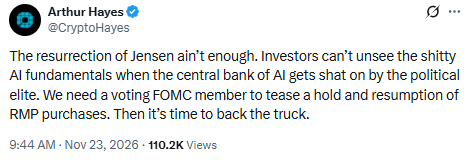
Hayes has laid out this thesis in public posts on X. Those figures are personal projections with no guarantee. And a $50,000 floor has no supporting calculation behind it.
Interest Rate Changes and Investor Confidence
Rate direction matters as much as the headline. The next FOMC meeting runs December 8-9, 2026. Futures pricing showed a 99.2% chance of a rate hike on November 25, up from 68.9% a month earlier. That would tighten conditions further.
Hayes wants two signals before buying. Gold should rise while the Nasdaq falls over a few days. And voting Fed members should hint at a pause or restarted reserve purchases.
Quantitative Tightening vs. Quantitative Easing
Quantitative tightening shrinks the Fed balance sheet and drains liquidity. Quantitative easing expands it through asset purchases.
Hayes calls a restart of reserve management purchases "QE by another name." That would be the clearest liquidity signal for crypto. Until it appears, current balance sheet policy is a headwind, not a tailwind.
How Institutional Capital Moves Into Crypto
Institutional money usually follows confirmed policy shifts, not forecasts. The latest ETF data shows that clearly.
US spot Bitcoin ETFs lost about $1.24 billion between November 16 and 20. That was a third straight week with outflows above $1 billion.
November outflows crossed $4 billion in total. That challenges any claim that institutional demand is already returning.
A crypto asset manager's head of research says a clear uptrend needs a better Fed outlook, renewed inflows and large holders buying again. The same analyst gives a base-case range of $60,000 to $90,000.
Can Bitcoin Benefit From Rising Global Liquidity?
Global liquidity covers several central banks, not only the Fed. Hayes points to Taiwan, South Korea and China backing their stock markets as early signs of intervention.
If global liquidity rises, a Bitcoin rally becomes more plausible. Bitcoin is also often described as a hedge against currency debasement.
The bearish evidence deserves equal weight. One research firm notes BTC broke below a level that marked every major turn this cycle. The last such break, in October 2025, came before a bear market.
Higher oil prices and renewed Fed tightening add pressure. Liquidity is the missing ingredient, and it hasn't arrived.
What Happens to Bitcoin When AI Stocks Crash?
AI stocks and crypto have moved together in recent months. Bitcoin has fallen alongside large tech names. That link is the core risk. A deeper equity drop could drag crypto lower before any policy response shows up.
There is another side. Some analysts argue a sharper AI slowdown could weaken growth and bring Fed rate cuts back into the picture. And much of the panic selling may already be done.
Sentiment adds a contrarian angle. The Crypto Fear and Greed Index read 12 on November 17, an extreme fear zone. Extreme fear has sometimes come before rebounds. But it isn't a reliable buy signal, and options demand for downside protection has also climbed.
Bull vs Bear: Bitcoin Scenarios at a Glance
Market condition | Possible Bitcoin impact |
AI stocks fall sharply | Initial selling pressure |
Fed holds tight policy | Liquidity stays constrained |
Fed pauses or restarts purchases | Risk appetite may improve |
ETF outflows continue | Institutional demand stays weak |
Stablecoin supply grows | More capital may be waiting to enter |
These are scenarios, not guaranteed outcomes.
What Could Invalidate the Liquidity Rally Theory?
Three things could break the thesis. Inflation could stay high, which keeps the Fed from easing.
AI stocks could recover without any liquidity help. Or liquidity could expand while Bitcoin lags, as has happened before. Each case would leave crypto without the catalyst Hayes expects.
Key Indicators to Watch Before the Next Crypto Rally
Several signals could show whether the liquidity cycle is turning:
Federal Reserve decisions: a pause, or any hint of restarted reserve purchases at the December 8-9 meeting.
Global liquidity trends: central bank balance sheets and state support for Asian stock markets.
Bitcoin ETF flows: sustained inflows would show institutions returning.
Stablecoin supply: growth points to fresh capital waiting nearby.
Market sentiment: fear readings, funding rates and options demand for protection.
Final Thoughts: Will Fed Liquidity Support the Next Crypto Rally?
The case linking AI bubble fears to a crypto rally follows a sequence. AI stocks fall, governments add liquidity, and BTC gains as a debasement hedge.
Each step is plausible. None is confirmed. And the first step could hurt crypto before the last one helps.
Until the Fed signals a pause or restarts purchases, the next rally stays conditional. Readers should verify Fed decisions, liquidity data and ETF flows independently, because AI bubble fears can fade or grow fast.
Disclaimer
This article is for informational purposes only and does not constitute financial, investment or trading advice. Cryptocurrency prices are highly volatile, forecasts quoted here are opinions and not guarantees, and readers should conduct independent research before making any decision.