AI Crypto Scams: When the Attacker Never Touches Your Wallet


What Are AI Crypto Scams, and Why Are They Rising?
AI crypto scams are frauds where scammers use artificial intelligence to build trust and push people into handing over wallet access themselves. The biggest risks are fake endorsements, malicious wallet approvals, and stolen seed phrases.
A regular hack breaks into a wallet. This kind does not have to. The victim authorizes the transaction themselves, and often does not realize it. Deepfake videos, cloned voices, and fake support bots now appear regularly in AI crypto news, which is why more users are paying attention.
This guide explains how these scams work, why they are hard to spot, how malicious approvals and seed phrase theft happen, and what to do if you have already signed something suspicious.
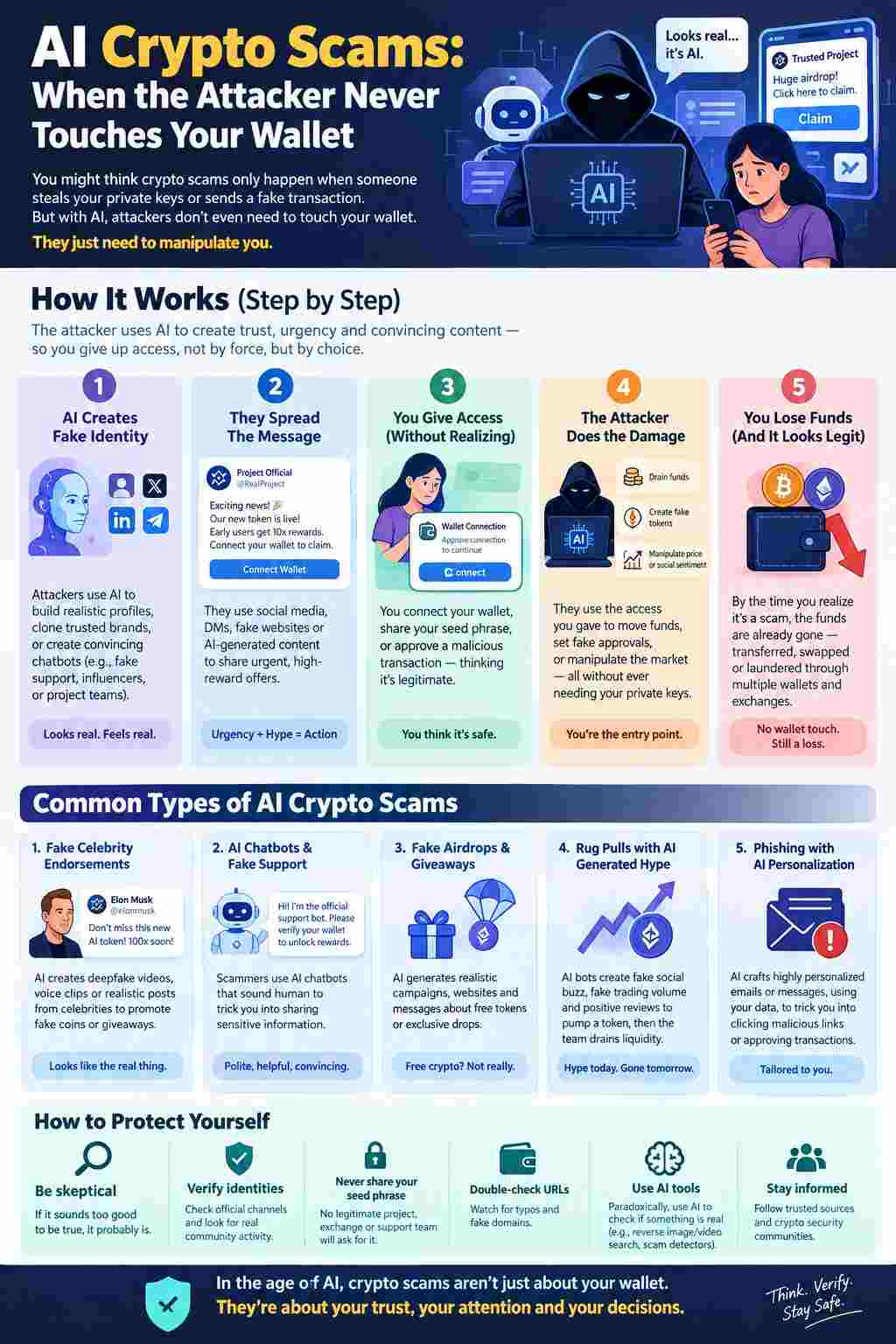
Infographic: Overview of AI crypto scam methods and warning signs. Source: CoinGabbar research.
Key Features of AI Crypto Scams
Three things make these scams different from older fraud.
Realism: AI can write clean messages, create believable photos, and build convincing videos within minutes. Scammers also use publicly shared posts and wallet activity to tailor each message to a specific target.
Mass reach: One person can run hundreds of fake accounts at the same time.
Psychology: The attack targets human decisions, not code. Even a well-secured wallet can be emptied once its owner approves a single malicious transaction.
How AI Crypto Scams Work Step by Step
Most cases follow five stages, and each one is designed to feel normal to the victim.
Fake identity: Scammers create believable accounts that pose as company representatives, social media influencers, or project teams, sometimes using AI tools that copy a real person's face or voice.
Urgent offer: The target receives a time-limited offer with big promised gains through social networks, direct messages, or a fake website.
Unintended access: The target connects a wallet, shares a seed phrase, or signs a harmful transaction while believing it is safe.
Fund movement: Once access is granted, the scammer can move funds without needing the private key. A malicious approval is enough to let the scammer's contract spend the victim's tokens.
Cash-out: By the time the victim notices, the funds have usually been split across several exchanges and wallets.
Why AI Makes Crypto Scams Harder to Detect
Older scams were easy to catch because bad grammar, poor images, and generic messages gave them away. AI removes most of those clues. A deepfake video, a cloned voice, and flawless text can make a fake endorsement look almost real.
Chatbots also reply instantly and sound human, so victims stay relaxed. Speed adds to the problem, because scam sites and fake accounts can be replaced faster than platforms can take them down.
AI-linked tokens are another target. Scammers use the popularity of AI projects to promote fake tokens and invented partnerships, so real and fake announcements appear side by side. Before acting on any claim, check the project's official website and verified channels. You can also follow AI token scam warnings to see which projects are being impersonated.
Common Types of AI Crypto Scams
Fake celebrity endorsements: Deepfake video and audio make it look like a well-known person is promoting a coin.
AI chatbots and fake personas: These ask people to connect their wallets or share private information.
Fake airdrops and giveaways: AI-generated campaigns promise free tokens, but the claim button prompts the user to approve a wallet transaction.
Rug pulls: Bots create hype and raise trading activity, then the creators drain the funds from the project.
Phishing through AI-generated messages: These contain personal details and urge users to click malicious links or authorize harmful transactions.
Quick comparison of scam types
| Scam type | Warning sign | Wallet risk | What to do |
|---|---|---|---|
| Deepfake endorsement | Guaranteed returns, no official announcement | Funds sent to a fake project | Check the person's verified accounts |
| Fake support bot | Asks for seed phrase or remote access | Full wallet takeover | Stop chatting and use only official support pages |
| Fake airdrop | Claim button asks for broad approval | Token approval abuse | Do not sign, then check the contract |
| Rug pull | Sudden hype, anonymous team, locked sell | Funds drained from liquidity | Research the team and contract before buying |
| AI phishing | Personalized message with urgent link | Malicious signature request | Type the URL yourself, never click |
AI Scam Attack Flow: The Five Stages Explained
Organized groups run these scams in stages, from early research to the final transfer of funds.
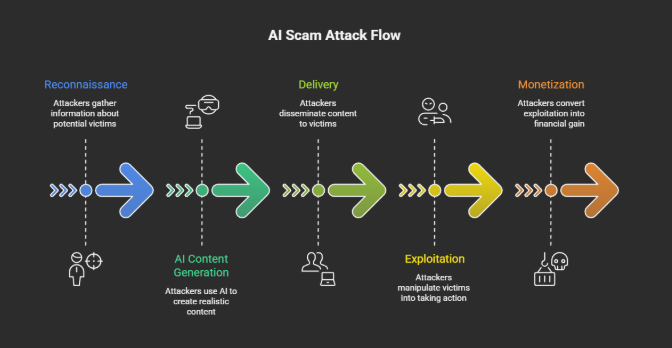
Diagram: The five stages of an AI crypto scam, from reconnaissance to exploitation. Source: CoinGabbar research.
1. Reconnaissance. Criminals collect information about their targets, including social media behavior and public wallet activity. This helps them find people likely to respond.
2. AI content generation. They produce believable text, images, and videos, along with fake project pages and support scripts.
3. Delivery. The content is sent through social media, direct messages, email, search ads, and chat groups. Timing matters, and scammers often launch when a major news story is trending.
4. Exploitation. Victims are asked to connect their wallets or approve token transactions, which gives the criminals access to the funds.
5. Laundering. The stolen funds are moved quickly across wallets and exchanges.
AI Crypto Scams and Seed Phrase Theft: The Hidden Risk
A seed phrase is the set of words that restores a wallet, and whoever holds it controls the funds completely. Many AI crypto scams go straight after it. A fake support chat, a phishing page, or malware can capture it in seconds. Once it is typed into a fake site, the phrase is compromised no matter how strong it was. No real support team ever needs it to fix a problem.
Careless habits make things worse. Saving the phrase in a phone note, taking a screenshot, keeping it in a cloud drive, or emailing it to yourself all leave a trail. This is why these scams count as a serious AI crypto threat, since one mistake can mean a total loss.
Malicious Wallet Approvals: How to Check Before You Sign
A token approval is a permission that lets a smart contract spend a specific token from your wallet. Legitimate apps use approvals, but scammers abuse them by asking for unlimited access. Seed phrase theft gives full control at once, while a malicious approval works more quietly, because the wallet owner signs it willingly.
Before signing any wallet request, check these points:
Does the website address exactly match the official project domain?
Is the request asking for approval of all tokens or an unlimited amount?
Does the contract address match the one listed on the project's official channels?
Does the wallet's transaction preview match what the site says you are doing?
Did the request come from an unexpected message, giveaway, or direct message?
If any answer feels wrong, reject the request. You can review and cancel existing permissions with a token approval checker such as Revoke.cash.
Main Causes and Risks of AI Crypto Threats
Pressure and excitement that prevent careful checking
Trust in familiar people, organizations, and voices
Limited knowledge of how to protect a seed phrase
Weakly monitored platforms where fraudulent projects spread
Crypto transactions are irreversible once confirmed, which makes recovery very difficult. Victims can lose their funds, have personal information exposed, and lose trust in crypto. Regulators and consumer-protection agencies publish scam alerts and trackers, so it is worth checking a project against them before getting involved.
How to Protect Crypto Assets From AI Crypto Scams
Confirm identities through official websites and verified accounts.
Never share your seed phrase, because no legitimate project, exchange, or support team asks for it.
Check the URL for spelling errors and fake domains before connecting a wallet.
Use verification tools carefully. Reverse image search (uploading a photo to find where else it appears online), video checks, and scam detectors can help, but none of them is perfect.
Store your seed phrase offline on paper or metal. A hardware wallet keeps your private keys offline and reduces exposure, but it cannot stop you from approving a malicious transaction, so always read what you sign.
Review your token approvals regularly and revoke any you do not recognize.
Follow reliable crypto security news to learn about new scam methods.
What to Do If You Have Been Scammed
Act quickly, because speed can limit the damage.
Revoke token approvals for the suspicious contract.
Move remaining funds to a new wallet with a fresh seed phrase.
Save evidence, including screenshots, wallet addresses, transaction hashes, and chat logs.
Contact your exchange if any funds passed through it.
Report the scam to the relevant authority, such as the FBI's Internet Crime Complaint Center (IC3), the FTC, or India's National Cyber Crime Reporting Portal.
Conclusion
The rise of AI crypto scams shows that the biggest weakness in crypto security is human error, not technical failure. Fake identities and urgent messages can drain a wallet without any hacking.
The best defense is a few simple habits. Verify announcements on official channels, protect your seed phrase, and read every wallet request before you sign it. Slow down, check twice, and never share your seed phrase, because that is the most reliable way to stay safe from AI crypto scams.
Disclaimer
This article is for informational purposes only and does not give financial, investment, or legal advice. Crypto assets are volatile and carry a high risk of loss, and readers should research independently and consult a licensed professional before making decisions.
















