Alipay Denies Crypto Trading Support After Peer USDC Integration

Payments Giant Calls the Crypto Buying Claims False and Unauthorized
Crypto news turned sharply on October 28, 2026. Alipay denies crypto trading support after the Peer protocol opened a beta that lets users buy and sell USDC with CNY transfers. It called the claims false and unauthorized.
In a reply to the announcement, the verified Alipay account said it does not support virtual currency trading or related services. It also told users to protect their funds and account safety.
The reply came one day after the launch. A matching Chinese statement followed, and The Block also covered the news on October 29.
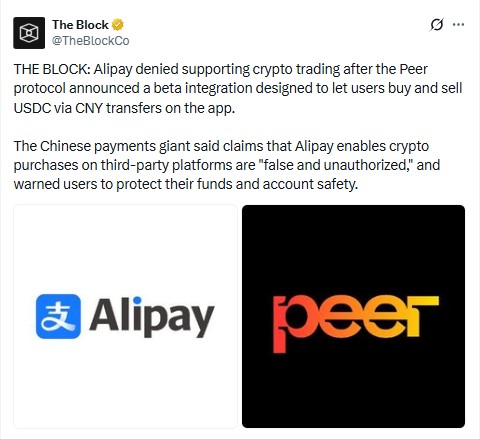
Source: The Block X-Post
How the Beta Works: Buyers Pay Sellers in CNY Directly
Peer, formerly known as ZKP2P, is a permissionless peer-to-peer on-ramp and off-ramp protocol. Sellers lock USDC, a dollar-backed stablecoin, in smart contracts on Base. Buyers pay fiat to the seller, and the protocol checks the payment before releasing the coins.
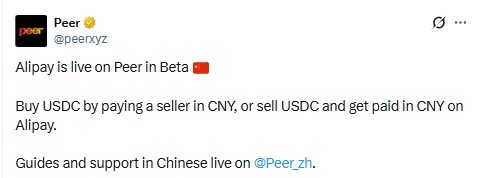
The team announced the beta on October 27, 2026. Buyers pay a seller in CNY to receive USDC. Sellers can cash out in CNY the same way. Chinese guides and support run through the @Peer_zh account.
Here is the flow described in the official guide:
-
A seller locks USDC in a smart contract on Base.
-
The buyer picks an open order and sees the seller’s payment details.
-
The buyer sends the exact CNY amount as a normal person-to-person transfer.
-
The buyer verifies the payment in the app or a browser extension.
-
The contract releases the USDC to the buyer’s wallet.
-
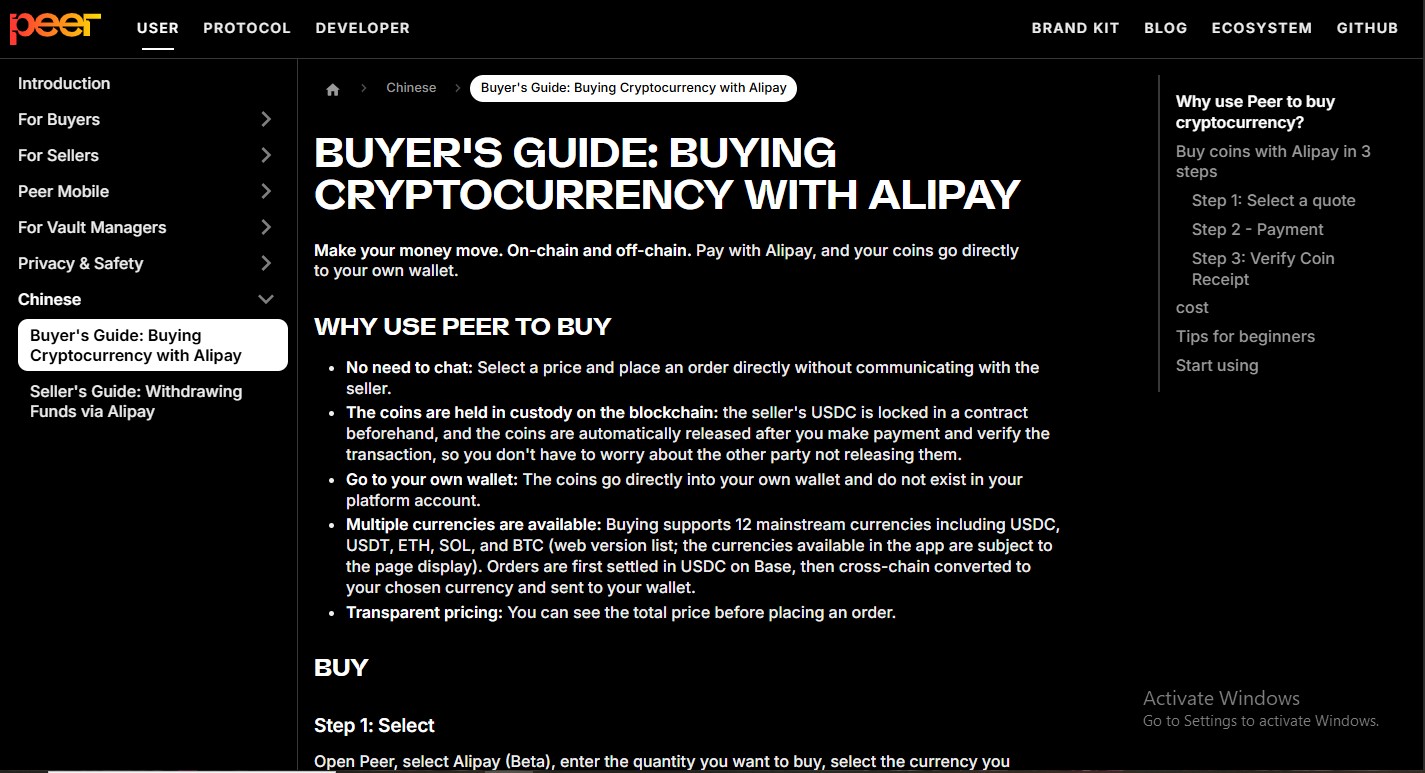
The buyer guide says the coins stay locked on-chain, so nobody sends first. Coins go straight to the buyer’s own wallet, not a platform account. Prices show in full before an order, and no chat with the seller is needed.
The web list covers 12 currencies, including USDT, ETH, SOL, and BTC. Orders settle first in USDC on Base, then convert across chains.
Settlement on the Base network also means the protocol does not hold user funds, according to the project. The guide labels the channel as Beta and states there is no official partnership with Alipay.
Limits are low, with new listings often between 5 and 500 USDC. The channel is still in Beta, so limits and rules may change.
Beta Numbers: 107 Orders and 45 Buyers Since August 21
In a follow-up post, the team said 45 buyers filled 107 orders on the new channel. Fills total $7,094 since August 21, 2026.
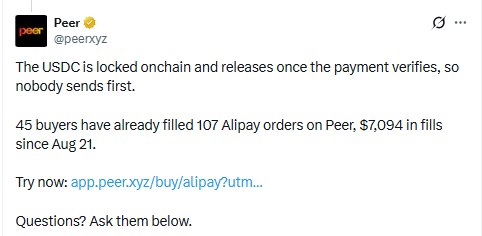
That works out to about $66 per order and 2.4 orders per buyer. Across the 67 days from August 21 to October 27, it is roughly $106 a day. These are small tickets, which fit a trial run with low limits.
| Date | Event | Source |
| Aug 21 to Oct 27 | 107 orders, $7,094 in fills | Peer thread |
| Oct 27 | Public launch | Peer post |
| Oct 28 | Denial and user warning | Official reply |
| Oct 29 | Media coverage of the denial | Secondary reports |
Why Alipay Denies Crypto Trading Amid Chinese Regulation
Since 2021, China has banned domestic crypto trading, and the rules also bar payment companies from supporting it. The denial lines up with that stance on payment services.
| Point | Peer guide | Alipay reply |
| Official tie | None stated | Claims called unauthorized |
| Custody | None held | Not addressed |
| Status | Beta | Warns on account safety |
The two statements are not direct opposites. The guide says there is no tie with the payments firm, and the process relies on ordinary transfers plus payment checks. The firm, for its part, says it enables no such purchases.
Regulators elsewhere also restrict platform access. Taiwan blocked Coinbase and Kalshi over election betting, for example.
The warning points to account safety. Users in China may also face regulatory risk, and since Alipay denies crypto trading services, users should not assume it will help with a flagged transfer.
What the Alipay Denial Means for Peer and P2P Crypto
So far, Alipay denies crypto trading support, while Peer says it holds no funds and has no partnership. The beta is small, and its limits are low.
Some points remain open. The statements reviewed do not show how many users sit behind the channel beyond the 45 buyers, or whether the company will act on the transfers.
Watch for any rise in the limits and any new statement from either side. Further details will appear in upcoming crypto updates.
Disclaimer: This article is for educational and informational purposes only and should not be considered financial or investment advice. Always conduct your own research before making investment decisions.









