Australia Crypto Regulation Sets Deadline for Digital Asset Rules

Australia Crypto Regulation: New Digital Asset Rules Start April 2027
Australia has set April 8, 2027, as the start date for its new digital asset (DA) rules. Crypto trading platforms and tokenised custody platforms will come under financial services licensing.
The Australian Securities and Investments Commission (ASIC) announced the plan on October 15, 2026. This Australia crypto regulation news raises a simple question: what changes for exchanges and everyday users?
At a Glance: Key Dates, Licensing Rules and ASIC Requirements
-
Start date: April 8, 2027
-
Regulator: ASIC
-
Law: Corporations Amendment (DA Framework) Act 2026
-
Consultation deadline: 5pm AEDT, November 27, 2026
-
Applications so far: More than 140 for digital asset financial services
-
Main duties: Licensing, customer disclosure, asset custody, settlement and financial requirements
Why Is Australia Introducing New Digital Asset Regulations?
The new law aims to close gaps in how digital assets are overseen. Its approach follows the principle of “same activity, same risk, same regulatory outcome.” In plain terms, a platform that does the job of a traditional financial firm should face similar rules.
ASIC Commissioner Alan Kirkland said the framework is meant to give consumers more confidence when trading digital assets. He also said it should support innovation and growth. For readers following Australia crypto regulation news, the key point is that the country is placing covered activity inside the existing financial services system rather than creating a separate crypto regime.
What New Digital Asset Rules Cover? Licensing, Custody and Settlement
The law creates two categories. Digital asset platforms (DAPs) hold digital tokens on behalf of clients and offer related services. Tokenised custody platforms (TCPs) record underlying assets held for clients as digital tokens.
| Regulatory area | What platforms may need to do |
| Financial services licensing | Apply for or vary an Australian Financial Services (AFS) licence |
| Customer disclosures | Provide disclosure documents and platform rules |
| Asset custody | Meet asset-holding standards |
| Trading and settlement | Follow transactional and settlement standards |
| Financial resources | Meet net tangible asset requirements, where relevant |
ASIC’s Consultation Paper 392 (CP 392) holds proposed standards and guidance. Final details may change after feedback.
What Happens After Implementation? How Crypto Exchanges Must Prepare
From April 2027, covered operators will need the right AFS licence or a variation of an existing one. They should prepare disclosure documents, custody procedures, internal controls and settlement processes now. ASIC will license, supervise and enforce the regime.
There is some relief for existing players. ASIC proposes a streamlined process for current AFS licensees, and for firms that applied after Information Sheet 225, to add DAP or TCP authorisations. Costs may rise, and smaller platforms could feel that most.
Users may get clearer information on how crypto platforms work and protect assets. Still, regulation does not remove investment risk or promise that a platform will never fail.
Australia Crypto Regulation News: Key Dates and Timeline
-
Oct 2025 to Sep 2026: Sector-wide no-action period under Information Sheet 225. ASIC says more than 110 applications arrived in this window.
-
Apr 2026: ASIC published its roadmap for the new regime.
-
Oct 15, 2026: Consultation on CP 392 opens.
-
Nov 27, 2026: Consultation closes at 5pm AEDT. Send submissions to fintech@asic.gov.au.
-
Apr 8, 2027: New framework starts.
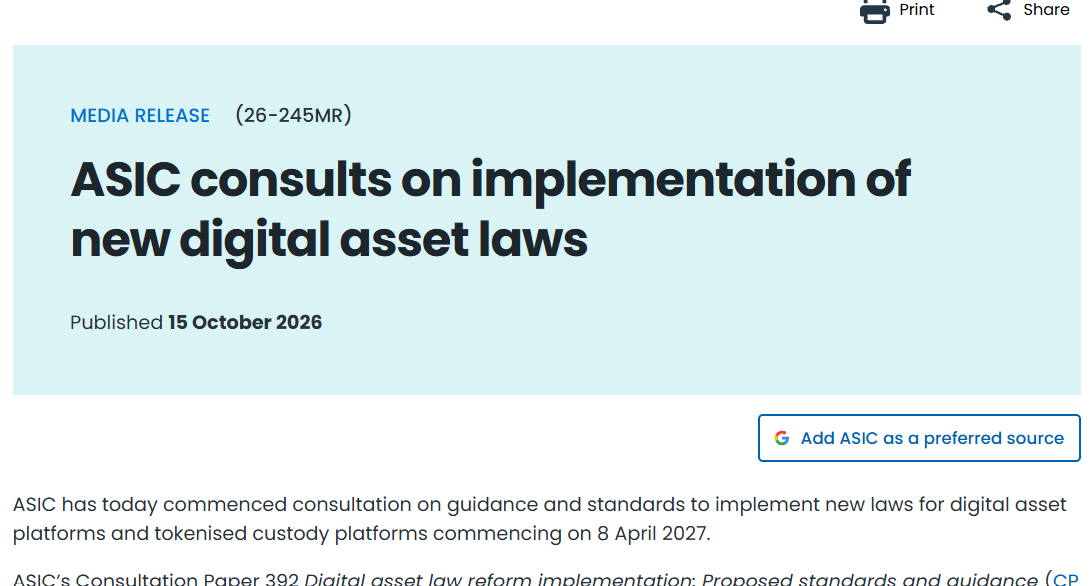
Source: ASIC media release 26-245MR, published October 15, 2026. Check transitional details against the final rules.
How Could the Rules Affect Australia and Global Markets?
Impact on Australia’s crypto market
Clearer rules may bring more transparent platform practices and stronger handling of customer assets. Firms with solid capital and compliance teams could gain trust. Smaller operators may struggle with licensing work and costs. More institutional interest is possible, but not guaranteed.
Impact on the overall crypto market
Australia joins other countries that are bringing DA intermediaries under financial rules. Clear standards could support tokenisation in traditional finance.
Any direct effect on global crypto market prices is uncertain and depends on adoption and wider market conditions. This Australia crypto regulation news is about structure, not price.
What This News Means for Crypto Users
This Australia crypto regulation news means users should expect clearer platform rules from April 8, 2027. Licensed platforms must share disclosure documents, follow asset custody standards and meet financial requirements.
That could give users information about how their assets are held. Check whether your exchange applies for an AFS licence and read its disclosures. Costs may rise for some platforms, and smaller ones may change services. Rules do not remove risk, so only invest what you can afford to lose.
Conclusion: What Crypto Investors and Platforms Should Watch Next
Three dates and details matter most. The consultation closes on November 27, 2026. The proposed licensing, custody, disclosure and settlement standards are still open to change.
The framework is set to start on April 8, 2027. The final guidance and industry response will decide how platforms adapt. Readers who follow Australia crypto regulation news should watch for ASIC’s final standards.
Disclaimer: This article is for informational purposes only and is not financial or investment advice. Cryptocurrency investments carry risk, including the loss of capital. Do your own research before making any decision.






