Pi Network News: What a Stablecoin Plan Could Bring to Pioneers


Pi Network News: Can Stablecoins Expand Ecosystem Payments?
Pi Network News today turns on one distinction from PiCoreTeam: Pi coin and stablecoins are built for different jobs. The team’s latest X post describes $PI as the native currency behind broad ecosystem activity, while stablecoins are pegged assets suited to payments and commerce.

$PI coin trades at $0.07751, down 3.56% in 24 hours. The question for Pi crypto news is whether a price-stable token adds to the network or competes with its own coin.
Pi Network Stablecoin Plan: How A Stablecoin Fits the Pi Network 2026 Roadmap
The latest Pi Network News frames stablecoins as an addition, not a replacement as per its official blog. PiCoreTeam says the aim is to widen economic activity inside the ecosystem without displacing Pi.
That matches the October 2026 push to explore complementary stablecoin support, including the Open Standard OUSD partnership, and it sits within the Pi network 2026 roadmap.
$PI role: native coin for ecosystem participation and utility
Stablecoin role: pegged token for payments and commerce
Partner: Open Standard OUSD
Stage: educational update, not a launch notice
Pi Network News Today: Pi Coin Utility vs Stablecoin Payments
Volatility explains the split. A coin that can move 3% in a day suits long-term participation, but it is a poor unit for pricing a purchase or an invoice. Merchants and app builders need a steady value to quote. A pegged token supplies it, while Pi coin stays the base currency of the network.
$PI coin: broad participation and ecosystem utility
Stablecoin: price-stable payments, commerce and everyday pricing
Net effect: two tokens working side by side
Pi Network Stablecoin Ecosystem: Readiness, Access and User Views
Readiness remains the open point. Only 11.24B of Pi’s 100B maximum supply circulates, and daily volume of $6.1M equals just 0.6991% of the $871.48M market cap. Thin trading could make a stable-value pairing harder to price. Access matters too, since a stablecoin helps only if users can reach it easily inside the ecosystem.
User reactions to the Pi network stablecoin update today are mixed. Some see a practical tool for commerce, while others fear it could pull attention from $PI coins.
Pi Network Price Update: Why Pi Price Is Down Today?
$PI fell with the wider market after hot US CPI data revived Fed rate-hike concerns. September CPI rose 3.7% from a year earlier, per the Bureau of Labor Statistics.
Bitcoin fell near $80K, $PI also trades below its key moving averages, and some traders may be cautious before the Pi Protocol 28 mainnet launch on October 16. Current price figures from CoinMarketCap as of October 15:
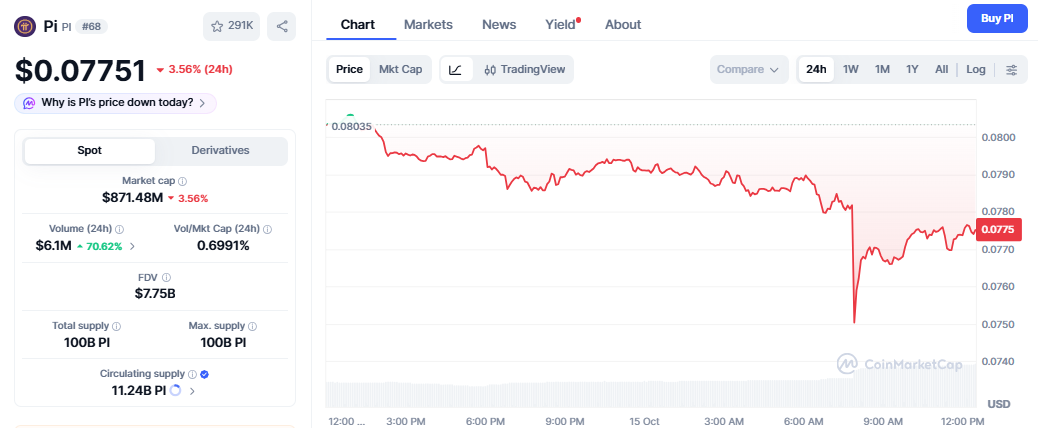
$PI price: $0.07751, down 3.56%
Market cap: $871.48M, down 3.56%
24h volume: $6.1M, up 70.62%
Fully diluted value: $7.75B
Circulating supply: 11.24B of 100B $PI
What Pi Users Could Do and Get If the Pi Network Stablecoin Arrives
If the plan moves ahead, everyday spending is where users would notice it first. PiCoreTeam has not confirmed any of the points below, so they are possible outcomes based on how pegged tokens normally work.
Payments: pay merchants and app developers in a token that holds its value
Pricing: see costs quoted in steady terms instead of shifting Pi amounts
Value storage: keep earnings in stable form while holding $PI coin for participation
Access: reach OUSD through the ecosystem, if Open Standard and PiCoreTeam open that route
Choice: spend the stable token and keep Pi coin for longer-term holding
Note: Stablecoins carry their own risks, including peg breaks and issuer reliability, so users would need to check reserves and terms before holding one.
What Comes Next: Pi Protocol 28 Mainnet Launch Tomorrow
The next scheduled event is the Pi Protocol 28 mainnet launch on October 16. Pi v28 is the technical step closest to the stablecoins discussion, since any payment token would depend on a stable network.
The wider crypto news today points to a busy window for $PI. Clear detail on OUSD timing, access and merchant use would show whether the stablecoin plan is moving from concept to product.
Disclaimer: This article is for informational purposes only and does not constitute financial or investment advice. Crypto markets carry significant risk. Always do your own research before making any investment decisions.






