Avalanche News: UAE’s Digital ID Just Made a Major Move


Avalanche News: Why Is the UAE Moving Millions to Its Blockchain?
Here's a piece of Avalanche news that marks one of the biggest real-world government adoptions the network has landed yet.
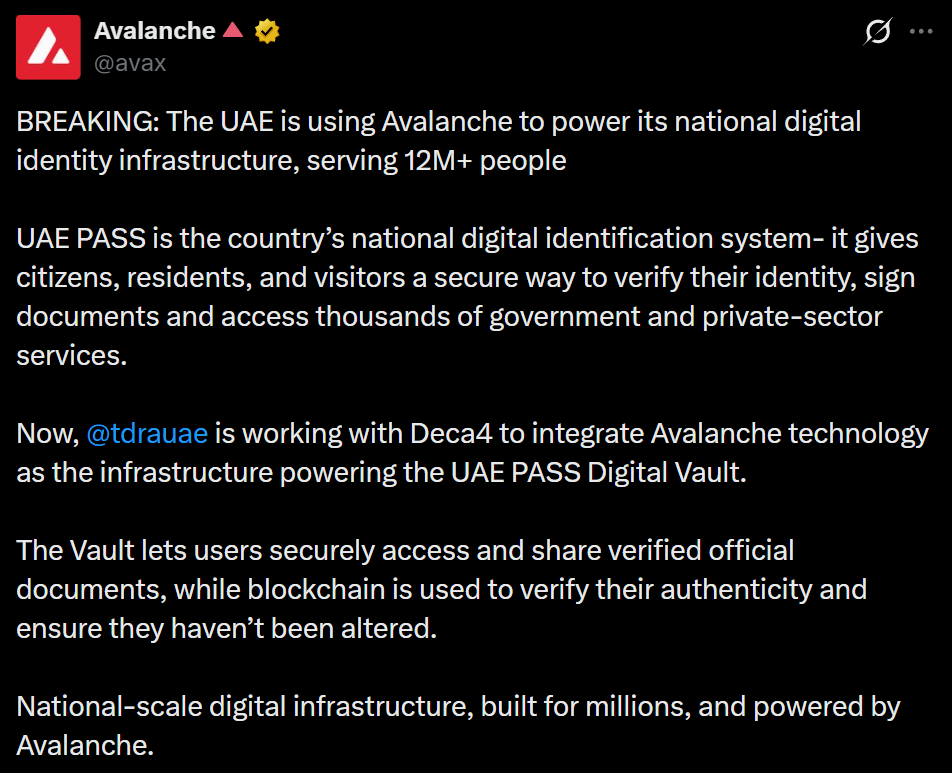
The UAE's Telecommunications and Digital Government Regulatory Authority has moved the blockchain layer behind UAEPASS, the country's national digital identity platform, over to Avalanche.
This isn't a small pilot either; it's infrastructure now supporting a system that 12.5 million people rely on every day.
Source: Avalanche on X
What UAEPASS Actually Is
According to Avalanche's official post, UAEPASS is the UAE's national digital identity platform, the way citizens, residents, and visitors authenticate themselves, sign documents, and access services online.
The numbers behind it are genuinely massive:
-
12.5 million citizens, residents, and visitors currently use it
-
Over 15,000 services are accessible through the platform
-
More than 350 government and private-sector entities rely on it for verification
Inside this system sits the Digital Vault, the piece responsible for storing and sharing verified documents securely.
That's the specific component now running on Avalanche's infrastructure.
Why the Digital Vault Needed an Upgrade
The problem UAEPASS is solving isn't really about technology for its own sake; it's about trust at scale.
Whether someone is opening a bank account, registering a company, or applying for a visa, an institution somewhere has to verify a document it didn't issue itself.
The traditional approach of paper, photocopies, and repeated manual verification simply doesn't scale to millions of people.
Per the official announcement, moving the Digital Vault's blockchain layer to Avalanche was specifically meant to strengthen scalability and performance to support continued growth in digital identity and verifiable documents across the country.
With 12.5 million users and 350 institutions plugged into the system, performance has to stay consistent, not fluctuate depending on unrelated network activity.
Why a Dedicated L1 Matters Here
This is where the technical architecture becomes genuinely important. The Digital Vault runs on a dedicated Avalanche L1, meaning it operates on its own infrastructure rather than sharing blockspace with unrelated activity.
A few reasons this distinction matters for a government-scale system:
-
Verification requests don't get delayed by traffic that has nothing to do with the UAE
-
Network membership, permissioning, and configuration remain fully in the operator's control
-
TDRA keeps direct oversight of the infrastructure underpinning a system millions of people depend on daily
That last point matters especially for public institutions, since a government can't really outsource accountability for a system this critical.
A Pattern Showing Up Elsewhere Too
This isn't the first time this kind of setup has appeared, and that's part of what makes this Avalanche news worth paying attention to.
The California DMV previously digitized 42 million vehicle titles on its own DMV-run Avalanche L1, cutting a title transfer process that used to take around two weeks down to just minutes.
Two very different government functions, identity credentials in one case, property titles in the other, both converging on the same basic architecture: a public authority running its own chain, built on Avalanche underneath it.
What This Unlocks for Verifiable Documents
The bigger shift here is in how verification itself works going forward. Instead of every institution independently checking every document it receives, verification effectively happens once, at the moment a document is issued, and everyone downstream can rely on that.
A document becomes portable across the entire system, and processes that used to take days can now resolve in minutes, with institutions still meeting compliance obligations at a stronger assurance level than a photocopy ever provided.
National identity platforms like UAEPASS have turned out to be where this kind of system actually gets used at scale, mainly because the trust problem is already solved.
When a country runs the identity layer itself, and both ministries and private companies already authenticate through it, there's no need to convince anyone to trust a new issuer.
Conclusion
This round of Avalanche news reflects a genuinely significant, live deployment rather than a theoretical use case.
A federal regulator responsible for a platform serving 12.5 million people went through a lengthy evaluation process and selected Avalanche to power the infrastructure underneath it.
With 350 institutions already relying on the system, this UAE PASS upgrade stands as a strong reference point for how large-scale government identity infrastructure is increasingly being built.
Disclaimer
This article is for educational and informational purposes only and should not be considered financial or investment advice. Always conduct your own research before making investment decisions.










