Bitcoin Strategy News: Strategy Just Broke Its Buying Habit


Bitcoin Strategy News: Why Did Strategy Choose STRC Over Bitcoin?
Here's a piece of Bitcoin strategy news that breaks from the pattern longtime followers of Strategy Inc. have gotten used to.
For the week spanning September 8 to September 13, 2026, the company didn't buy a single Bitcoin, didn't sell any either, and didn't tap its at-the-market share program at all.
Instead, it redirected $139.3 million in cash toward buying back its own preferred stock.
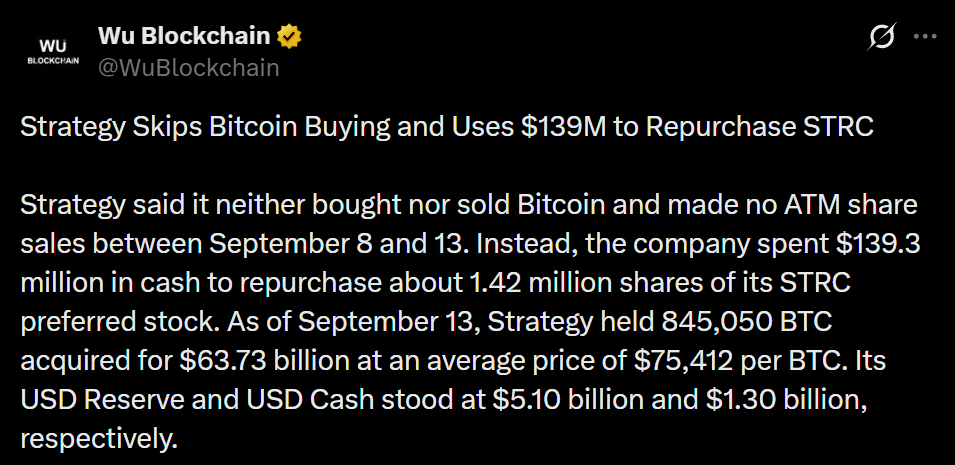
Source: WuBlockchain on X
What Strategy Actually Was Disclosed
According to the company's official Form 8-K filing with the SEC, Strategy confirmed it neither purchased nor sold bitcoin during this reporting period and made no sales under its at-the-market offering program either.
This is a notable pause for a company that's become almost synonymous with regular, ongoing Bitcoin accumulation.
Instead, Strategy used its cash to repurchase 1,420,467 shares of its STRC preferred stock, spending a total of $139.3 million to do it.
That's the entirety of the company's repurchase activity for the week, with zero repurchases made across its other listed securities, including STRF, STRK, STRD, or its Class A common stock, MSTR.
Breaking Down the Repurchase Activity
Here's how the repurchase program actually broke down across Strategy's various securities during this specific window:
| Security | Shares Repurchased | Aggregate Purchase Price |
| STRF Stock | 0 | $0 |
| STRC Stock | 1,420,467 | $139.3 million |
| STRK Stock | 0 | $0 |
| STRD Stock | 0 | $0 |
| MSTR Stock | 0 | $0 |
The filing also notes that $1.05 billion remains available under the company's digital credit securities repurchase program, while a separate $1.0 billion remains available specifically for future MSTR stock repurchases, meaning this STRC buyback used just a portion of the total capacity Strategy has set aside for these programs.
Where Strategy's Bitcoin Holdings Currently Stand
Even with no new purchases this week, Strategy's overall Bitcoin position remains massive.
As of September 13, 2026, the company holds approximately 845,050 BTC, acquired at a total cost of $63.73 billion, working out to an average purchase price of roughly $75,412 per coin, inclusive of fees and expenses.
That average cost basis gives a clear benchmark for tracking how the position performs relative to current market prices going forward.
Understanding the USD Reserve and USD Cash Structure
Part of what makes this piece of Bitcoin strategy news interesting is the window it offers into how the company actually manages its capital day to day.
Per the filing, Strategy maintains two separate cash pools:
-
USD Reserve—set aside specifically to cover dividend payments on preferred stock and interest on outstanding debt
-
USD Cash—a more flexible pool management can deploy for broader purposes, including future bitcoin purchases, expanding the USD Reserve, or general capital management needs
The $139.3 million used for this week's STRC buyback came directly out of USD cash.
As of September 13, the balances stood at $5.10 billion in the USD Reserve and $1.30 billion in USD Cash, giving a fairly clear picture of how much flexible capital the company currently has on hand.
Why Choosing a Buyback Over Bitcoin Purchases Matters
Strategy's decision to prioritize repurchasing its own STRC preferred shares over acquiring more bitcoin this particular week stands out given how consistently the company has leaned into Bitcoin accumulation as its core strategy.
A few points worth considering about this shift:
-
Buying back preferred stock can reduce future dividend obligations tied to those shares
-
It signals management sees value in its own securities at current pricing, at least for this specific window
-
Skipping ATM sales entirely means the company didn't raise additional capital through new share issuance this week either
-
None of this changes the underlying Bitcoin position, which remains untouched at 845,050 BTC
Conclusion
This update marks a notable pause in Strategy Inc.'s usual rhythm of continuous Bitcoin buying, with the company instead directing $139.3 million toward repurchasing STRC preferred shares during the September 8 to 13 window.
With 845,050 BTC still held at an average cost of $75,412 per coin, and $6.4 billion combined sitting across its USD Reserve and USD Cash pools, this piece of Bitcoin strategy news shows a company actively managing multiple levers of its capital structure rather than running on a single, unchanging playbook.
Disclaimer
This article is for educational and informational purposes only and should not be considered financial or investment advice. Always conduct your own research before making investment decisions.