Bank Digital Asset Infrastructure: Build, Integrate or White-Label

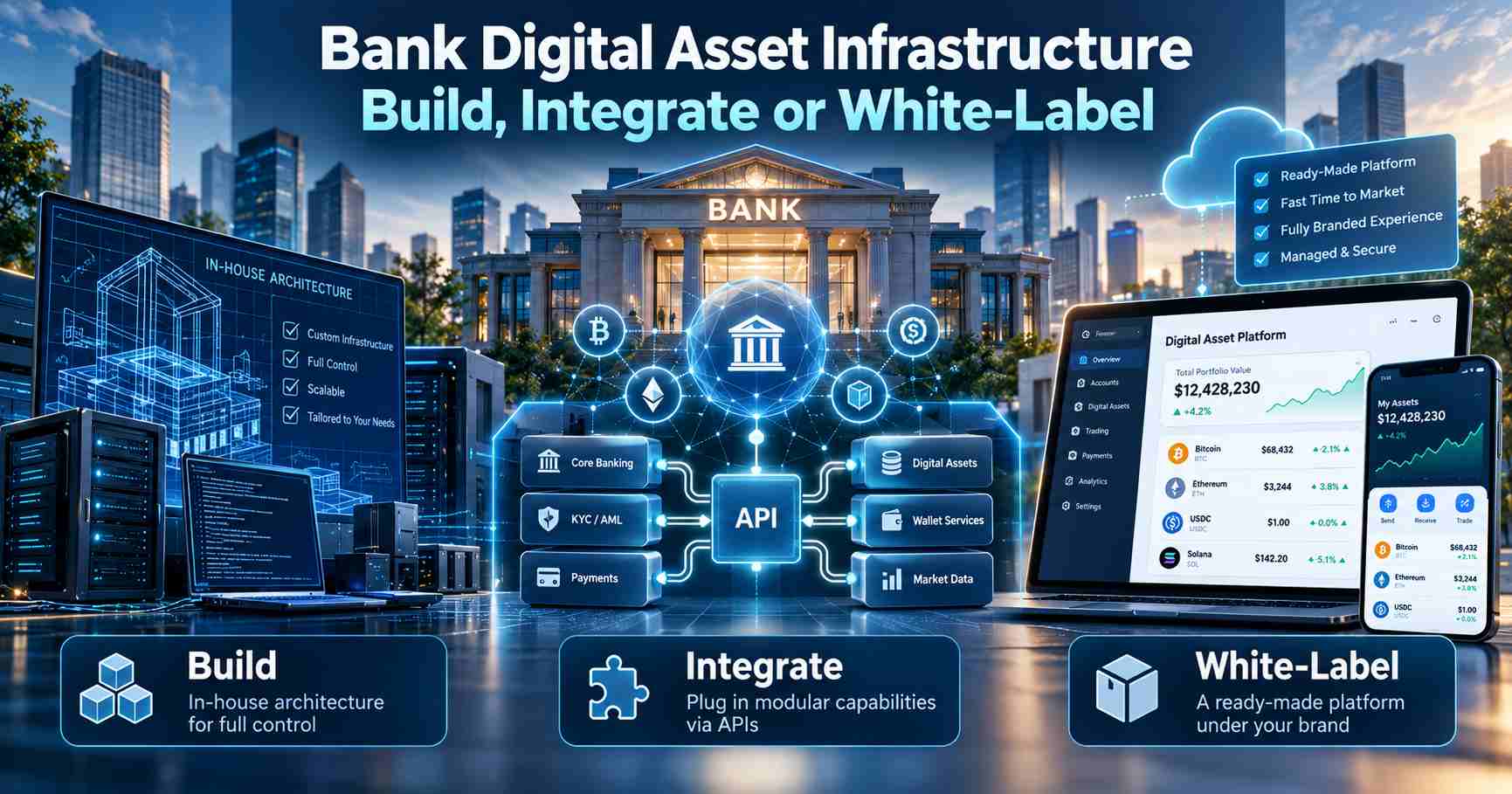
Before choosing how to launch digital asset services, a bank must assign responsibility for wallet operations, signing keys, network access, transaction processing, financial records, and incident response. That ownership map guides discussions with a payment infrastructure provider and frames the trade-offs in staffing, service resilience, cost, and vendor exposure.
Compare 3 operating models
| Decision factor | Build in-house | Modular integration | Ready-to-launch software |
| Time to market | Typically longest | Varies with integration scope | Typically shortest |
| Technical control | Direct control across the stack | Bank retains selected components | Limited by platform interfaces and contract |
| Engineering needs | Dedicated blockchain and security specialists | Integration team with targeted expertise | Product and integration expertise |
| Maintenance | Primarily internal | Shared by component | Primarily provider-led |
| Security responsibility | Mostly internal | Defined at each system boundary | Depends on custody arrangement and contract |
| Customization | Broad within available resources | Flexible within selected modules | Limited to supported settings and extensions |
| Provider dependency | Lower software dependency | Dependencies on component suppliers | Greater dependence on a platform vendor |
The right comparison also depends on product scope. Stablecoin settlement across a small set of networks calls for different skills than multi-chain custody or asset servicing.
Build in-house when technology is strategic
Internal development may suit a bank whose blockchain processing methods constitute strategic intellectual property, whose requirements are unusually specific, or whose existing engineering team can manage distributed networks and key security. Substantial transaction volume can also improve the case for dedicated investment.
The bank must fund protocol updates, asset expansion, monitoring, incident response, and the long-term maintenance of any proprietary transaction logic. Those obligations belong in the business case alongside initial development cost.
Integrate specialist components to preserve selected controls
A modular approach allows a bank to retain key generation, custody, and signing while sourcing blockchain connectivity or transaction orchestration. Another bank might integrate wallet services with its own compliance, liquidity, and settlement applications.
The trade-off is coordination among systems that may change on different schedules. Interfaces need defined authentication, event handling, version compatibility, and ownership of failures at each handoff. A complete transfer should remain traceable across all components.
Use ready-to-launch software for a defined service
A white-label platform combines several capabilities, such as wallets, transaction processing, settlement, and reporting. It may allow the bank to concentrate on customer access, pricing, distribution, and regulated responsibilities while offering the service under its own brand.
The bank should confirm supported assets and networks, permitted customer-experience changes, data access, and the provider's service obligations. The provider's supported workflows must cover the intended service before the bank can rely on a shorter rollout schedule.
Test the responsibilities before approval
A technical and procurement workshop should produce evidence for each of these checks. Even narrowly scoped suppliers need due diligence proportionate to their role:
-
Signing authority: Demonstrate who generates keys, approves transfers, and can suspend activity
-
Financial records: Reconcile a test transaction across network status, fees, settlement, and the bank's ledger
-
Regulatory scope: Confirm customer eligibility, supported assets, custody, and monitoring obligations
-
Service continuity: Rehearse a delayed transfer, provider outage, recovery procedure, and operational escalation
-
Exit capability: Confirm export of wallet records, transaction history, and the support needed for migration
Use provider configurations as reference points
Coinspaid Core illustrates the modular model through backend wallet and multi-chain transaction-processing capabilities. Coinspaid Console supports configurations in which clients retain keys and transaction signing within their own environments. Coinspaid Enterprise represents a more complete software option for institutions offering digital asset payments and exchange under their own brand.
The wider review of blockchain technology for banks also covers custody, treasury, and tokenized assets. Their different operational needs should inform the sourcing decision, even if the initial product is limited to payments.
After testing, the bank should document how the selected model meets its service requirements and cost targets. That assessment gives the investment committee a concrete basis for approval.