Bank Payment Modernization Without Core Banking Replacement

For many banks, payment modernization no longer starts with a question about replacing the core. The more practical issue is how to add capabilities around systems that still perform their main job reliably. A specialized blockchain infrastructure provider can fit into that model by supplying a separate software layer for digital asset payments, settlement, compliance, and related operations without forcing the bank to rebuild its system of record.
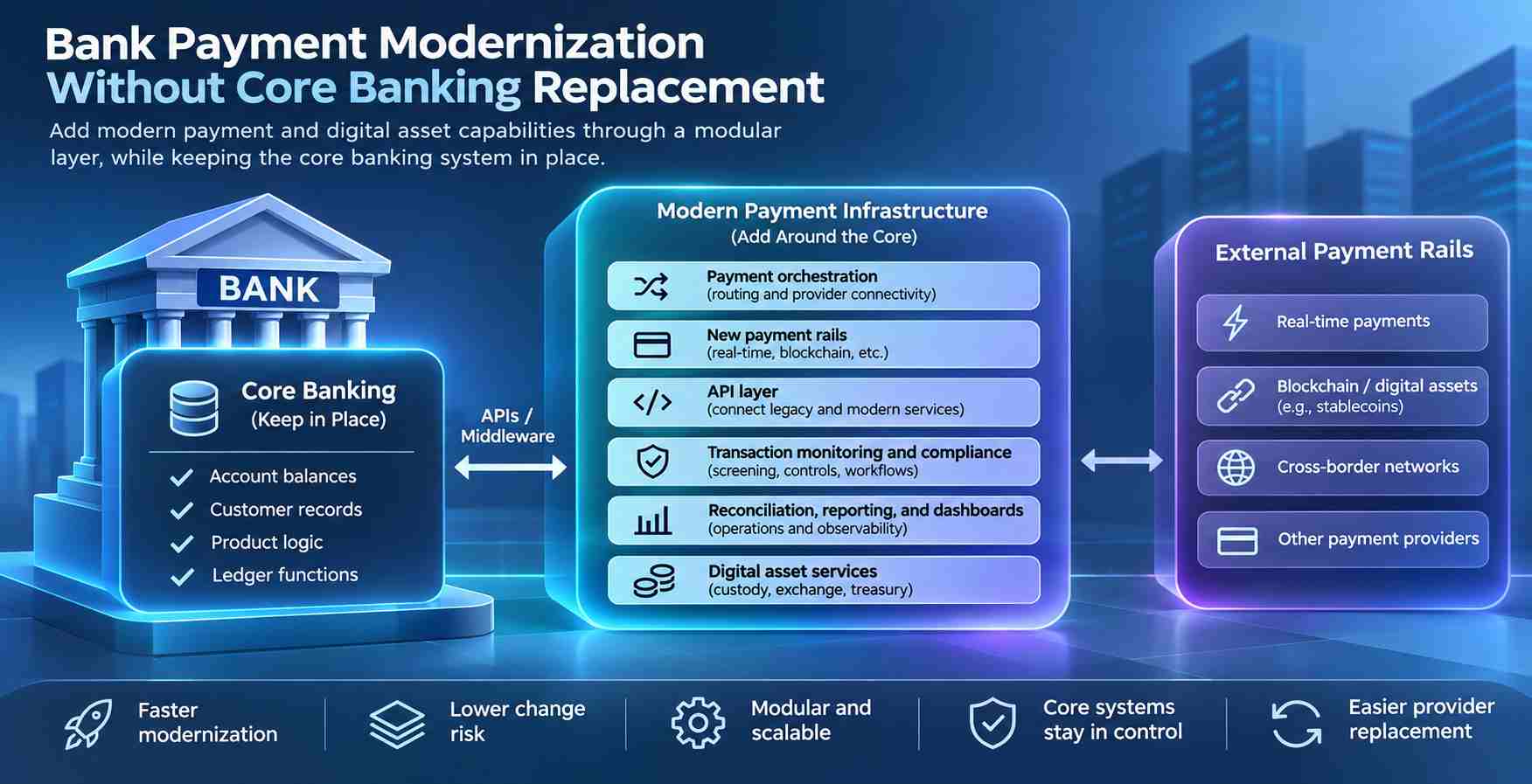
Core banking platforms usually handle account balances, customer records, product logic, and ledger functions embedded in daily operations. Replacing them can affect multiple departments, create long migration programs, and introduce dependencies that are difficult to test in isolation. In many cases, the pressure to modernize comes from the payment side instead. Banks may need faster processing, broader connectivity, more flexible routing, improved reporting, or access to digital asset rails.
Many of those functions can sit outside the core. A bank can keep the existing ledger and customer logic while introducing new infrastructure through APIs, middleware, and orchestration tools. The architecture changes at the edges first, where payment messages, transaction controls, and external networks interact with the bank.
What Can Move Outside the Core
A modular approach works best when the institution separates functions that must remain in the core from capabilities that can be externalized. Common candidates include:
-
Payment orchestration, including routing rules and connectivity to multiple providers.
-
New payment rails, such as real-time networks or blockchain-based settlement.
-
API layers that connect legacy systems with modern services.
-
Transaction monitoring and selected compliance workflows.
-
Reconciliation, reporting, and operational dashboards.
-
Digital asset services, including custody, exchange, and treasury functions where required.
This separation gives technology teams more control over scope. They can introduce one capability within a defined release cycle, test it in production, and expand it after operational teams confirm that the new flow works as intended.
A Practical Architecture for Incremental Change
In a modular setup, the core remains the authoritative source for balances, accounts, and internal booking. External infrastructure handles functions that benefit from faster development cycles or specialized connectivity. APIs and webhooks move instructions and status updates between layers, while reconciliation processes keep records aligned.
Payment orchestration can sit between the bank and external rails. It can decide where a transaction should go, apply routing logic, and return status to internal systems. A compliance layer can screen or monitor activity without changing the core ledger. Blockchain connectivity can be added in the same way, as another specialized component with defined interfaces and controls.
This architecture lets modernization happen through controlled additions. It can reduce the number of systems affected by each change and make provider replacement easier if technical or commercial requirements shift.
Where Blockchain Fits
Blockchain infrastructure can operate as an additional settlement and transaction layer for use cases such as stablecoin payments, digital asset transfers, 24/7 settlement, and selected cross-border flows.
The bank still needs clear ownership of customer relationships, compliance policies, accounting rules, and operational controls. The external layer supplies connectivity and specialized software. This distinction matters for institutions that want digital asset payments without turning the project into a broader core transformation.
A bank evaluating blockchain infrastructure should look at how the provider connects to existing systems, how transaction data is exchanged, which networks and assets are supported, and how monitoring tools fit into the institution's compliance process. Portability also matters because infrastructure decisions can create long-term dependencies when interfaces and data flows lack a practical exit path.
A Step-by-Step Modernization Process
Banks can make the project more manageable by mapping the architecture before selecting vendors. The first task is to trace the current payment flow and identify the actual bottleneck. Slow settlement, limited rail connectivity, weak observability, and fragmented reconciliation require different solutions.
Next, teams should decide which responsibilities must remain in the core. Once that boundary is clear, they can define the capabilities that belong in external services and document APIs, message formats, data ownership rules, and exception flows.
Provider selection should come after this work. Technology leaders can compare platforms against a specific operating model instead of evaluating long feature lists. Useful questions include whether modules can launch independently, how the provider supports resilience and monitoring, what happens when a transaction fails, and whether another provider can replace the service later without redesigning the entire stack.
Launching one rail or capability first usually gives teams more useful information than a broad simultaneous rollout. Production traffic exposes integration issues, operational handoffs, and reporting gaps that may not appear in testing. Once those elements are stable, the bank can extend the same architecture to additional services.
Choosing Infrastructure That Fits the Existing Bank
Modernization programs should define the integration model before the product shortlist. Banks should favor infrastructure that connects through standard interfaces, supports incremental deployment, and leaves core customer and ledger logic under the institution's control.
For teams assessing blockchain infrastructure for banks, the same principle applies. The key question is whether the platform can complement the current banking stack with specialized digital asset functionality while preserving established systems of record and operational governance.
Modernization can start with the parts of the payment architecture that create the clearest constraint. By isolating those capabilities and upgrading them through modular infrastructure, banks can add new rails and services while keeping the core focused on the functions it already owns.