Best Bitcoin Loan Platforms as Banks Start Lending Against BTC


Best Bitcoin Loan Platforms as Banks Start Lending Against BTC
Bitcoin loan platforms let you borrow cash while you keep your Bitcoin. You lock BTC as collateral, which is an asset a lender can claim if you do not repay. In return, you get dollars or stablecoins. The short answer for 2026 is simple. Banks are entering this market mostly through partners, while specialist bitcoin loan platforms still set the terms. Every figure below comes from the lender's own page or a data provider, with a date. Lender data was last checked on 25 November 2026. New to exchanges? Read our guide to crypto KYC first.
Are Banks Really Lending Against Bitcoin in 2026?
Partly. Among bitcoin loan platforms, banks are still new. A Silicon Valley Bank insight piece, published on 25 June 2026, says several large institutions launched bitcoin-backed lending for select clients in the first half of 2026. It names no loan terms for them. A disclosure lists JPMorgan, Wells Fargo, Citi, Charles Schwab, and Morgan Stanley but ties them mainly to bitcoin ETF products. So treat headlines about big banks with care.
One clear bank example is Cross River Bank. LendingUSA's crypto page, retrieved on 25 November 2026, says Cross River issues its loans. Amounts run from $10,000 to $250,000, and BTC is the only collateral. Funding usually takes one to three business days. The page lists no crypto-specific rate. Its general footer cites an APR of up to 29.99% and an origination fee of up to 8%. Cross River also agreed to buy up to $250 million in assets backing Figure's crypto loans, per its release dated 4 June 2026.
Why now? Rule changes help. A Crowell client alert, dated 08.11.26 on its page, says lending against crypto no longer needs advance regulatory permission. It also says New York's UCC Article 12 took effect on 3 June 2026. That law treats most crypto as a "controllable electronic record," which helps lenders prove they hold a claim.
Best Bitcoin Loan Platforms Compared: Rates, LTV, and Terms
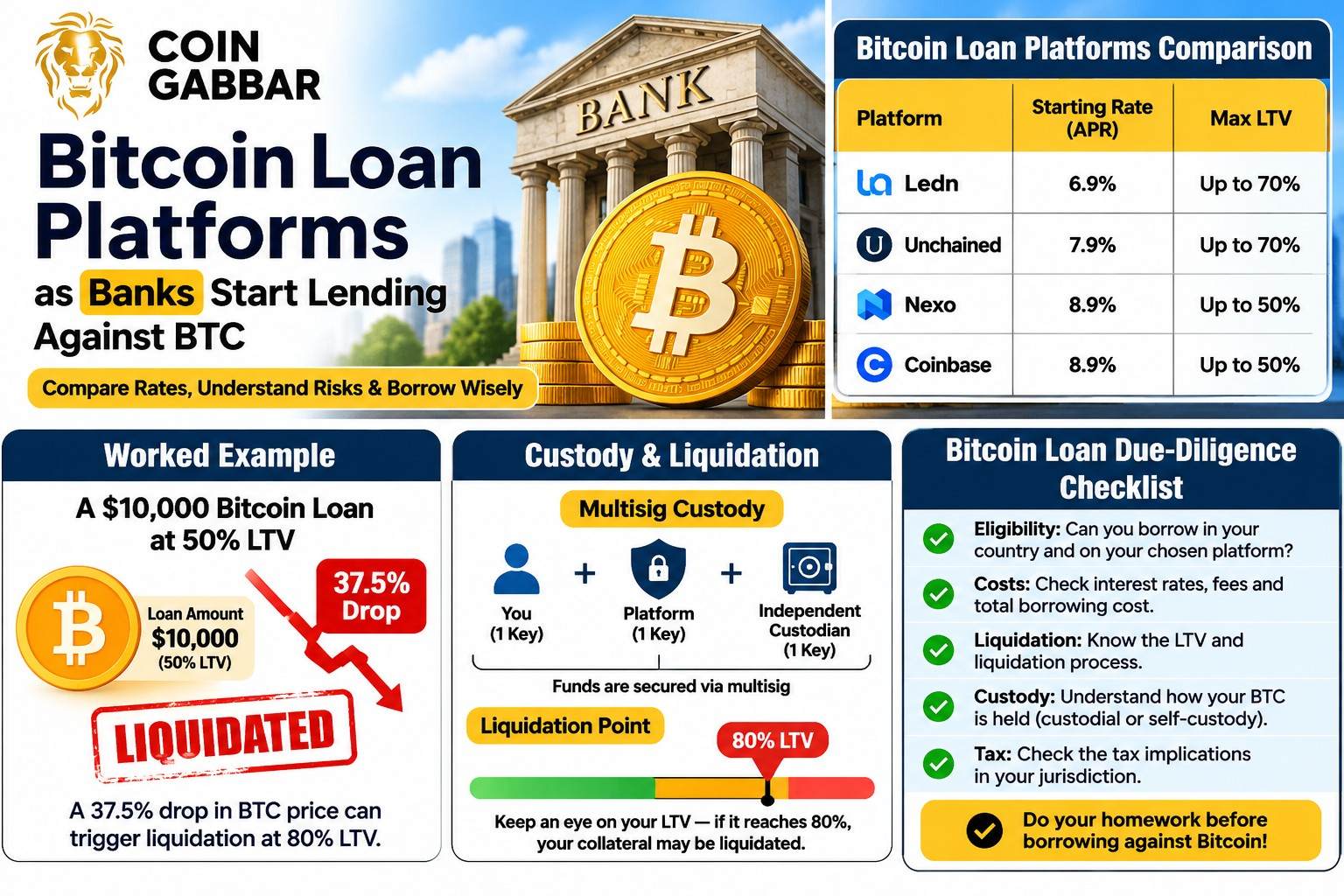
LTV means loan-to-value. It is the loan size divided by your collateral's value. A lower LTV is safer. The table compares bitcoin loan platforms using each lender's own page, retrieved and re-checked on 25 November 2026 unless noted.
Platform | Stated rate | Starting LTV | Loan size | Notes |
10.99% APR under $250,000 | 50% | From $500 | 12 months, no early repayment penalty | |
12% interest in its example (14.18% APR) | 50% (200% collateral) | From $150,000 for businesses | Multisig custody, estimated as of 10 November 2025 | |
From 1.9% | 50% for BTC | $50 to $2 million | Over 100 collateral assets | |
"As low as 5%" | Capped at 86% | Up to $1 million USDC | US only, not New York, page undated | |
LendingUSA with Cross River | Not stated | Not stated | $10,000 to $250,000 | BTC only, bank-issued |
Source note: the lender's pages. "From" rates rarely apply to everyone. Lend's page shows two sets of rates. One lists 11.49% for loans under $250,000. So confirm the live figure before you apply. Nexo says its rates vary by region and loyalty tier.
The SVB piece, dated 25 June 2026, puts bitcoin-backed loan rates at 7.5% to 16% APR. It adds that they remain above comparable traditional products.
How Bitcoin Loan Platforms Handle Custody and Liquidation
Custody means who holds your bitcoin. With custodial platforms, the company or its partner holds it. Ledn says it does not lend collateral out and publishes proof of reserves every six months. Unchained uses multisig. A multisig wallet needs several keys to move coins. Unchained and Fortis Bank each hold a key, and the borrower holds one. Our crypto wallet comparison explains custody types.
Liquidation is the forced sale of your collateral when its value falls too far. Ledn sends alerts at 70% and 75% LTV and liquidates at 80%, with a 0.50% trade spread. Coinbase says collateral is liquidated if debt reaches 86% of its value. Nexo and Unchained state no exact trigger on the pages I opened.
Coinbase's loan runs on Morpho, an on-chain lending protocol, so a smart contract holds the collateral. That adds software risk. Our guide to Ethereum smart contracts shows how they work.
The SVB piece says the 2022 collapses of BlockFi, Celsius, and Genesis wiped out about $11 billion in customer funds. That is why custody terms matter.
A Worked Example: What a Bitcoin Loan Really Costs
This is an illustration, not a quote. Say you borrow $10,000 at a 50% starting LTV. You must lock $20,000 of BTC. At Ledn's 10.99% rate, a year of interest is about $1,099 if you keep the loan for the full 12 months.
Now test the risk. Ledn liquidates at 80% LTV. That happens when your collateral falls to $12,500, because $10,000 divided by 0.8 is $12,500. From $20,000, that is a 37.5% drop. You would also pay the trade spread. You may need to add collateral or repay part of the loan.
The market has shifted too. Galaxy Research, published on 17 August 2026, shows crypto-collateralized lending at $56.16 billion at the end of Q2 2026. That is down 16.78% from about $67.49 billion in Q1. Its CeFi share was 40.93%, with DeFi at 36.37%. Expert view: analysts who follow this market note that falling balances often mean borrowers are repaying or being liquidated, so cheap rates do not remove risk.
How to Choose Among Bitcoin Loan Platforms and Stay Safe
Match the platform to your situation:
Your situation | What to check first |
Small loan, under $10,000 | Minimum loan size, such as Ledn's $500 |
Large loan, over $150,000 | Multisig custody and origination fees, as with Unchained |
US borrower who wants a bank lender | The bank issuer and your state's availability |
Comfortable with DeFi | Smart contract risk and the liquidation point |
Use this checklist before you pick any of the bitcoin loan platforms above:
Eligibility: Loans are not available in every state or country.
Total cost: Add interest, origination fees, and trade spreads.
Liquidation point: Know the exact LTV that triggers a sale.
Custody: Learn who holds your BTC and what happens if the lender fails.
Taxes: Rules differ by country, so ask a qualified adviser.
Scams: Only use links from the official site, and never share your recovery phrase.
If you plan to receive funds in stablecoins, our stablecoin explainer helps. You can also follow your collateral transfer with a Bitcoin block explorer.
Final Thoughts on Bitcoin Loan Platforms
Banks are stepping in through partners, but specialist Bitcoin loan platforms still lead on terms. Compare rates, LTV, and liquidation rules across Bitcoin loan platforms before you borrow. Start small, keep your LTV low, and never borrow more than you can afford to lose.
Disclaimer: This article is for education and information only. It is not financial, investment, legal, or tax advice. Borrowing against crypto can cause the loss of your collateral. Rates, rules, and availability change, so verify everything on official pages before you act.












Frequently Asked Questions (FAQ)




