Which Coins Can You Buy on Fidelity Crypto? LINK, AAVE, and UNI Added

Which Tokens Did Fidelity Crypto Add?
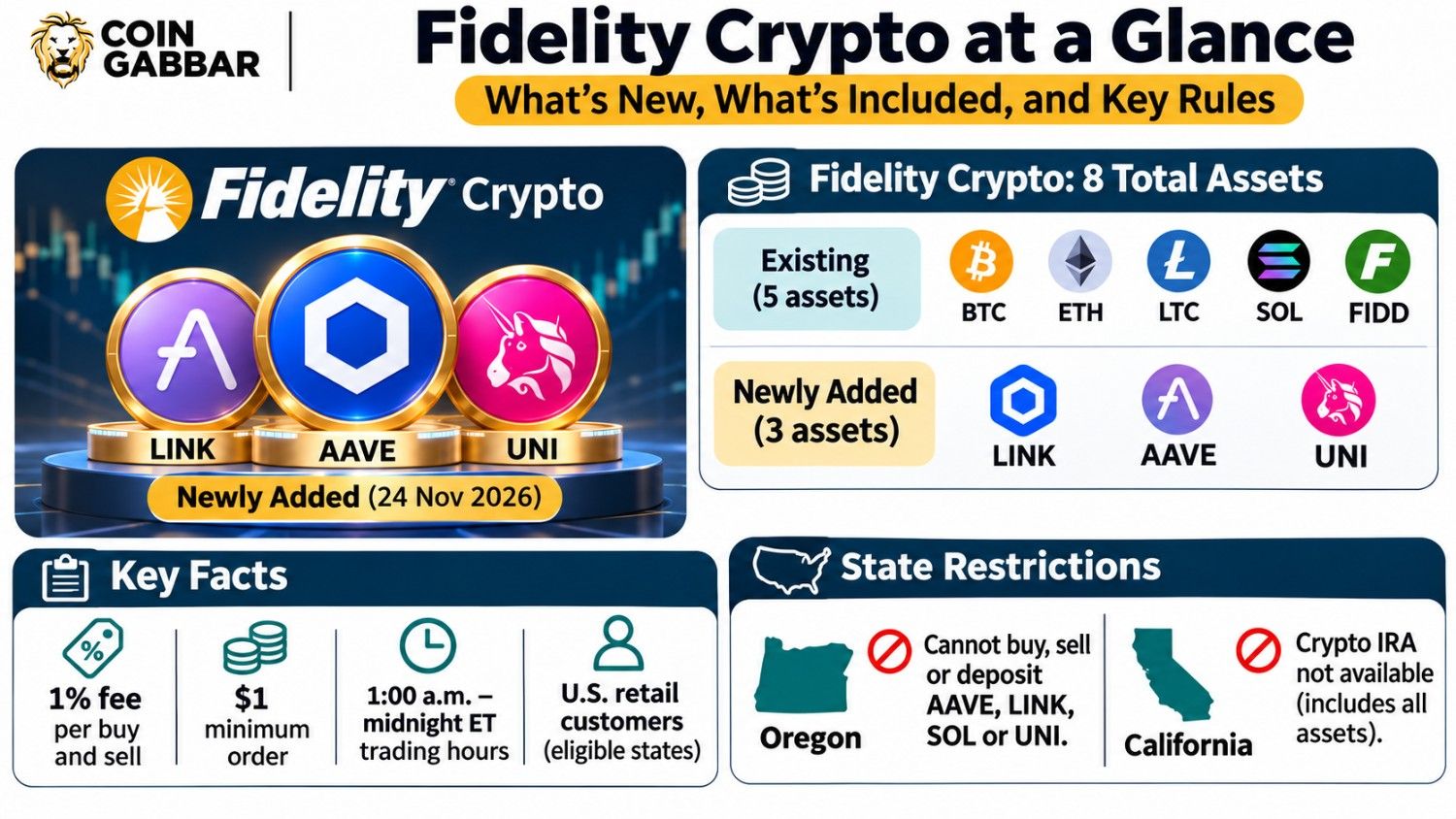
Fidelity Crypto now lists eight assets, including Chainlink (LINK), Aave (AAVE), and Uniswap (UNI). Retail customers in eligible U.S. states can buy and sell the three tokens at a 1% fee per trade (Fidelity trading basics page, accessed 25 November 2026).
The launch came on 24 November 2026 at 16:11 UTC. Fidelity also posted guides on Aave, Chainlink, and Uniswap in its Fidelity Learning Center. FDAs also dated three matching Coin Reports on 24 November 2026. The listing gives DeFi tokens a regulated brokerage channel. It does not prove a future price move.
What Are the Key Takeaways on Fidelity Crypto?
Confirmed asset expansion: Fidelity's trading basics page lists AAVE, LINK, and UNI among eight supported digital assets (accessed 25 November 2026).
Confirmed fee structure: Fidelity charges a 1% fee on each buy and sell order, with a $1 minimum order size (Fidelity trading basics page, accessed 25 November 2026).
Confirmed Oregon limit: Oregon residents cannot buy, sell, or deposit AAVE, LINK, SOL, or UNI (Fidelity availability by state page, accessed 25 November 2026).
Next trigger for Fidelity Crypto: any Fidelity notice that changes fees, states, or assets.
Which Tokens Did Fidelity Crypto Add?
Fidelity already offered Bitcoin (BTC), Ethereum (ETH), Litecoin (LTC), Solana (SOL), and the Fidelity Digital Dollar stablecoin (FIDD). Adding Aave (AAVE), Chainlink (LINK), and Uniswap (UNI) lifts the standard trading list to eight assets (Fidelity trading basics page, accessed 25 November 2026).
TokenRole Named by Fidelity Digital Assets Report / Guide Date: Uniswap (UNI) A decentralized exchange built for automatic token swaps. Fidelity & Uniswap DocAave (AAVE) A decentralized protocol for crypto lending and borrowing.
24 November 2026 Chainlink (LINK): A decentralized oracle network that brings outside data and links chains. Fidelity & Chainlink Docs Smart Contract Overview
Source: Fidelity Digital Assets Coin Reports, Fidelity Learning Center token guides (published 24 November 2026), and official protocol documentation, accessed 25 November 2026.
Chainlink supplies external price data to smart contracts. CoinGabbar explains that dependency guides on oracle risk and bad price data and on how financial institutions use Chainlink.
Who Can Use Fidelity Crypto to Trade These Tokens?
Fidelity states that the service is for eligible persons in the United States only. Eligible customers can trade in a standard account or through Fidelity Crypto for IRAs. That product is a retirement account that holds digital assets directly. Fidelity lists the same seven cryptocurrencies for the IRA, without the FIDD stablecoin (Fidelity IRA page, accessed 25 November 2026).
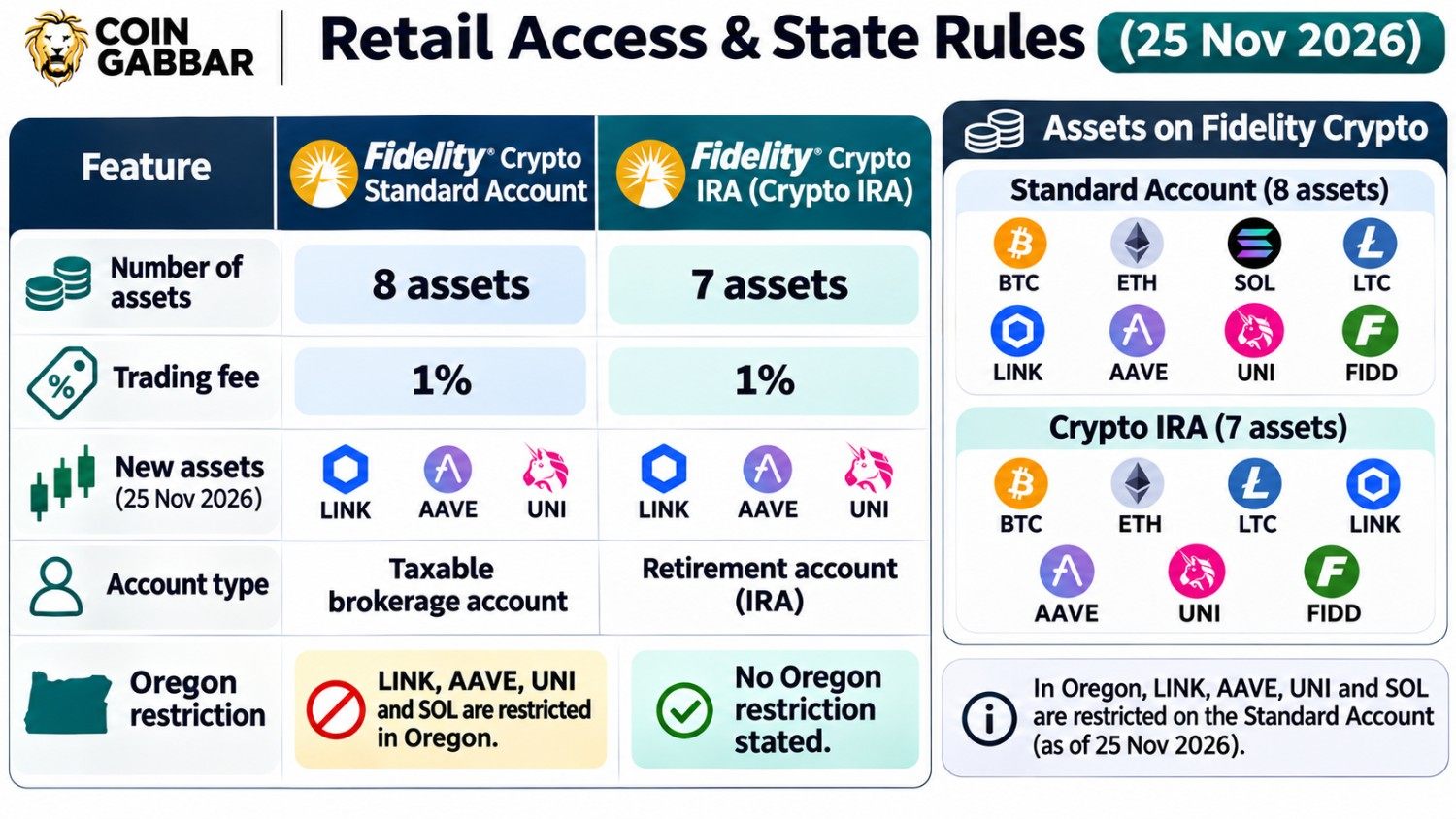
Trading runs from 1:00 a.m. to midnight Eastern Time. Orders start at $1 (Fidelity trading basics page, accessed 25 November 2026).
ClaimStatus on 25 November 2026: Official Source: AAVE, LINK, and UNI are tradable.
The three tokens appear on Fidelity's live asset list.
Fidelity trading basics page: 1% fee on buys and sells confirmed.
Fidelity charges 1% on each executed buy and sell order. The Fidelity Trading Basics page for Crypto IRA lists the three tokens.
The IRA offers seven coins without FIDD. Fidelity Crypto for IRAs Oregon is excluded for the new tokens. Oregon customers cannot buy, sell, or deposit the four tokens. Fidelity availability by state page: Crypto IRA unavailable in California and Oregon. The IRA is restricted in both states. Fidelity availability by state page
Source: Official Fidelity Crypto Help pages named in each row, accessed 25 November 2026.
How Did LINK Trade Around the Listing?
CoinGabbar reviewed market data for Chainlink on 25 November 2026 at 05:07 UTC (10:37 AM IST). On the CoinGecko Chainlink page, LINK traded at $8.79. Its 24-hour trading volume was $287.26 million (accessed 25 November 2026 at 05:07 UTC). Yahoo Finance showed LINK-USD at $8.76 at the same timestamp, down 4.00% over 24 hours.
Earlier snapshots on 25 November 2026 showed LINK near $8.74. The seven-day change was down 4.8%, and the market cap was $6.708 billion at rank 15. Volume ran 22.9% below the prior day, and the price sat 83.4% below its $52.70 all-time high.
Those mixed signals do not isolate the brokerage listing as a price driver. AAVE and UNI prices were not captured at the same timestamp, so no figures are given for those two tokens.
What Does CoinGabbar Expert Analysis Say About the 1% Fee?
CoinGabbar analysis suggests the fee matters more than the headline for short-term buyers. A 1% fee applies on the way in and again on the way out (Fidelity trading basics page, accessed 25 November 2026).
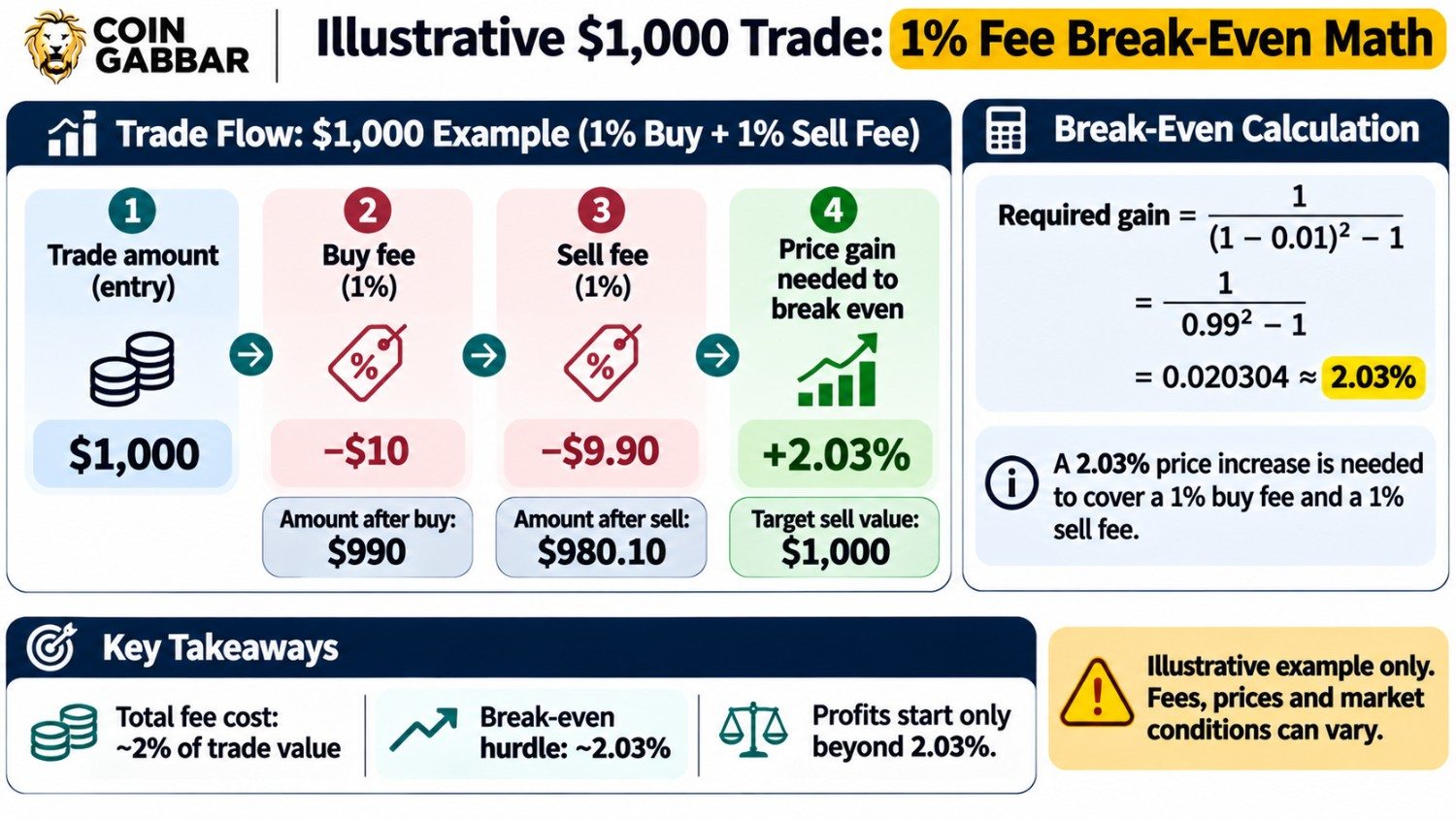
For example: Buy $1,000:
Buy fee: A 1% entry fee subtracts $10.00 (990.00 tokens of 1000-10)
Sale Price: You sell at the same price: 990.00 - 1% exit = fee ($9.90) = $980.10.
Break-even hurdle: need that token price increase about 2.03% (990 * 0.99 = 1,000 / 1.0203 = $1,000.00).
How Was This Figure Calculated?
Model input: the published 1% fee from Fidelity's trading basics page, applied first to the buy value and then to the sale value.
Calculation method: the formula solves for the price gain needed to restore the starting $1,000.00 after both fees.
Scope limits: taxes, bid-ask spreads, and future fee changes are excluded, and the $1,000.00 amount is illustrative.
What Could the Listing Mean for Each Side?
Supporters point to a regulated route for three established DeFi tokens. Customers with a Fidelity login get a familiar screen and no outside wallet to manage. Some states also get a retirement option with tax perks.
Skeptics point to the muted price signal in the 25 November 2026 snapshot and to the 2.03% round-trip fee hurdle. A listing during a market pullback can also meet selling from earlier holders. Neither view is a price forecast.
Fidelity warns that crypto is highly volatile and can become illiquid at any time. It is not insured by the FDIC or protected by the SIPC. Those are U.S. protections for bank deposits and brokerage accounts (Fidelity Crypto overview page, Nov. 25, 2026).
What Should Retail Buyers Check Before Trading on Fidelity Crypto?
State eligibility: confirm that the home state allows the chosen account and the token.
Account structure: compare a standard account, a crypto IRA, and a brokerage account.
Round-trip fees: apply the 1% fee to the buy and to the later sale.
Token fundamentals: read Fidelity's token guides and Coin Reports before sizing a position.
Risk limit: commit only money that can be lost without financial harm.
Source: Official Fidelity Investments documentation, accessed 25 November 2026.
Disclaimer: This article is for informational purposes only and is not financial, legal, or investment advice. Digital assets are volatile, and account eligibility or fee terms may change.












Frequently Asked Questions (FAQ)




