Biggest Crypto Hacks in History: A Billion-Dollar Security Crisis


Biggest Crypto Hacks in History: What Happened During Each Attack?
Some crypto hacks are big. A few are on a different scale altogether. Three of them sit far above the rest in the ranking, and each one is measured in billions of dollars. Binance was hit in 2026, Bybit in 2025, and the LuBian mining pool in 2020.
This guide covers the biggest crypto hacks in history. It looks at what happened in each case, how large the losses were, and what the biggest ones have in common. Where the facts are still unclear, the guide says so.
Key Takeaways
Binance estimates its 2026 impact at around $6.3B, with about $3 billion frozen on-chain so far.
LuBian lost 127,426 BTC in 2020, worth $3.5 billion at the time, and never announced it.
Bybit lost about $1.46 billion in 2025 after its signing interface was spoofed.
Top 3 Biggest Crypto Hacks in History
Together, these are the biggest crypto hacks of all time by reported amount.
Hack | Year | Amount | What the source says happened |
Binance | 2026 | About $6.3B (Binance estimate) | Unauthorized withdrawals, possibly via a compromised DevOps laptop |
LuBian | 2020 | $3.5B at the time | 127,426 BTC drained from a mining pool |
Bybit | 2025 | $1.46B | A phishing attack on a multisig cold wallet interface |
Biggest Crypto Hacks Ranked by Amount Stolen
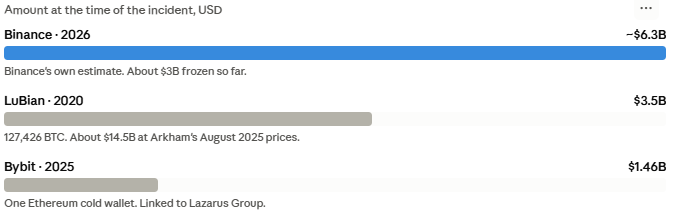
Ranking depends on when the loss is measured. The ranking lists Binance at $6.3B. Arkham counts LuBian at the value on the day of theft, $3.5 billion, though the same coins were worth about $14.5 billion when Arkham reported them in August 2025.
For comparison, the picture below uses the value at the time of each incident.
Binance Hack 2026 Explained
The Binance hack involved unauthorized withdrawal transactions, according to the exchange's security update published on October 30, 2026. Binance estimates the total impact at around $6.3 billion and says approximately $3 billion in affected assets has been frozen on-chain so far.
How the Attack Happened, So Far
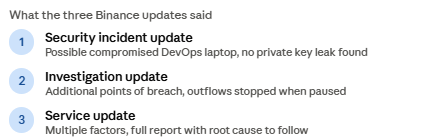
Binance’s first finding was that a compromised DevOps engineer’s laptop may have let an attacker reach a service container and submit the unauthorized withdrawals. It found no evidence of any wallet private key leak.
A later update changed the picture. The investigation uncovered additional points of breach, and Binance called it a complex attack. A third notice said the incident stems from multiple factors. The security team is tracing the full attack path through the compromised computer, which may be the entry point.
Source: official Binance announcement.
What Binance Did
Binance took four steps right away. It suspended deposits and withdrawals while security checks run, revoked the affected address authorisation, worked with blockchain partners to freeze assets, and engaged law enforcement and blockchain intelligence partners to trace and recover funds. Outflows stopped once withdrawals were paused.
Who Covers the Loss
Binance says it will cover all losses from its SAFU fund and the company’s funds, and that user funds are safe. It also plans to publish an updated Proof of Reserves once remediation is complete.
Deposits and Withdrawals
Deposits were never affected and continue as normal. Withdrawals are paused while the team revamps the withdrawal service and its related addresses. Binance’s updates expect them to resume within 45 to 48 hours.
Source: official X Account.
What Binance Has Not Said Yet
A detailed technical post-mortem is still to come, along with the root cause report. The extra points of breach have not been named. BNB is working with law enforcement to confirm who the attackers are, and the loss figure is still an estimate.
LuBian: The Hack Nobody Announced
LuBian was a Chinese mining pool with facilities in China and Iran, and it controlled almost 6% of Bitcoin’s hash rate in May 2020. According to Arkham, over 90% of its BTC was drained on December 28, 2020. About $6 million more in BTC and USDT left a second address a day later.
LuBian moved its remaining funds to recovery wallets on December 31 and kept 11,886 BTC. It also sent 1,516 transactions carrying messages that asked the hacker to return the funds, which Arkham says suggests the theft was real. Arkham believes LuBian’s key generation algorithm was open to brute-force attacks, which may be how the hackers got in.
Source: Arkham X Account.
Largest Crypto Hack Ever: Which One Holds the Title?
Arkham called LuBian the largest ever at $3.5 billion. Binance’s estimate is higher on a same-day basis, but its investigation is still open. The honest answer is that BNb is the largest by reported amount, LuBian is larger at the coin prices Arkham used in August 2025, and neither figure is final.
Bybit Hack Explained
On February 21, 2025, Bybit moved 30,000 ETH from a multisig cold wallet to a warm wallet. About 43 minutes later, attackers had spoofed the signing interface through a phishing attack and changed the wallet’s contract logic. Funds were split across 39 addresses.
The loss was 401,347 ETH, 90,375 stETH, 15,000 cmETH and 8,000 mETH. Bybit links the attack to North Korea’s Lazarus Group, and a researcher claimed a bounty from Arkham Intelligence for the proof. Preliminary reports traced the root cause to malicious JavaScript.
The recovery effort shows what is possible. Tether froze $181,000 USDT, and that stablecoin freeze was part of a wider effort in which partners including Tether and Circle froze $42.89 million in total. On-chain tracing helped Bybit and analytics providers identify the addresses. Bybit processed 99.994% of over 350,000 withdrawal requests within 10 hours and closed its ETH gap within 72 hours. Hacken’s reserve report showed key assets, including BTC, ETH, USDT and USDC, above 100% collateral.
What the Three Hacks Have in Common
Hack | Weak point | Private keys |
LuBian | Key generation method | Likely brute-forced |
Bybit | Spoofed signing interface | Signers were tricked |
Binance | Compromised laptop and service container | No leak found, per Binance |
Each case shows a security breach around the keys rather than in the blockchain itself.
Are Crypto Exchanges Safe After the Binance Hack?
Binance says user funds are safe and that losses will be covered. Bybit made a similar promise in 2025 and backed it with an updated reserve report from Hacken.
Still, Binance’s root-cause report is not out yet. Until it arrives, the claims remain statements, not verified findings.
How to Protect Your Crypto From Exchange Hacks
Keep only the funds needed for trading on exchanges. Store the rest in a secure personal wallet.
Never share your private keys, seed phrase or recovery phrase with anyone.
Avoid suspicious emails, links, attachments and unknown downloads that may contain malware.
Never give wallet access to strangers or connect your wallet to unverified websites and apps.
Check transaction details carefully on your hardware wallet before signing.
Follow official exchange channels for security updates and instructions.
Check Proof of Reserves reports when exchanges publish them, but remember they do not guarantee complete security.
Final Thoughts
The biggest crypto hacks in history share one lesson: the weak point is usually how keys and access are handled. Binance, LuBian and Bybit lost billions in different ways, and only Bybit has published a detailed timeline so far. Readers should treat Binance’s numbers as an evolving estimate.
Disclaimer: This article is for information only and is not financial advice. Crypto participation involves risk.