The 10 Biggest Crypto Hacks in History and Their Impact


The 10 Biggest Crypto Hacks in History and What They Share
The biggest crypto hacks didn’t all start the same way. A few began with a stolen key. Others slipped in through code bugs, fake approvals, or shaky bridges.
The same weak spots kept turning up.
How were losses in these crypto hacks counted?
Every figure here is the value reported at the time.
Sources often give a range for crypto thefts, since coin prices move and totals can be counted in more than one way.
For bridges, the value may include tokens created or affected, not just funds that left the network.
What are the biggest crypto hacks in history?
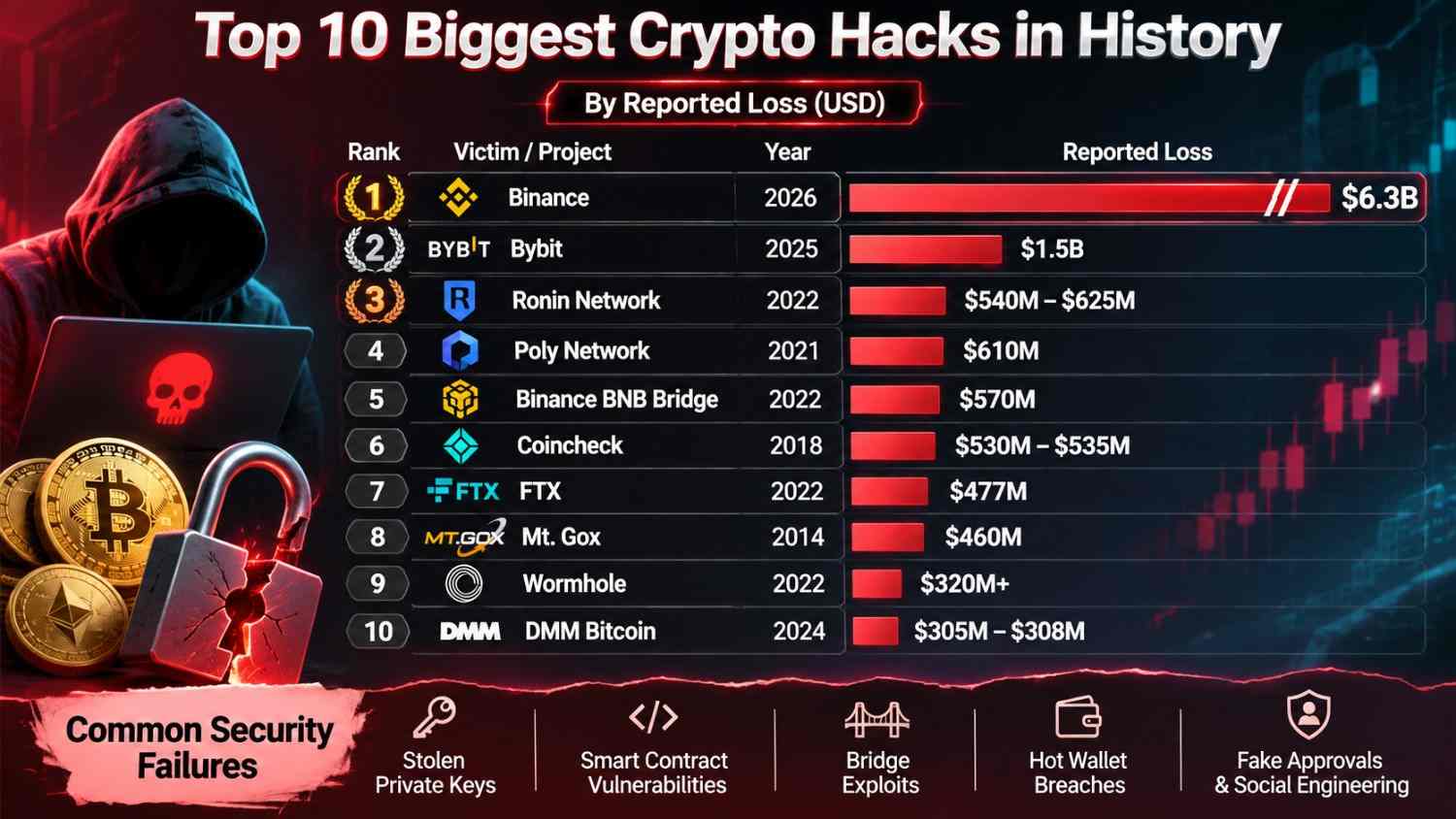
Here are the top 10 largest cryptocurrency hacks by losses.
The largest crypto hacks span exchanges, bridges, and blockchain projects.
Rank | Victim | Year | Reported loss |
1 | Binance | 2026 | $6.3 billion |
2 | Bybit | 2025 | $1.5 billion |
3 | Ronin Network | 2022 | $540M to $625M |
4 | Poly Network | 2021 | $610 million |
5 | Binance BNB Bridge | 2022 | $570 million |
6 | Coincheck | 2018 | $530M to $535M |
7 | FTX | 2022 | $477 million |
8 | Mt. Gox | 2014 | $460 million |
9 | Wormhole | 2022 | $320 million or more |
10 | DMM Bitcoin | 2024 | $305M to $308M |
Some totals are ranges, so the order can shift by source.
What was the largest cryptocurrency hack ever?
Binance lost $6.3 billion on 29 October 2026, when hackers got into its hot wallets. A hot wallet is one linked to the internet.
Early reports pointed to a hacked staff laptop and access to an internal service. Our Binance incident update covers that first account. Later findings described a wider attack.
The exchange said it would cover the loss with its own funds and its Secure Asset Fund for Users. The FBI tied the attack to North Korea’s TraderTraitor group. The case is still under review.
How did the Bybit hack in 2025 steal $1.5 billion?
Hackers took almost 401,000 ETH from Bybit on 21 February 2025.
It happened mid-move, as funds went from a hot wallet to a cold one. Attackers had changed the data shown to the staff who approved it.
They thought it was a normal transfer. Their approval handed the hackers control of the wallet.
How did hackers drain the Ronin Network bridge in 2022?
Ronin Network supports the game Axie Infinity. On 23 March 2022, hackers hit its bridge and took 173,600 ETH and 25.5 million USDC.
They’d gained control of five of the nine validator keys. That let them approve cash-outs without consent.
The team didn’t spot the theft until six days later. The FBI linked it to North Korea’s Lazarus Group.
What went wrong in the Poly Network hack of 2021?
On 10 August 2021, a hacker found a flaw in Poly Network’s smart contract code. The service lets people move coins between blockchains.
The flaw sat in its access checks, so the hacker could change who held control.
The reported loss was $610 million.
What happened in the BNB Bridge exploit of 2022?
In October 2022, hackers found flaws in the BNB Chain bridge. A bug let them make about two million BNB tokens without the funds that should back them.
The tokens were worth about $570 million.
Roughly $100 million to $110 million actually left the network.
Why did Coincheck lose 523 million NEM tokens?
Exchange Coincheck lost 523 million NEM tokens on 26 January 2018.
The coins sat in a hot wallet with no multi-signature checks. Those checks need more than one key to approve a move.
After the Coincheck hack, the exchange paid back the users who lost funds.
What happened to FTX funds during its 2022 collapse?
On 11 November 2022, during its bankruptcy filing, about $477 million left FTX wallets in unauthorized transfers.
US prosecutors later charged three people over a roughly $400 million SIM-swap theft linked to FTX.
The public indictment didn’t name the exchange as the victim.
How did Mt. Gox lose so much Bitcoin back in 2014?
Mt. Gox was once the world’s top Bitcoin exchange. It fell in 2014 after saying about 850,000 BTC were gone.
It later found about 200,000 BTC in old wallets.
That still left about 650,000 BTC missing, worth about $460 million at the time.
How did a flaw in Wormhole lead to a $320 million loss?
Wormhole links one blockchain to another. On 2 February 2022, a hacker found a flaw in its checks for digital signatures.
That let the hacker create 120,000 ETH worth of tokens on Solana without locking the funds that should back them on Ethereum.
Jump Crypto later put in new funds to cover the Wormhole exploit.
How did a fake job offer lead to the DMM Bitcoin hack?
Exchange DMM Bitcoin lost 4,502.9 BTC on 31 May 2024.
It began with a fake job offer sent to a worker at an outside wallet firm. A bad file opened up that firm’s systems.
The hackers then sent a Bitcoin transfer without approval. The FBI linked the attack to the TraderTraitor group.
What are the common causes of major crypto hacks?
How do crypto exchange hacks happen? Hot wallets keep showing up in the biggest crypto hacks. Coincheck and Binance both lost funds from them, so hot wallet security matters a lot.
Stolen private keys let funds move fast. Some systems also give too much power to too few keys. At Bybit, extra signers didn’t help, since staff saw the same fake data.
Bridges are a weak spot too. Ronin, Poly Network, and Wormhole all moved coins between chains, and one bug can put funds on more than one network at risk.
People matter as well. DMM Bitcoin was reached through a firm working for the exchange. Attackers keep targeting exchanges, and the CERT-In exchange warning points the same way.
Expert Opinion: What do these attacks teach us?
CoinGabbar analysis suggests the biggest crypto hacks came from keys, people, and approval steps more than from the blockchains themselves.
Firms that avoid single points of control are better placed to limit losses. Our guide to digital asset exchanges shows what to look for.
Disclaimer: This article is for information only. It isn’t financial or investment advice. Crypto markets are volatile, and security incidents can happen at any time. Nothing here is a guarantee of any outcome.
Last updated: 10 November 2026






