

Litecoin and Bitcoin Cash both rose on 26 November 2026, and both present themselves as cheap, fast digital cash. Traders ask which one works better for payments. The answer depends on features and access, not on a one-day rally. This guide covers Bitcoin Cash vs. Litecoin with dated data, and it links to a Litecoin price outlook for readers who want chart levels.
Bitcoin Cash vs Litecoin: Which Is Better for Payments?
Neither coin wins for each user. Litecoin targets 2.5-minute blocks and offers optional MWEB privacy. Bitcoin Cash (CashTokens, 10 min blocks) Fees, wallet support, merchant acceptance, and local access decide the better fit, so a one-day price move proves little.
Both networks use proof of work, and both aim to move value cheaply. The Bitcoin Cash vs. Litecoin choice, therefore, rests on features and access.
A reader checklist near the end of this guide matches each coin to a goal.
Bitcoin Cash vs Litecoin Prices on 26 November 2026?
CoinMarketCap data retrieved at 5:48 AM UTC on 26 November 2026 (05:48 UTC) showed Litecoin at $43.76 on CoinMarketCap's Litecoin page and Bitcoin Cash at $208.10 on its Bitcoin Cash page.
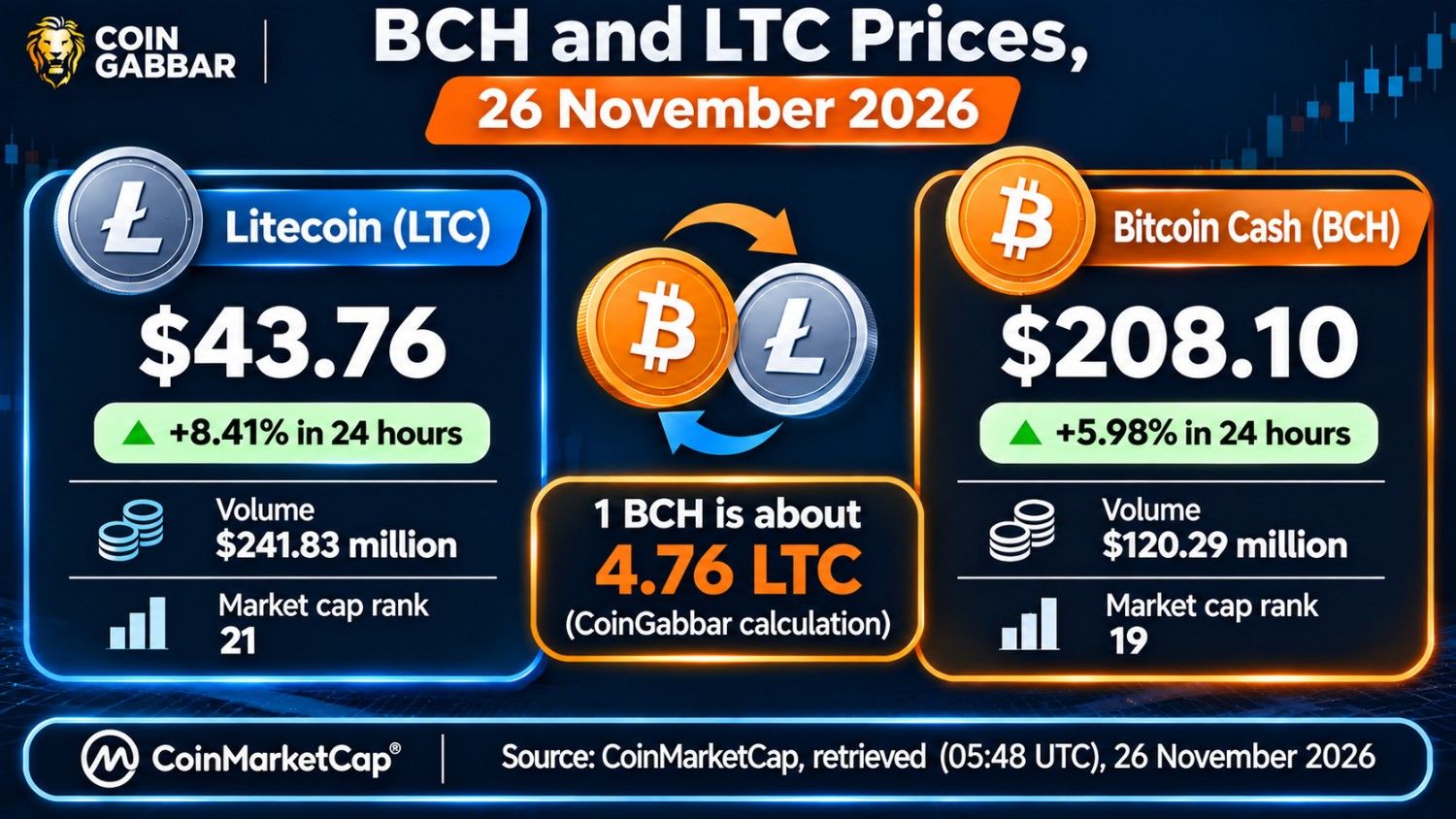
Litecoin gained 8.41% over 24 hours on $241.83 million in trading volume and ranked 21st by market capitalization. Bitcoin Cash gained 5.98% on $120.29 million and ranked 19th. CoinMarketCap measures gains over a rolling 24-hour window, so these figures change during the day.
At that snapshot, one BCH equaled about 4.76 Litecoin($208.10 divided by $43.76). That ratio is a CoinGabbar calculation from the two prices. A rally does not show payment adoption, and readers should refresh both pages before acting.
How Do Bitcoin Cash and Litecoin Differ Technically?
The technical side of Bitcoin Cash vs. Litecoin starts with a shared Bitcoin-style design. The settings then differ.
Feature | Bitcoin Cash (BCH) | Litecoin (LTC) |
Mining | BCH uses the SHA-256 algorithm. | LTC uses the Scrypt algorithm. |
Block target | BCH targets a 10-minute block interval. | LTC targets a 2.5-minute block interval. |
Supply cap | BCH has a cap of 21 million coins. | LTC has a cap of 84 million coins. |
Block reward | BCH pays 3.125 BCH per block. | LTC pays 6.25 LTC per block. |
Source: Bitcoin Cash and Litecoin project documentation, reviewed on 26 November 2026.
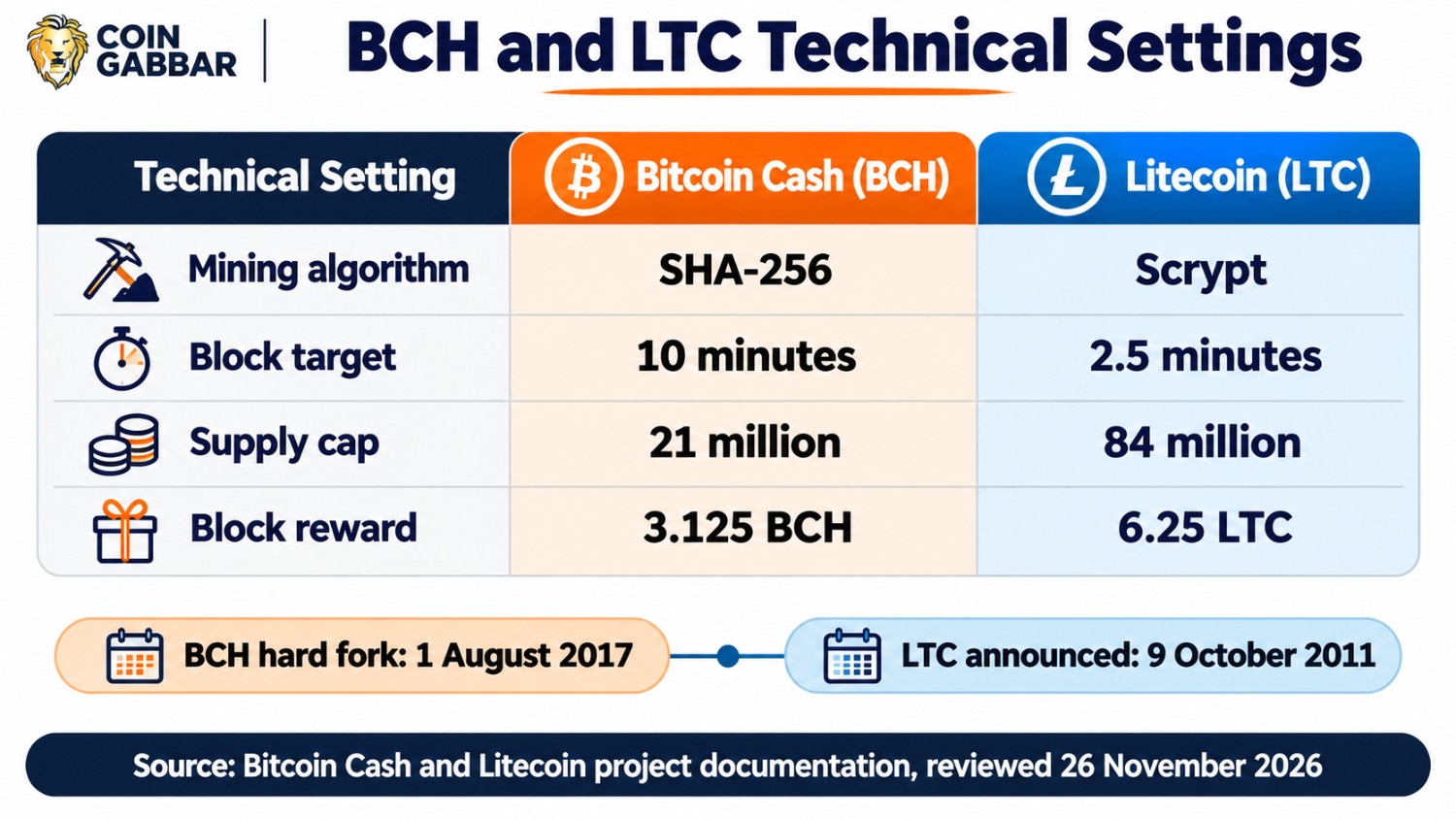
BCH split from Bitcoin by hard fork on 1 August 2017, so it shares Bitcoin's ledger history. Charlie Lee publicly announced Litecoin on 9 October 2011 as a separate chain built on Bitcoin-derived software. The two should not be described as sharing one origin. For background on SHA-256 mining, as mentioned in the Bitcoin mining efficiency guide.
Which Coin Has Faster Blocks and Lower Fees for Payments?
Litecoin targets blocks four times faster than BCH. Faster blocks give more frequent confirmation chances. Actual finality still depends on mining conditions and on the confirmation count a merchant requires.
Neither network has a fixed fee, so any Bitcoin Cash vs. Litecoin fee claim needs a date. Cost depends on demand, transaction size, wallet settings, and coin price.
A fair fee comparison needs one estimator, one transaction type, and one timestamp. Mixing an explorer average with a wallet suggestion gives a misleading result.
How Much New Supply Does Each Network Issue Daily?
At target block times, LTC produces 576 blocks per day (1,440 minutes divided by 2.5), and BCH produces 144. With rewards of 6.25 LTC and 3.125 BCH, daily issuance is about 3,600 LTC and 450 BCH.
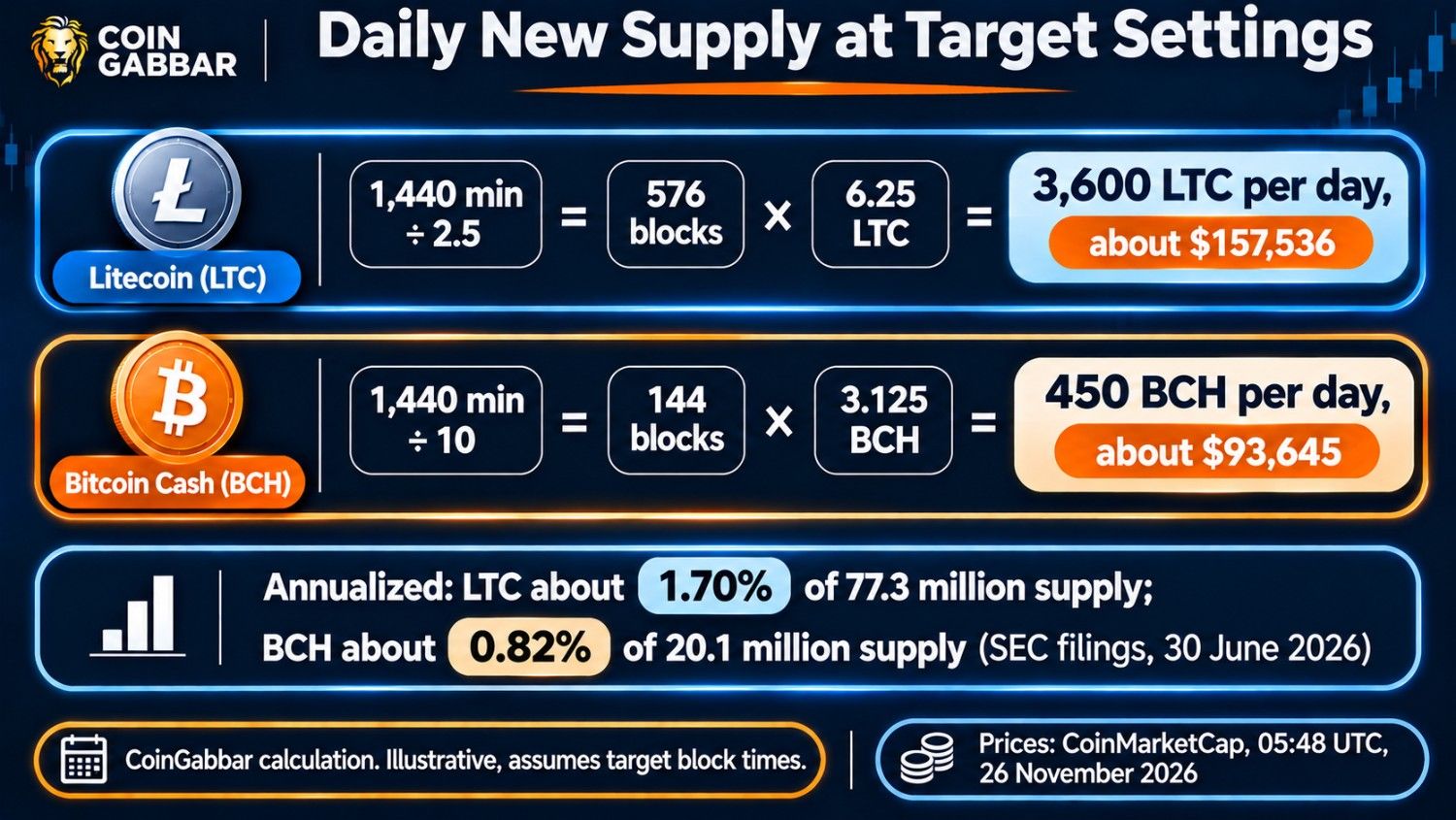
At the 5:48 AM UTC prices on 26 November 2026, that equals about $157,536 for LTC and $93,645 for BCH. SEC filings report about 77.3 million LTC and 20.1 million BCH outstanding as of 30 June 2026. Annualized, issuance is about 1.70% of LTC supply and 0.82% of BCH supply.
How Do Litecoin MWEB and Bitcoin Cash CashTokens Differ?
Litecoin activated MimbleWimble Extension Blocks, or MWEB, in May 2022. MWEB is optional. It hides amounts and balances in supported transactions. It does not make Litecoin transactions fully anonymous.
Bitcoin Cash activated CashTokens in May 2023. CashTokens lets developers create fungible tokens and NFTs on the BCH network.
The two upgrades do not compete. One adds optional confidentiality, and the other adds token and contract features.
Which Coin Has More Payment Support and ETF Access?
BitPay lists both BCH and LTC for invoice payments and payouts, although availability varies by region. Fidelity Crypto's supported-asset page, checked on 26 November 2026, lists LTC for buying and selling, subject to state rules, and does not list BCH. That shows access on one US platform, not global payment volume.
Blockchain transaction counts do not equal customer payments. Counts include wallet transfers, exchange movements, and batching, so the sources reviewed do not support a reliable Bitcoin Cash vs. Litecoin payment-volume ranking.
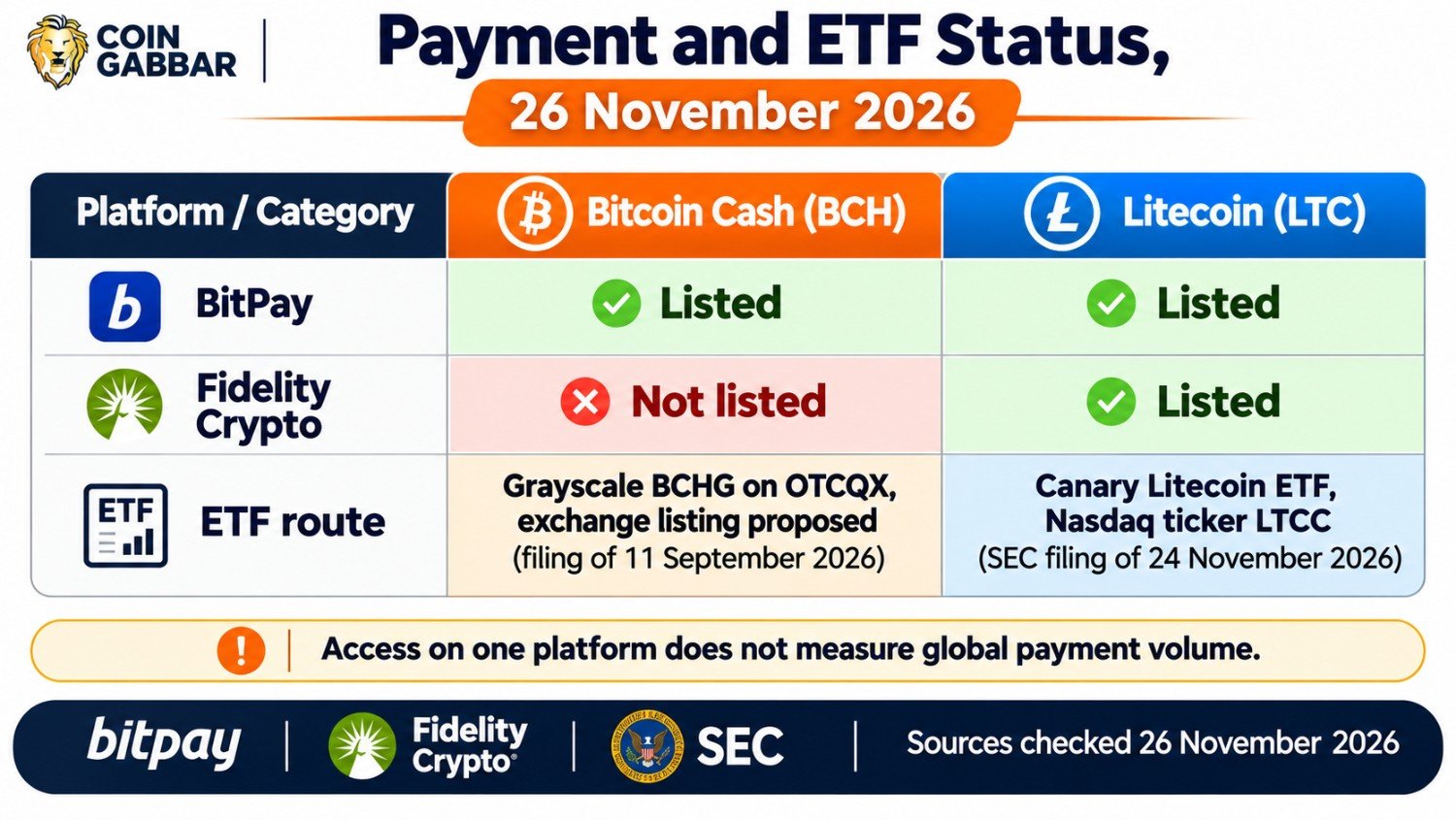
An SEC filing dated 24 November 2026 for the Canary Litecoin ETF refers to a Nasdaq listing under ticker LTCC. Grayscale's Bitcoin Cash Trust trades on OTCQX as BCHG, and its filing of 11 September 2026 describes a proposed exchange listing. That filing does not confirm completion by 26 November 2026. This Bitcoin ETF explainer covers how such funds work.
Who Might Prefer Bitcoin Cash and Who Might Prefer Litecoin?
This Bitcoin Cash vs. Litecoin checklist is a use-case guide, not advice.
Faster block targets point to Litecoin.
Base-layer tokens point to Bitcoin Cash.
Optional confidential transfers point to Litecoin.
US brokerage access through Fidelity Crypto points to Litecoin.
Payment-processor access is similar, since BitPay lists both.
Both coins carry risk. A one-day gain of 8.41% for Litecoin on 26 November 2026 can fade quickly, and Bitcoin Cash trades on thinner volume, at $120.29 million against $241.83 million at the 5:48 AM UTC snapshot.
Fund plans may also shift, since the Bitcoin Cash filing describes a proposal, not a finished listing. Merchants decide for themselves which coin to accept. Before moving funds, a reader should check wallet support, a current fee estimate, and whether the recipient takes that coin.
Expert Opinion: What Should Readers Take Away?
CoinGabbar analysis suggests Bitcoin Cash vs. Litecoin comes down to features and access, not to one day of gains. Litecoin brings 2.5-minute block targets, optional MWEB confidentiality, and a Nasdaq-listed fund, the Canary Litecoin ETF, under the ticker LTCC. Bitcoin Cash brings CashTokens and a proposed fund route through Grayscale's BCHG.
One number stands out. At target settings, new LTC equals about 1.70% of supply per year, against 0.82% for BCH. That is roughly double, which matters for anyone who weighs long-term dilution.
The method is simple. It uses CoinMarketCap prices from 5:48 AM UTC on 26 November 2026, block settings from project documentation, and supply figures from SEC filings as of 30 June 2026. Readers should rerun the Bitcoin Cash vs Litecoin comparison after a new filing or a change in listings.
Disclaimer: This article offers information only. It is not financial or investment advice. Crypto prices swing sharply, and losses can occur. Rules, listings, and network conditions may change after publication, and nothing here promises a result.
Frequently Asked Questions (FAQ)




Owned by:-
DCG Tech FZCO, UAE
Delivery Partner:-
Gabbar MediaTech Pvt Ltd.
Copyright © 2026 Coin Gabbar. All Rights Reserved












