Bitcoin Mining Efficiency Paradox: Why Better Rigs Keep Power Use High

What Is the Bitcoin Mining Efficiency Paradox?
Better machines should mean less power use. That is how most industries work. But Bitcoin mining efficiency may not follow that rule. A 2026 paper in Energy Economics argues that leaner mining can pull in more machines and keep total power use high. The authors call this the productivity trap. The guide to Bitcoin mining demand response shows why it matters: miners act as a flexible load, so their behavior affects its prices and emissions.
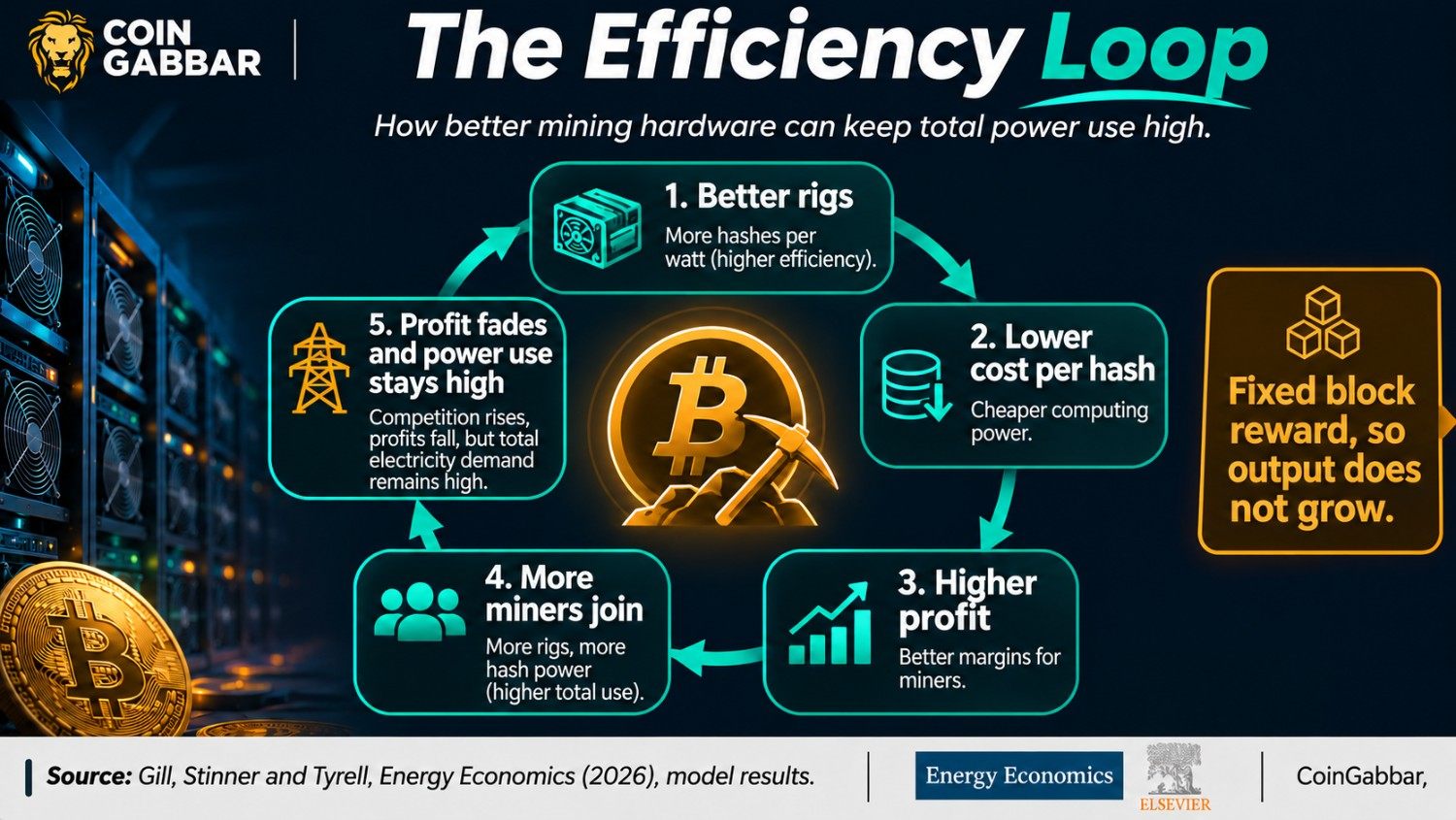
In one 2026 economic model, higher Bitcoin mining efficiency raises profit and attracts more miners. Competition then pushes costs back up.
Network security stays about the same, but hardware use can grow.
What Does Bitcoin Mining Efficiency Actually Measure?
Bitcoin mining efficiency is how much electricity a machine needs for a set amount of hashing. Hashing is the trial-and-error computing miners do to win a block. Efficiency is often shown as joules per terahash. A lower number means less power for the same work.
For example, picture two machines. One needs 20 joules per terahash, and the other needs 10. The second uses half the power for the same work. This example is illustrative, not from the study.
Newer ASICs, the chips built only for mining, improve this number. The study uses the Bitmain Antminer S21 Pro as a reference machine. That is machine-level efficiency. It shows how lean one rig is. It does not show how much power the whole network uses.
Why Do Better Rigs Not Shrink the Network Power Bill?
Mining is a race for a fixed prize. The reward has been 3.125 BTC per block since the April 2024 halving, plus fees. The model treats the market as perfectly competitive. A better machine cuts a miner's cost per hash. Profit rises.
Other miners see that profit and buy rigs. This continues until the extra profit disappears. The prize did not grow. So the network ends up about as secure as before, but with more machines and more electricity in the race.
This is why Bitcoin mining efficiency can look good on one rig and still not lower the total bill.
What Is the Productivity Trap in Bitcoin Mining?
Researchers Maximilian Gill, Jona Stinner, and Marcel Tyrell use this name in their Energy Economics study. Inputs grow, but output does not.
A car factory shows the contrast. A better machine there can make more cars. In mining, more hashing does not create more bitcoin. It only raises the cost of winning the same reward.
Three sources of lower costs are tested: surplus renewable power, better hardware, and extra revenue streams. All three work through the same mechanism. Any gain in Bitcoin mining efficiency is shared out through more competition.
Does Cheap Renewable Power Make Bitcoin Mining Greener?
Partly. In the model, surplus renewable power cuts carbon emissions, as most people expect. But cheap power also lets miners run more ASICs and replace old ones faster. That raises electronic waste, or e-waste.
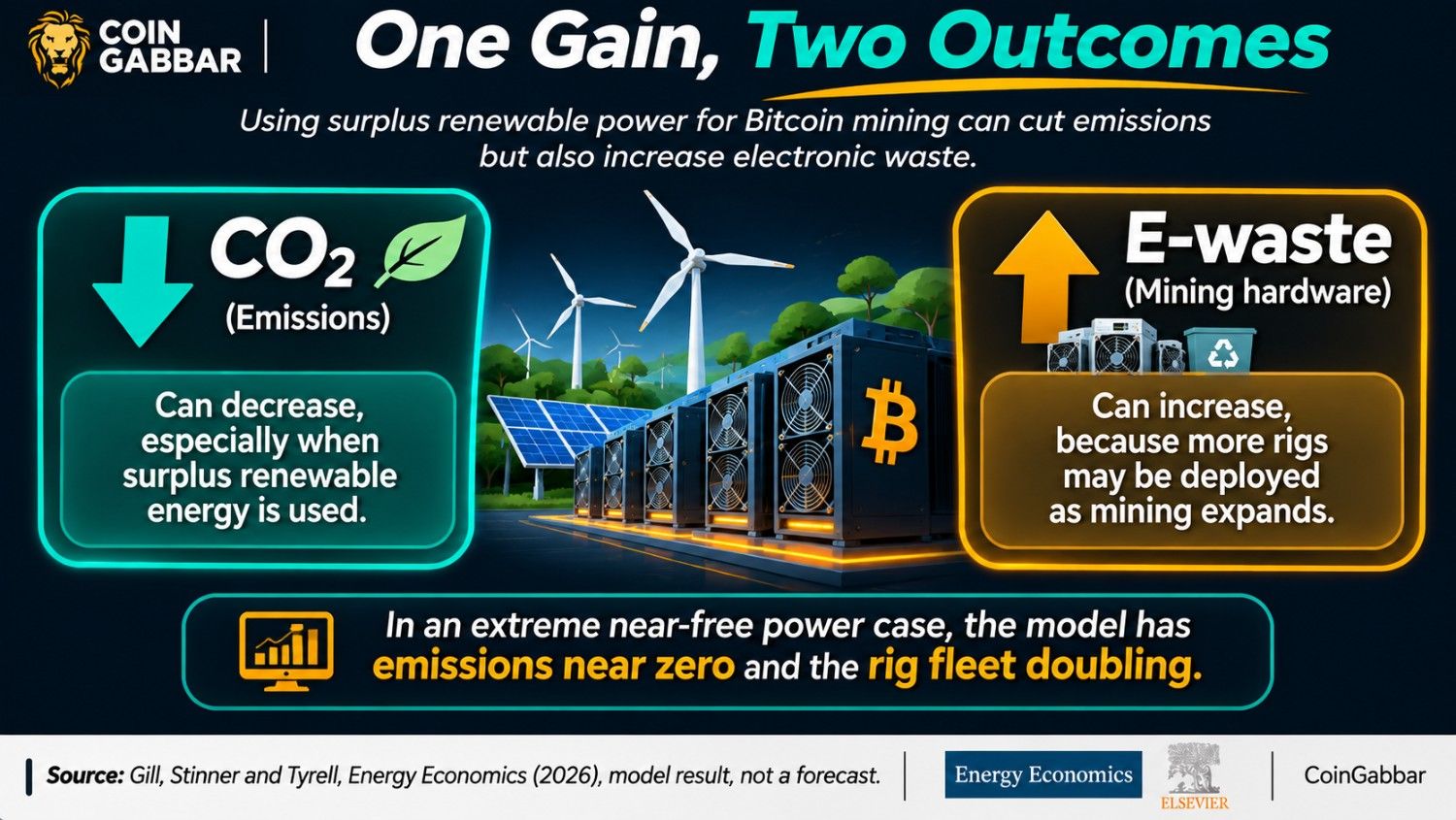
In an extreme case of near-free surplus power, emissions could fall to zero while the rig fleet doubles. Once a grid is already mostly clean, extra carbon gains shrink. Total harm could even rise. So cleaner energy and Bitcoin mining efficiency can pull in different directions.
The real power mix is moving. The 2025 Cambridge mining report says surveyed miners reported 52.4% sustainable energy, up from 37.6% in 2022. Surveyed firms are not the whole network, so treat it as an estimate.
Could a carbon tax fix the efficiency paradox?
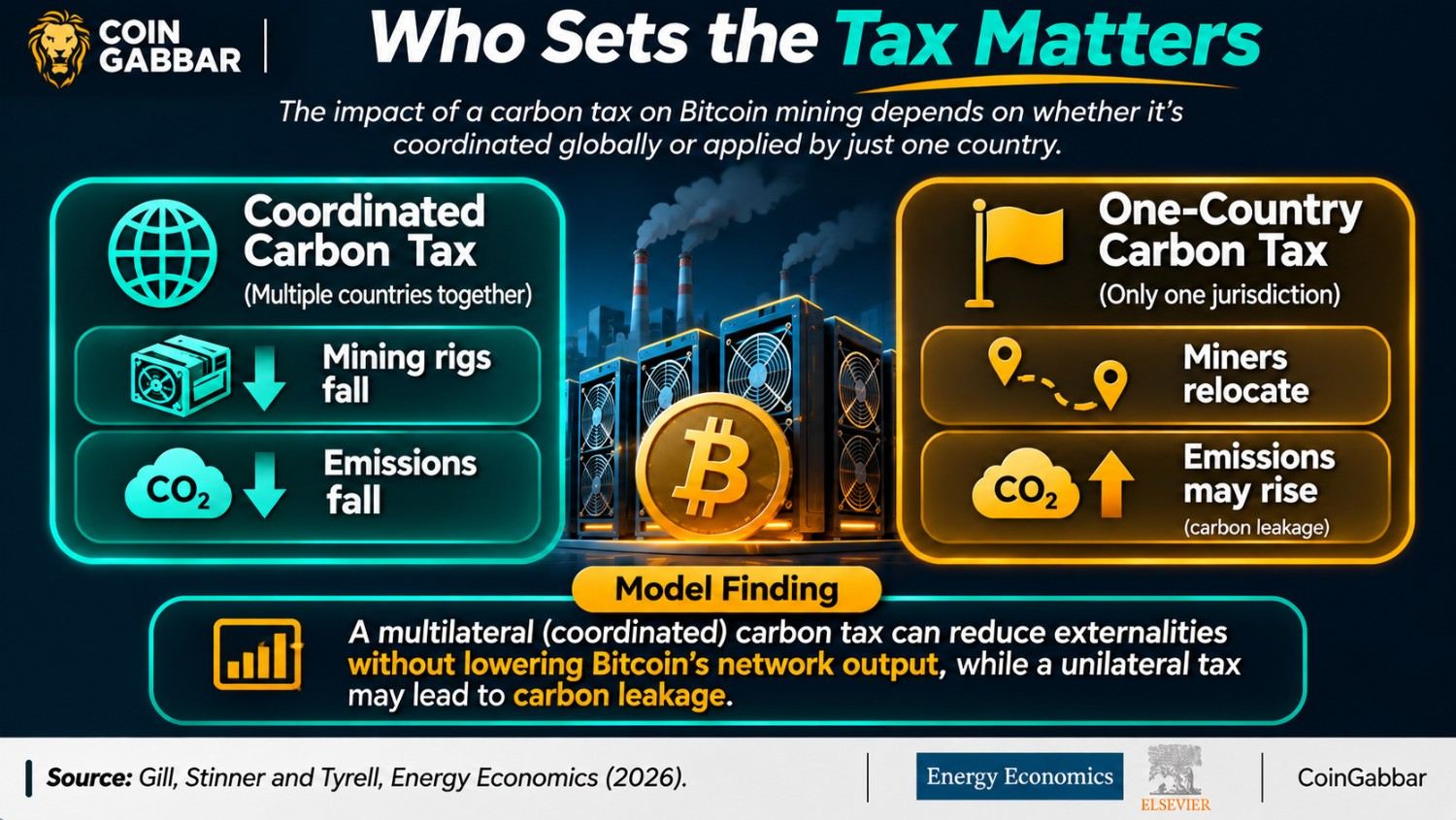
It depends on who sets it. A tax applied by many countries together could cut emissions and e-waste. It works by raising costs and lowering the number of rigs, without weakening security. In effect, it changes how far Bitcoin mining efficiency pays off. How well it works depends on the energy mix.
A tax in one place can backfire. Miners move easily. They may relocate to cheaper, dirtier grids. This is carbon leakage, and global emissions could rise.
The authors also mention other options, such as changing how rewards are shared or moving away from proof of work. These are ideas from the paper, not changes planned for Bitcoin.
Where Does This Model Stop Matching Real Life?
Three limits matter. First, it is a formal model with a perfectly competitive market. Real mining has large firms, fees, and hardware shortages.
Second, it uses set inputs such as Texas industrial power prices. Other regions differ.
Third, it does not prove that any single ASIC upgrade raised Bitcoin's energy use. Models and network data answer different questions, so any claim about Bitcoin mining efficiency needs real network data too.
The next halving, expected around April 2028, should cut the reward from 3.125 to 1.5625 BTC. That changes the prize miners race for.
Why Should Crypto Readers Care About This Study?
Headlines often praise a new, more efficient ASIC. That is good news for one miner's costs. It is not proof that the network uses less power.
To judge the real effect, look at three things: the total hash rate, the energy mix behind it, and how fast old rigs are replaced. A change in any of these can outweigh one hardware upgrade. The study gives readers a simple rule. Ask what happens to the whole fleet, not one machine.
A simple formula helps here. Total power use equals total hash rate times energy per terahash. Efficiency can improve while the hash rate grows faster, and the total still rises. Many listed mining firms quote fleet efficiency in joules per terahash. Compare those figures with changes in total hash rate before drawing a conclusion.
How Is Mining Different From a Normal Factory?
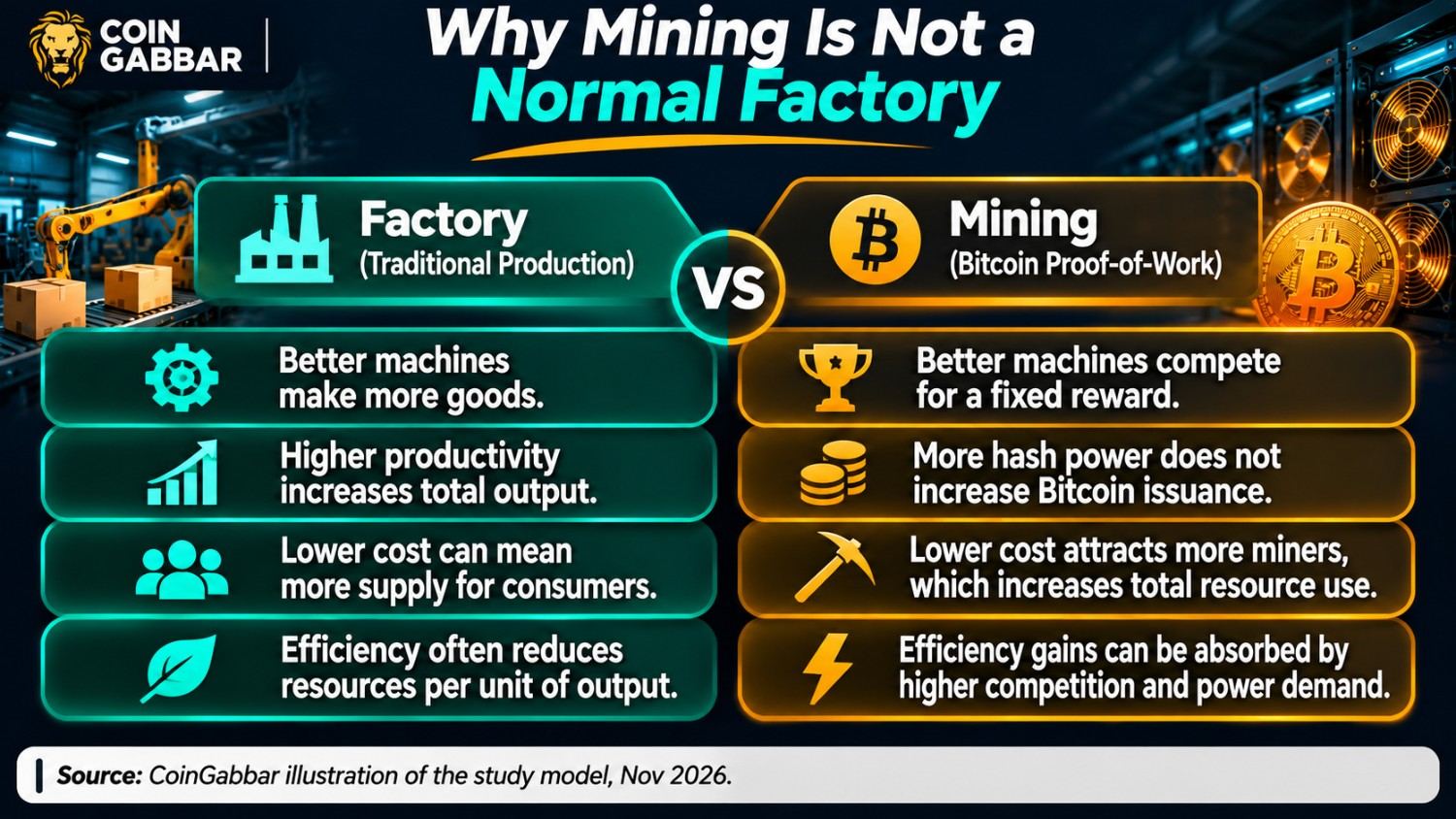
The table below shows why Bitcoin mining efficiency behaves differently from efficiency in a factory.
Feature | Normal factory | Bitcoin mining |
Better machines | Make more goods. | Compete for a fixed reward |
Lower costs | Often lead to lower prices | Often attract more miners |
Extra output | Can be sold | Extra hashes add no coins. |
Efficiency gain | Can cut resources per item | Can be absorbed by competition |
Expert View: Is Efficiency Still Worth Pursuing?
CoinGabbar analysis suggests Bitcoin mining efficiency still matters, but it is not enough alone. Lower power per hash helps only if the total fleet and the energy source are also managed.
CoinGabbar uses a four-point check: energy source, fleet size, hardware lifespan and policy reach. This checklist is CoinGabbar's own framework. It is not from the study.
This view rests on the paper's model results, not on new measurements. Read it alongside the latest Bitcoin news for real network data.
Key Terms Used in This Bitcoin Guide
ASIC: a chip built only for mining.
Joules per terahash: power used for a set amount of hashing.
Productivity trap: efficiency gains absorbed by more inputs, not more output.
E-waste: discarded electronics, such as old mining rigs.
Pigouvian tax: a tax that makes a polluter pay for the harm caused.
Carbon leakage: emissions that move to another place after a local rule.
Disclaimer: This guide explains research. It is not financial, legal, tax or investment advice. No outcome or return can be promised or assured. Crypto prices and mining income are volatile, and a risk of loss applies. Check local energy rules before building or joining any mining site.