

As of November 26, 2026, crypto news today is led by a Braiins alert on a bitcoin mining hashrate hijack.
Per the Braiins security report, published on November 25, 2026, attackers rerouted internet traffic and sent miners on unencrypted V1 to an imposter pool. 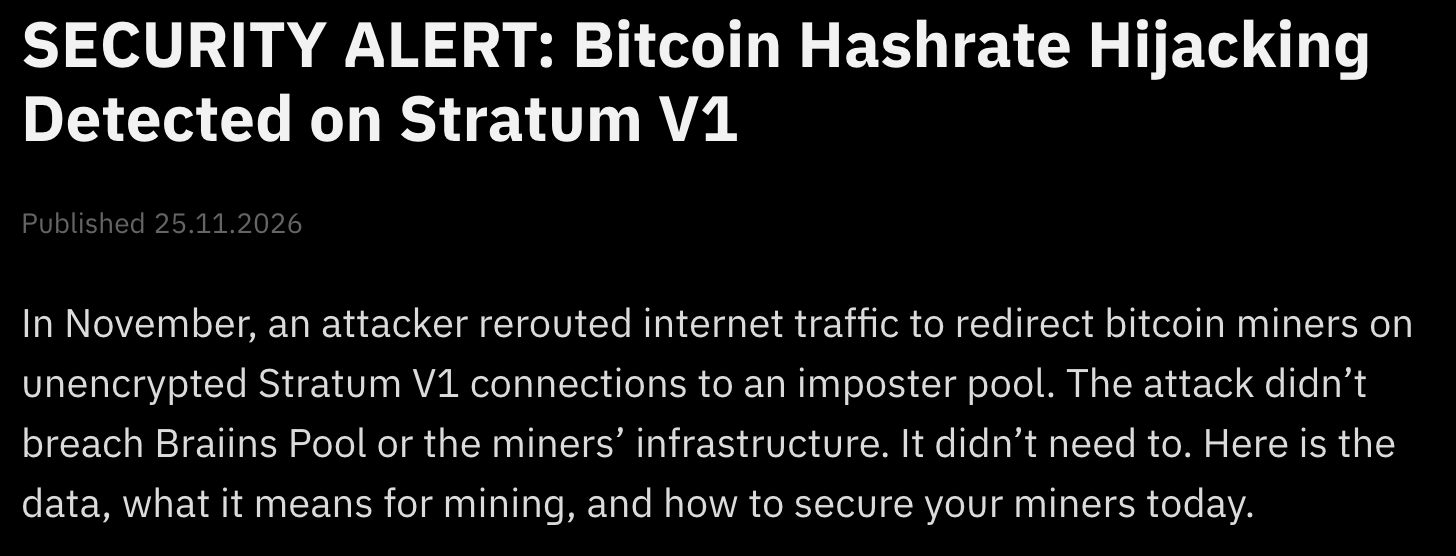
The machines kept hashing while someone else took the credit.
The firm also covered this news in its tweet on X, urging miners and pools to act now.
This Braiins V1 warning matters for anyone following crypto news and bitcoin mining news.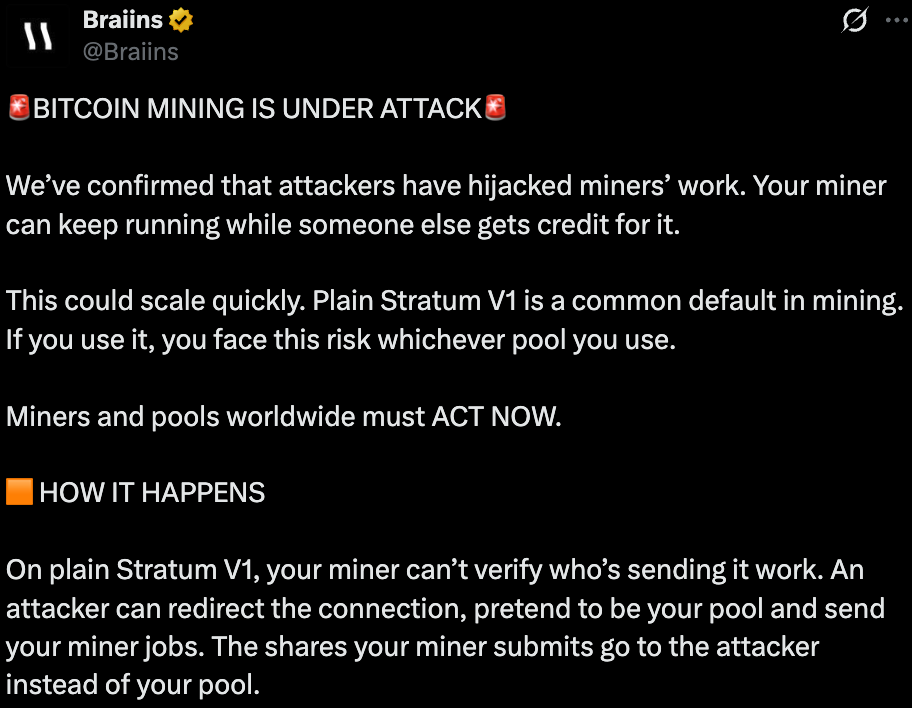
Here is the bitcoin mining hashrate hijack explained simply. Plain-text V1 gives a miner no way to verify who sends the work.
An attacker can pose as the pools, which is mining pool impersonation, and hand out real jobs.
Miner shares redirected this way go to the attacker, a case of miner shares stolen without any rig being breached.
They says its pool, accounts and payouts were not affected. The V1 vulnerability sits in the protocol.
They explains the attacker announced a 256-address block inside a 4,096-address block, so accepting networks sent miner traffic to the attacker.
This connection redirect attack worked where networks skip RPKI checks.
Braiins recalls a 2014 Dell SecureWorks case worth about $83,000.
Dates | Region | Episodes | Sites per episode | Length |
Nov 7 to 12 | Latin America | 19 | 120 to 400 | 1.5 min to 3 hrs |
Nov 20 | Mostly Europe | 4 | 1,050 to 1,600 | 6 to 49 min |
On November 20, more than 1,000 mining sites lost connection in the same second.
This hashrate theft grew from under 175 PH/s to 1.9 EH/s in two weeks. This bitcoin mining pool attack and mining hijack may repeat.
They says no, and any on plain V1 is exposed. Of seven firmware builds tested, two widely used ones accepted invalid certificates, weakening TLS encryption for mining and identity verification.
Watch for ASIC miners hashing at full speed while the dashboard shows nothing, and difficulty in the hundreds of millions. Its Pool never exceeds 16,777,216.
Stratum V2 upgrade: the first choice, since the URL carries the pool's public key.
Stratum V1 TLS: use stratum+ssl:// links, but only on firmware that checks certificates.
Braiins SV2 Proxy: a free tool for mining proxy security when firmware supports neither option. See the proxy setup guide.
Backup pool connection: remove every plain stratum+tcp:// entry.
Hosted miners: ask operators about hosted mining security and mining farm security.
Does V2 stop hashrate hijacking? Per Braiins Academy, V2 and TLS stop hashrate from being stolen, though an attacker can still cut the connection. The steps on how to switch from V1 to V2 sit there.
Which mining pools support Stratum V2? Braiins Pool does. Most large pools offered only plain V1 on November 23, so miners should ask their own.
Analysts tracking bitcoin miners security may see a pressure test for pools and firmware makers.
Since the Braiins warning V1 attack alert, one bitcoin mining hashrate hijack episode did not touch the Bitcoin network, but a V1 attack could recur while hashrate hijacking stays easy on unencrypted Stratum V1.
Bitcoin miners attack news today may bring pool responses, though outcomes remain uncertain.
Disclaimer: This article is for information only and is not financial or investment advice. Verify details with official sources.
Frequently Asked Questions (FAQ)




Owned by:-
DCG Tech FZCO, UAE
Delivery Partner:-
Gabbar MediaTech Pvt Ltd.
Copyright © 2026 Coin Gabbar. All Rights Reserved


