Bitcoin Mining Profits at Risk: Is AI Driving an $8B BTC Exit?


Why Is Bitcoin Mining Becoming a Thinner Margin Business?
CleanSpark Chief Business Officer Harry Sudock expects Bitcoin mining profits to shrink over the next decade. He made the case in an interview published on November 5, calling mining a commodity business where the lowest-cost operators last longest.
A post from CryptosRus has since pushed the comments into wider crypto mining news coverage. It ties them to heavy selling by publicly traded Bitcoin miners, which it puts at more than 108,000 BTC, worth roughly $8 billion, this year.
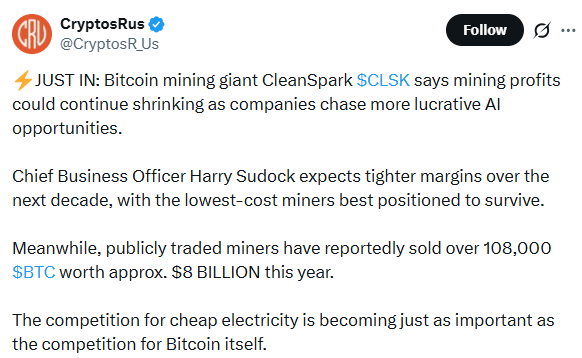
Source: CryptosRus Post on X
Sudock said commodity production tends to get "harder and thinner margin over time." He expects the global hash rate to keep growing, though more slowly than in the past ten years. More efficient machines and a move by large listed miners toward AI data centers are part of that picture.
Is the $8 Billion Bitcoin Sell Off Part of the AI Shift?
On-chain tracking data puts the total at 108,247 BTC, worth about $8.08 billion, sold by 14 listed miners in 2026. That 108,000 BTC sold estimate comes from a data tracker, not from company filings.
The timing fits the Bitcoin mining AI shift. Many miners use Bitcoin miner $BTC sales to fund AI and high-performance computing sites, where long leases promise steadier income than block rewards. The figure has also become part of crypto news today, since miner sales add supply to the market.
Which Publicly Traded Bitcoin Miners Are Selling $BTC?
The tracked group includes MARA, Riot, CleanSpark, Hut 8, American Bitcoin, and Cango. A company-by-company split is not available in the figures reviewed, so only the group total is known.
How Is CleanSpark Balancing AI vs Bitcoin Mining?
CleanSpark CLSK frames mining as the base of its wider plan. Management told investors that Bitcoin mining funds the platform while AI monetizes it. The company also reported more than 50 exahash per second of mining capacity in that update.
Its Sandersville, Georgia, site now carries a 20-year AI lease expected to generate $6.6 billion. Sudock has described the deal as triple net, with a near 100% NOI margin. The mining side looks softer. Revenue fell 30.5% to $138.0 million in results released on August 6.
CleanSpark mined 529 BTC in September and ended the month with 13,530 BTC. It sold 700 BTC through call option exercises at an average $72,928, and it moved from monthly to quarterly mining updates.
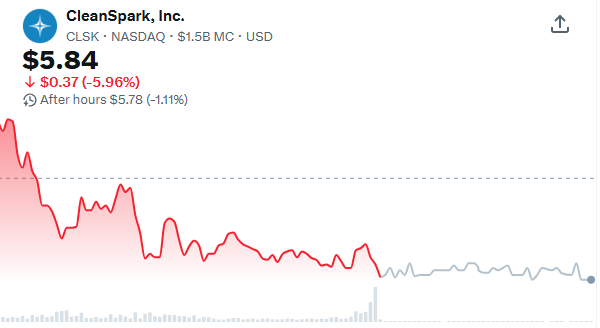
On the latest NASDAQ quote, CLSK traded at $5.84, down 5.96%, with $5.78 after hours. Market capitalization stood near $1.5 billion.
Can Cheap Electricity Decide Who Survives the Margin Squeeze?
Power is the sharpest dividing line. Industry estimates put the average cash cost to produce one $BTC near $79,995 in the fourth quarter of 2025, above spot at the time. Those Bitcoin mining costs leave little room for operators facing high Bitcoin electricity costs.
CleanSpark said its power cost fell to 5.2 cents per kilowatt hour from 6 cents a year earlier. The CryptosRus post frames the shift simply: the race for cheap electricity now matters as much as the race for Bitcoin.
Revenue adds strain. Miners earned only 912 BTC in transaction fees through November, the lowest yearly total since at least 2011, based on reported chain data. That weighs on Bitcoin miner revenue.
Sudock also said smaller and private miners can stay profitable. Mining may rely less on listed firms raising billions for giant sites.
Expert Take: What Could Shape the Bitcoin Mining Future?
The data suggests cost leadership will matter more than size. Hashrate growth, fee income, and power prices are the key numbers. The 2028 halving will cut the block subsidy from 3.125 BTC to 1.5625 BTC, which adds pressure to Bitcoin mining profitability for higher-cost fleets.
A slower hashrate path also touches Bitcoin network security, since hashrate reflects the computing power guarding the chain.
The main uncertainty remains whether the sales are a one-time funding step or a lasting trend. AI income also depends on tenants and construction timelines, and the 108,247 BTC figure is not an audited total.
Conclusion
Sudock's outlook points to a leaner industry where low costs decide who lasts. Listed miners are moving capital toward AI, while smaller operators may find room to grow. Bitcoin news today shows a split between AI-focused miners and cost leaders that keep mining.
Disclaimer: This article is for information only and is not investment advice. Crypto assets and mining stocks carry high risk, and prices can fall sharply. Figures come from public data and may change.






