Blockchain Node Centralization: The Hidden Geography of Crypto


Blockchain Node Centralization - What It Means?
Blockchain node centralization is the gap between how decentralized a network looks and how independent its machines really are. A chain can show thousands of nodes and still lean on a few regions, cloud providers, or single servers. New peer-reviewed measurement work now lets us see where those dependencies sit.
Key Terms
Node: A computer that stores a copy of a blockchain and verifies new blocks.
Validator: A proof-of-stake participant that helps propose and approve blocks.
Autonomous system (AS): A network run by one operator, such as a cloud company or ISP.
Latency: The delay in sending data between two points.
Block builder: A party that assembles the transactions placed in a block.
Staking pool: A service that runs validators on behalf of many token holders.
What Is Blockchain Node Centralization?
Blockchain node centralization means a network's nodes, validators, or hosting depend on a small number of places, providers, or machines, even when the visible node count is large. A network can look spread out by headcount while sharing the same regions, internet providers, or servers underneath.
Most people judge decentralization by counting nodes. That is a start, not the finish. A node is a computer that keeps a copy of the chain and checks new blocks. A validator is a participant in a proof-of-stake network that helps approve those blocks. One machine can run many validators, so the two counts can differ a lot.
Four layers are worth separating, and this is a CoinGabbar editorial framework, not a formal index:
Layer | Question it answers | Example risk |
Machine | How many validators run on one computer? | One fault can affect |
Hosting | How many depend on the same cloud or network? | One provider outage hits many nodes. |
Geography | Which countries and regions hold the nodes? | Regional rules or outages |
Latency | Does speed reward sitting in the same place? | Operators cluster over time. |
For context on what backs digital assets, see the guide to stablecoins and US debt. This article looks at the machines underneath, not the money on top.
Where Do Blockchain Nodes Sit Around the World?
The widest look at blockchain node centralization is a measurement study of 36 public blockchain networks by Lucianna Kiffer, Lioba Heimbach, Dennis Trautwein, Yann Vonlanthen, and Oliver Gasser. It appears in the Proceedings of the ACM on Measurement and Analysis of Computing Systems and was presented at SIGMETRICS 2026.
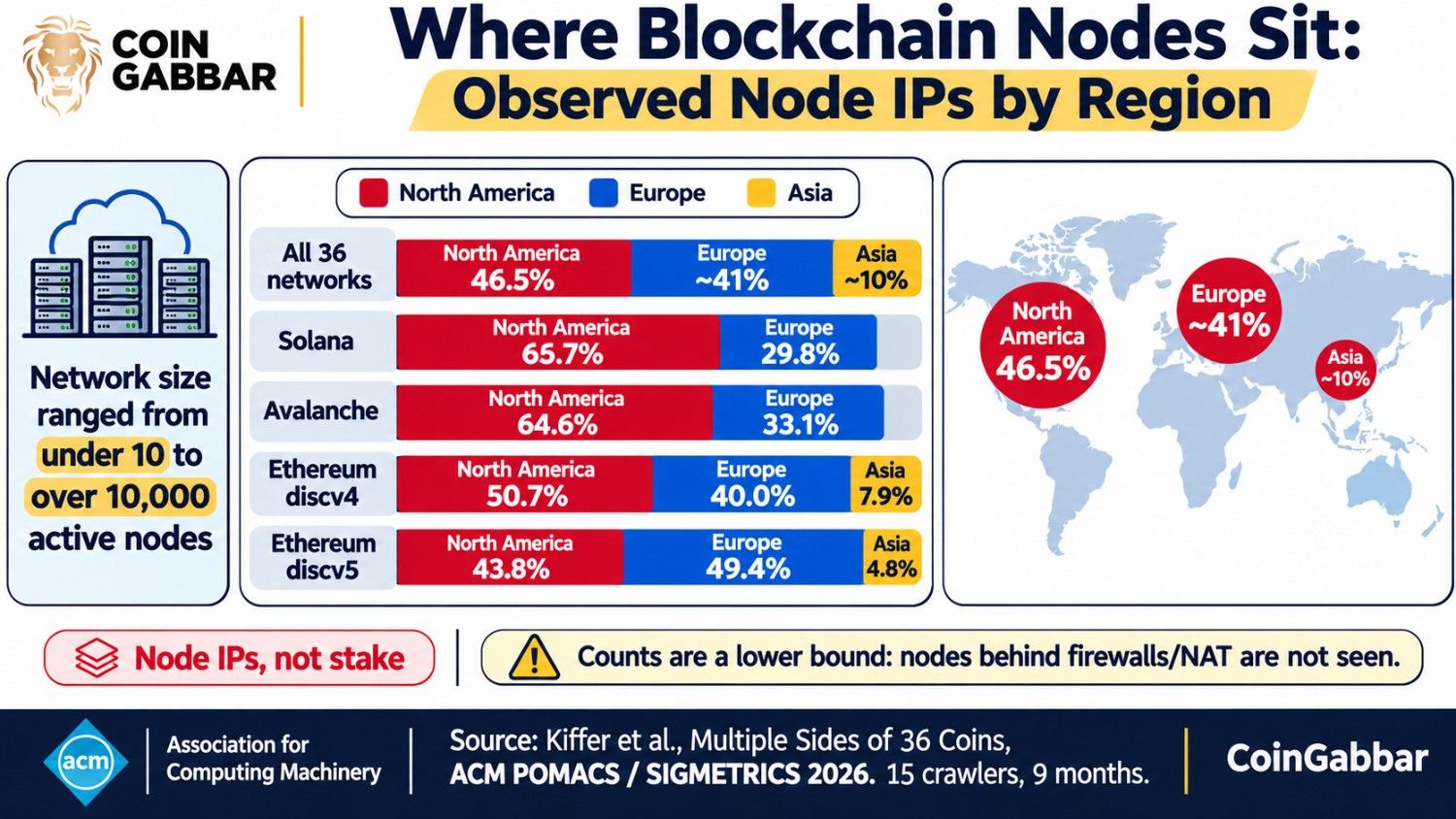
The authors also posted it as an arXiv preprint. The team ran 15 active crawlers over nine months and sent hourly connectivity checks. They also inferred data for 19 auxiliary networks that reuse Ethereum's peer discovery. Active node counts ranged from under 10 to more than 10,000 per network.
Across all networks, North America held about 46.5% of observed node IPs and Europe about 41%. Asia held roughly 10%. The paper's text and its table differ slightly on the Europe and Asia figures, so we round them here.
Network | North America | Europe |
Solana | 65.7% | 29.8% |
Avalanche | 64.6% | 33.1% |
Ethereum (discv4) | 50.7% | 40.0% |
Ethereum (discv5) | 43.8% | 49.4% |
One limit matters. The crawlers only see nodes that accept inbound connections. Nodes behind firewalls or NAT are missed, so the authors treat their counts as a lower bound on true network size.
Which Networks Show the Most Blockchain Node Centralization?
Geography is one view. Hosting is another. Every node sits inside an autonomous system (AS), which is a network run by one operator, such as a cloud company or an internet service provider.
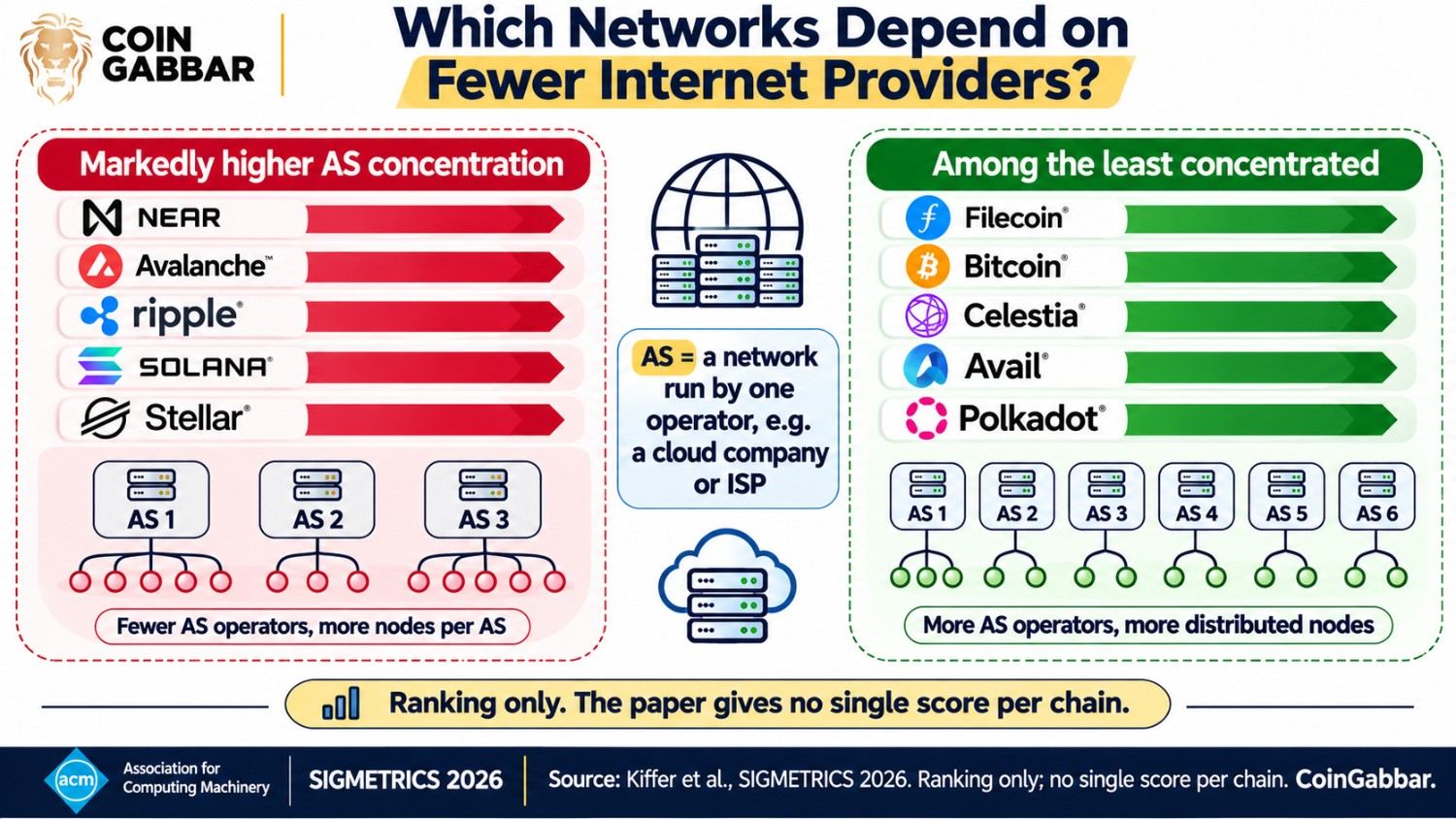
The same study found that Near, Avalanche, Ripple, Solana, and Stellar showed markedly higher AS concentration. Filecoin, Bitcoin, Celestia, Avail, and Polkadot ranked among the least concentrated. The paper gives rankings here, not a single score per chain.
This shows why blockchain node centralization differs by network. "All blockchains run on a few clouds" is too broad. "Hosting concentration varies a lot between networks," is what the data supports.
What Does Ethereum Validator Hosting Reveal?
A second study looked inside Ethereum. In "Deanonymizing Ethereum ", presented at USENIX Security 2025, researchers from ETH Zurich, the University of Bern, and IMDEA Networks linked validators to the IP addresses of the peers hosting them. Their full paper is on arXiv.
They used four measurement nodes over three days in May 2024 and located more than 15% of Ethereum validators in the peer-to-peer network. Their findings:
About half of the identified peers were hosted through cloud providers.
About 90% of the located validators ran through cloud providers. The rest used residential internet.
Amazon data centers held 19.07% of the located validators.
Those two cloud numbers measure different things, and together they show blockchain node centralization hiding behind a healthy node count. Half the machines sit in the cloud, yet nine in ten validators do. Counting machines alone hides that.
A caution on wording. It is not a count of every Ethereum validator today. The authors also say they lack ground-truth data, and their checks are not definitive.
Can Thousands of Validators Depend on a Single Machine?
In that study, yes. The largest peer the researchers found hosted 19,390 validators. For the five largest staking pools, the average was 709 validators on a given peer.
The authors also report cases where validators from two different staking pools ran on the same machine under shared operators. On paper those pools look separate. In practice they share a failure point.
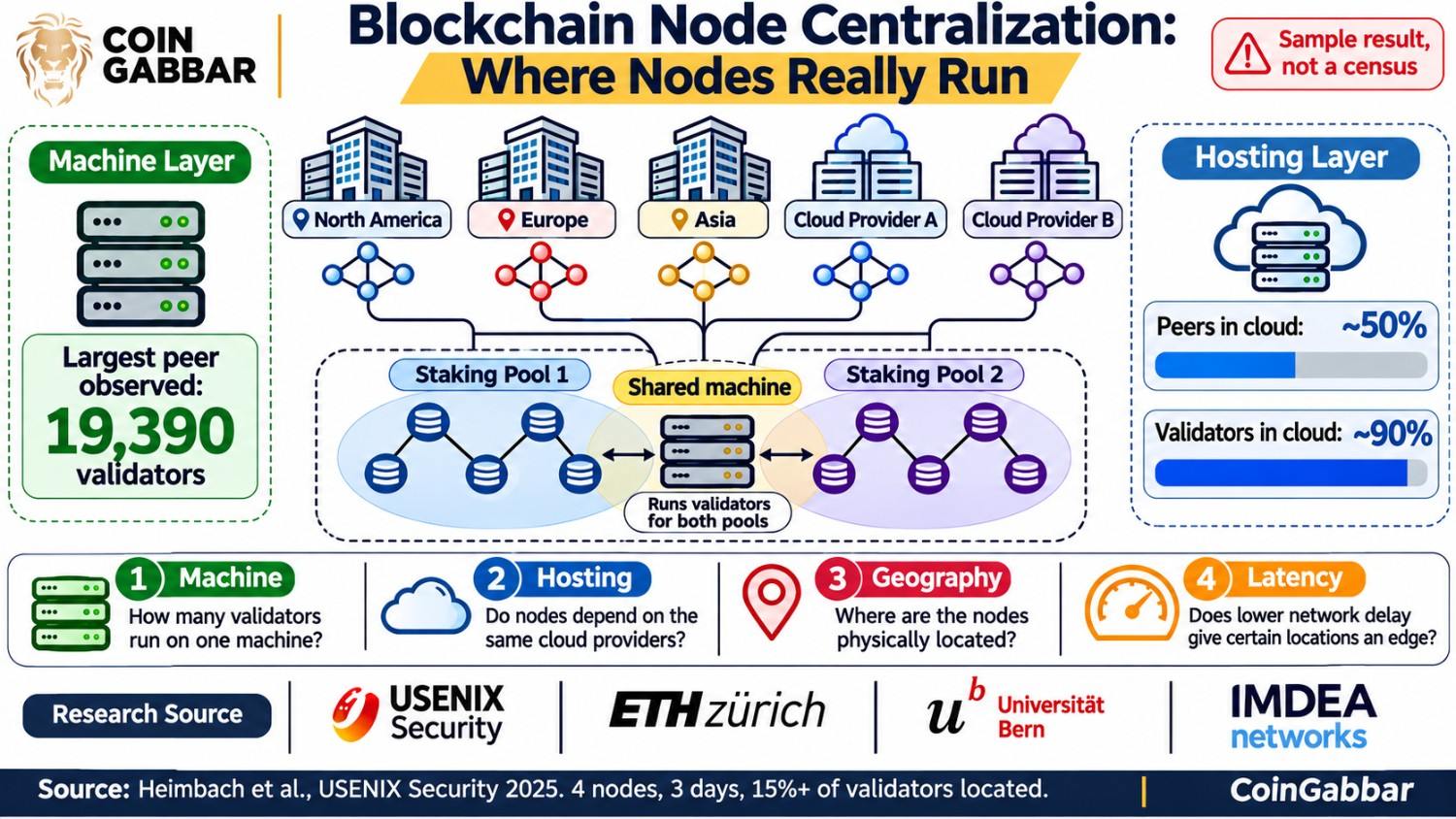
This is a second form of blockchain node centralization. "Number of validators" and "number of independent operators" are different questions. A thousand validators may not mean a thousand independent setups.
Operators can add redundancy, and many do. Dedicated staking firms publish multi-region, multi-provider designs with backup validators and hardware key storage. Whether a given operator does this is exactly what outside observers cannot easily see, which is the point of the research.
Why Does Latency Push Nodes Into the Same Places?
Blockchain node centralization does not need a central planner. Researchers at Yale, King's College London, and Flashbots modeled how Ethereum's block-building rules shape where validators want to run. Their paper, "Geographical Centralization Resilience in Ethereum's Block-Building Paradigms," uses a latency-calibrated, agent-based simulation.
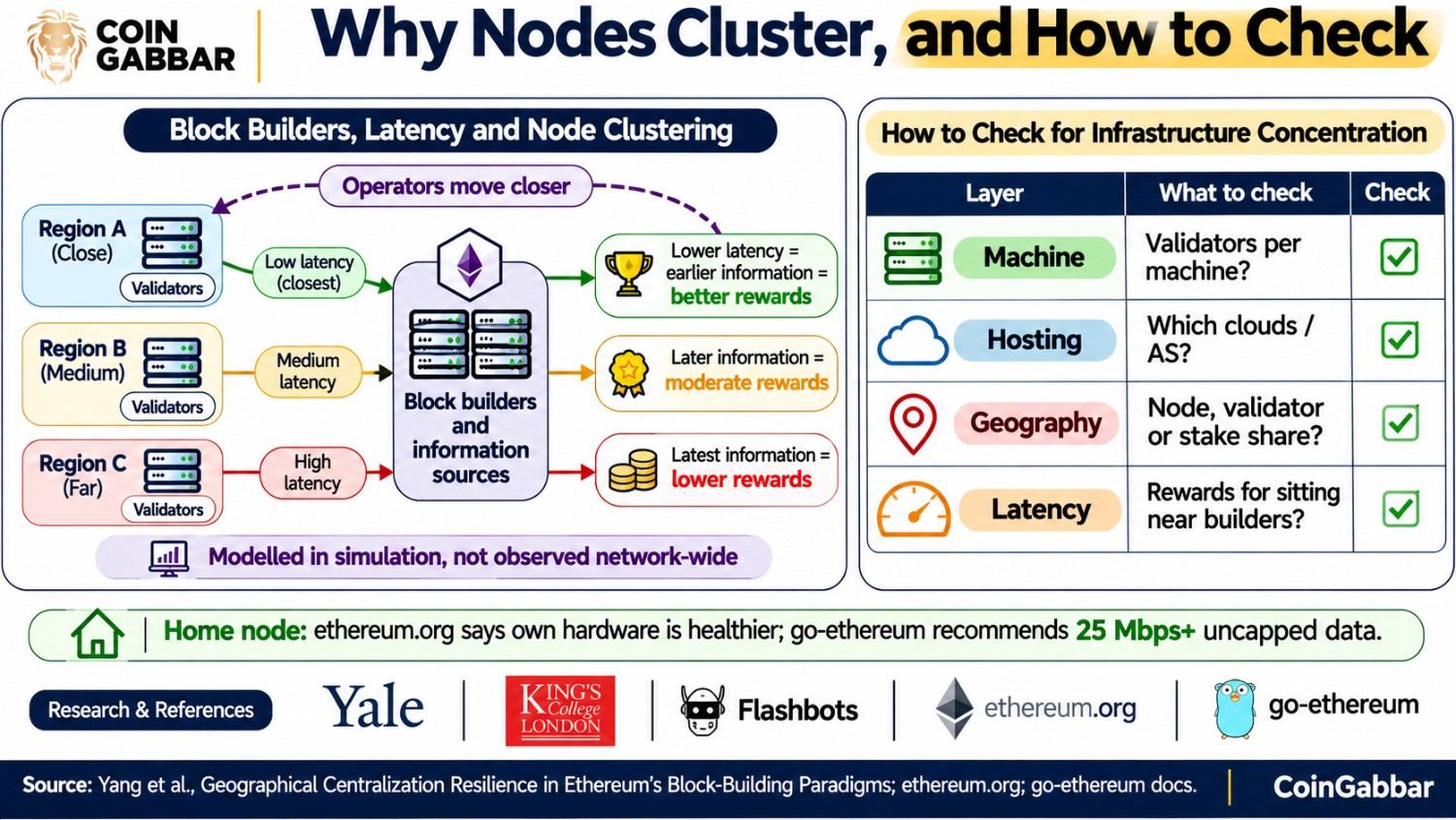
The result: Ethereum's block-building design is not geographically neutral. Both local and external block building create location-dependent payoffs, giving validators a reason to move closer to the parties that matter. Unequal access to information can amplify this.
Put simply, being nearer to block builders can mean earlier information and better rewards. Over time, competition can draw operators to the same few locations. The authors note that where validators run also affects resilience to regional outages and government intervention.
Is Running a Blockchain Node at Home Still Practical?
Partly. Ethereum's own documentation says clients can run on consumer-grade computers, laptops, servers, or single-board computers. The go-ethereum hardware guide recommends at least 25 Mbps download speed and an uncapped data plan, since nodes move a lot of data.
The Ethereum Foundation's run-a-node guide says running a node on one’s own hardware is healthier for the network. It adds that estimates show a large share of nodes running in the cloud, which could become a single point of failure.
Hardware demands come up often in debates on blockchain node centralization. Storage, memory, bandwidth, and sync time all make home operation more demanding than a cloud rental. That is a reasonable factor to examine. It is not proven to be the cause of hosting concentration. Requirements also change by client and setup, so check current documentation before buying hardware.
How Can You Measure Real Blockchain Decentralization?
Node counts still count. They just need company. Use the CoinGabbar four-layer checklist when reading any network's claims about blockchain node centralization:
Machine: Does the network or staking pool show validators per machine?
Hosting: Which cloud providers and autonomous systems carry the nodes?
Geography: Which regions hold the node IPs, and is the data for nodes or for stake?
Latency: Do protocol rules reward sitting near block builders?
Also check whether a figure is a node-IP share, a validator share, or a stake share. The ACM and USENIX numbers above are different measurements, and mixing them produces wrong conclusions.
CoinGabbar Expert Analysis
The three studies approach one idea from different sides. The 36-network paper maps where nodes appear. The USENIX paper shows how validators stack onto fewer machines. The Yale-linked paper explains why locations may cluster. Read together, they support a careful claim: decentralization should be measured on several layers, not only by node count.
CoinGabbar’s view of blockchain node centralization is a reading of published research, not a new measurement. The studies use different methods and dates, from a 2024 Ethereum sample to a nine-month cross-chain crawl, so their numbers should not be added together. One of the papers is also a simulation. Treat the findings as evidence of where to look, not as a verdict on any single network.
For related reading on infrastructure risk, see the coverage of crypto hacks and the US crypto policy landscape, where regional rules can matter for validators.
For how staking works, see Ethereum staking guide
Key Takeaways
Blockchain node centralization cannot be judged by node count alone. Location, hosting, and machine sharing matter too.
A 36-network study found about 46.5% of observed node IPs in North America and roughly 41% in Europe.
In one Ethereum study, about 90% of the researchers located ran through cloud providers. That is a sample result, not a census.
Economic incentives can pull validators toward the same places. No one has to order it.
Holders and builders can check four things: validators per machine, hosting providers, regions, and latency advantages.
Disclaimer: This article explains published research. It is not financial, legal, or technical advice. Node and validator figures come from specific study samples and may not reflect current conditions. No outcome can be promised or assured. Check each network's current documentation before acting.